
On September 6, 2025 the community of Bethlehem, PA celebrated the inscription of nine buildings and the God’s Acre onto the UNESCO World Heritage list as one of four transnational locations of the Moravian Church Settlements site.
The nomination document includes the criterion that “Moravian Church cultural tradition is characterised by the quest for an ordered communal Christian life, as well as by recurrent experiences of migration and a high level of mobility, the settlement congregations acting as places of support for local outreach and missionary work. The continuing presence of Moravian Church communities in each settlement ties the historic structures to the ongoing life of the larger Moravian Church community, which is based on the ideal of a universal fellowship of believers that cuts across all boundaries of nationality, ethnicity, gender, culture, and class.” (Executive Summary)
One of the elements of the World Heritage site is God’s Acre, the burial site started in 1742 by Nicholas von Zinzendorf on the occasion of the sudden death of a visitor to Bethlehem, Johannes Müller from New York. The site contains over 2700 graves of both Moravians and “Strangers”, friends of the community who has asked to be buried there. It follows the pattern established at earlier Moravian congregations where graves are arranged by choir (the homosocial groupings based on gender, marital status and age) and not by family. Each stone is flat, reflecting the Moravian ideal of democracy in death.
Gods Acre allows a visitor to witness something extraordinary. The orderly, flat stones map the global Moravian community that nearly 300 years ago stretched from Greenland to the Caribbean. Here the cultural bridges are visible: Native Americans who spoke multiple languages and navigated between worlds, serving as interpreters and teachers; European Moravians rest alongside African converts, enslaved and free, who carried their own rich traditions into this new spiritual community; Indigenous community members who maintained connections to their Nation’s heritage while embracing the Moravian faith created a fabric of radical integration that was revolutionary for its time. All of these diverse lives lie together in this cemetery, their flat stones embodying the Moravian principle of the “democracy of death.”
Visiting this place, an 18th-century world, where global networks of faith, trade, and cultural exchange converged in a single community, becomes a physically manifest. Each stone marks not only an individual life, but also a node in a vast web of relationships that spanned continents and cultures. This network was recorded in the “Catalog of Baptized Indians” (1742-1764) complied by Peter Boehler, John Heckewelder and finally Joseph Traeger and found in the Moravian Archives, Bethlehem Pa. (Item # 313.4) In a data visualization classes at Bucknell, this archival document became the basis for a database from which network diagrams of the relationships present in that data could be created. An example designed by CS student Khoi Le can be seen here:
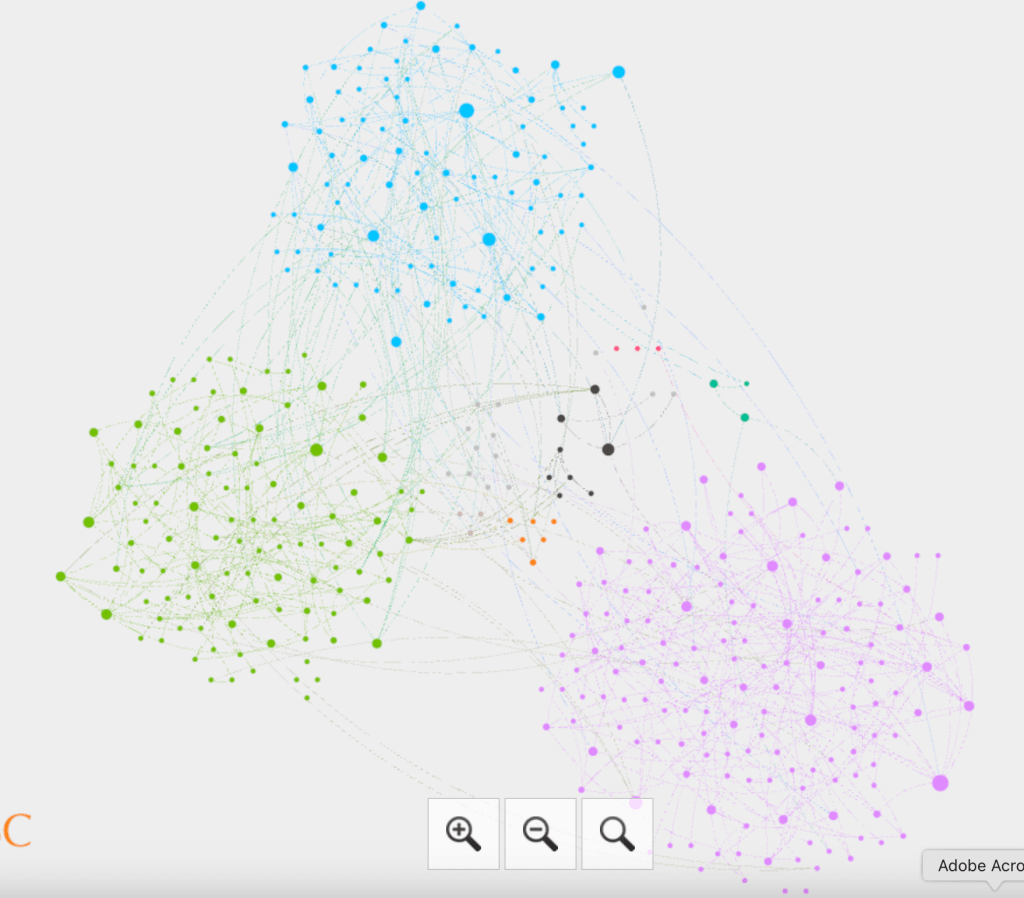
If you click on this image you can access the interactive visualization.
What makes Gods Acre truly remarkable is how it embodies what UNESCO recognized as “outstanding universal value to humanity.” The most powerful of these is the principle of equality and human dignity, manifested in what the Moravians called the “democracy of death.” Every person buried here – whether European settler, Native American convert, or African Moravian – receives the same simple, flat headstone. Social status, wealth, race, and background become irrelevant in this final resting place, creating a radical statement of human equality that remains profound today.
This physical equality reflects the broader Moravian commitment to what UNESCO identified as the “ageless values of education, equality, industry, integrity, and spirituality” that shaped this community from 1741 onward. The cemetery’s organization by choir rather than family demonstrates their democratic principles in action – people were grouped by life stage and spiritual community rather than blood relations or social hierarchy. This created a space where a Native American teacher might rest beside a German craftsman, where converted Indigenous families were fully integrated into the community’s spiritual and social structure.
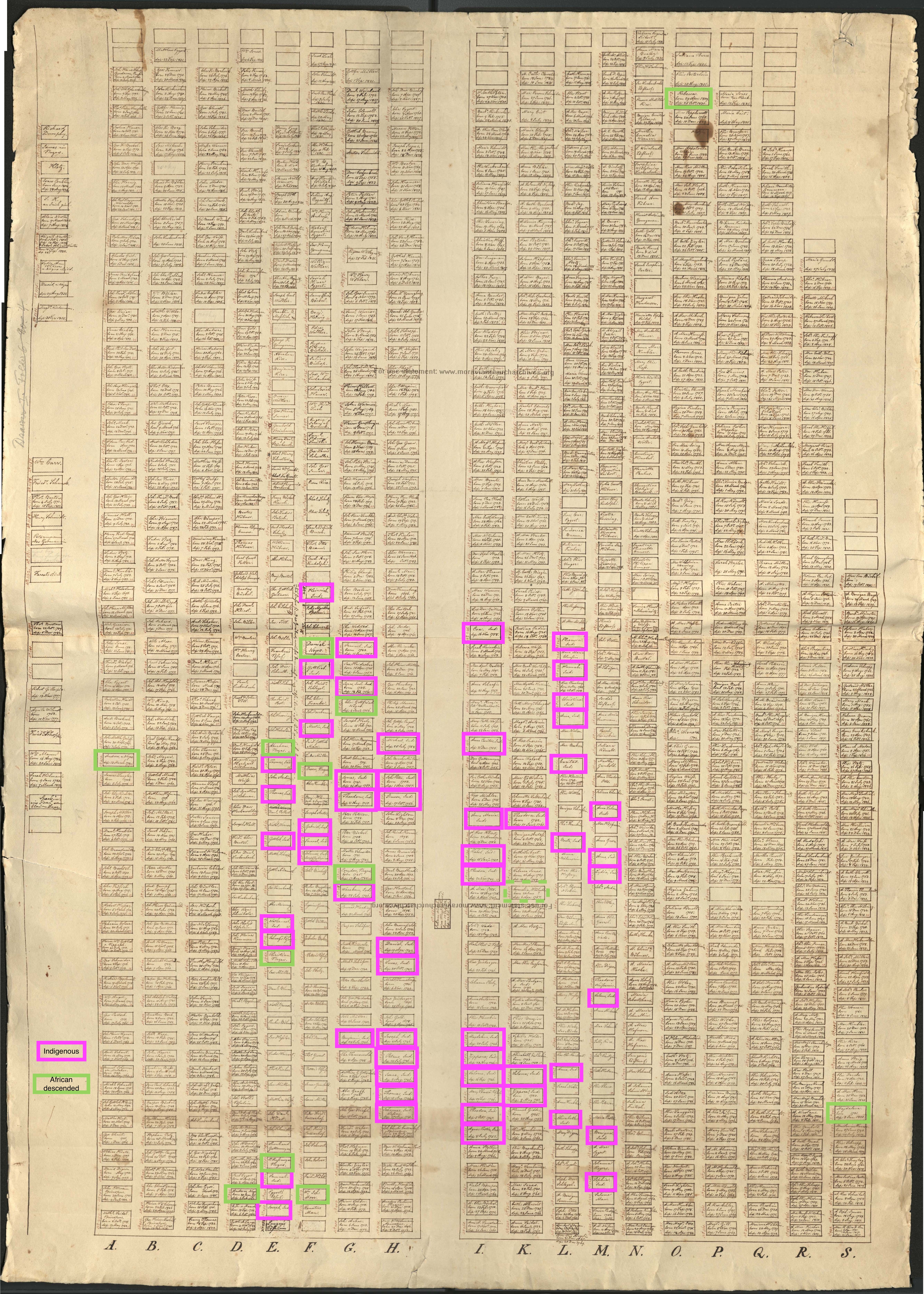
The Moravians’ early vision for community represented a movement toward democratization that offered the same standard of living to all members and prioritized the common welfare over individual advantage. In Gods Acre, these values become tangible and permanent, creating a space where visitors can literally walk among the evidence of a community that successfully built bridges across cultural, racial, and linguistic differences. These universal human aspirations for equality, dignity, and community that recognize shared humanity regardless of earthly distinctions remain as relevant today as they were nearly three centuries ago.
Some of the life stories of those buried here:
Isaac – Wampanoag/Mahican (Grave #203)
Born at Shekomeko, Isaac’s early life was marked by both loss and the care of the Moravian community. His father was baptized by Brother Rauch at Oley in 1742, but following his father’s death, eight-year-old Isaac found a home in Bethlehem’s Single Brethren’s House, where Brother Cammerhof baptized him. In 1750, he traveled to Gnadenhütten to reunite with his mother, Rebecca, and remained with her until her passing. Afterward, other Native American members of the Gnadenhütten community looked after the orphaned boy. At sixteen, Isaac briefly returned to the Native American community in Wyoming Valley before making his way back to Gnadenhütten. The 1755 attack on that settlement forced him to flee once more to Bethlehem’s Single Brethren’s House. Suffering from consumption, Isaac died there at just eighteen years old, his short life a testament to the resilience of those who navigated between worlds during a tumultuous period in colonial Pennsylvania.
Eva – Mohican (Grave #241)
Eva was an elderly Mahican widow from Shekomeko whose faith journey spanned some of the most turbulent years of the Moravian mission. Baptized by Peter Boehler in 1743, she and her husband Nicodemus first moved to Bethlehem before settling in Gnadenhütten, where Nicodemus served as Elder. Following his death in 1747, Eva remained in the Gnadenhütten community for eight years until the attack of 1755 forced her to flee. The elderly woman escaped into the woods and, after three days, arrived safely in Bethlehem. In 1758, she relocated to Nain, where she lived out her final years. Eva died at approximately eighty years of age, and in a testament to the bonds she had forged within the Native American Christian community, she was accompanied to God’s Acre by fellow Native converts and laid to rest by Brother Mack. Her life story reflects the extraordinary perseverance of Native American Moravians who maintained their faith through displacement, loss, and danger.
Michael – Minnisink (Grave #235)
Michael was a great warrior of the Minnisink nation whose appearance told the story of his former life. His face bore intricate tattoos marking his victories in battle: a snake, a totem pole adorned with faces, two crossed spears on one cheek, and the head of a boar on his jawline. Yet this warrior’s life took a dramatic turn when he was “awakened” to the Christian faith at Shekomeko in 1742. Four years later, he came to Bethlehem, and subsequently moved to Gnadenhütten, where he remained until the 1755 attack forced him to flee once more. Michael found refuge in Bethlehem’s Single Brethren’s House, living among the community until his death in 1758 at the age of seventy-two. He died surrounded by his Native American Brethren, who had walked alongside him through his remarkable transformation. To the Moravian community, Michael stood as a powerful example of spiritual conversion—a warrior whose facial markings spoke of one life, while his peaceful final years testified to another. .
Simeon – Lenape (1686-1756) (Grave #209)
Born at Oak Harbor, New Jersey, Simeon was a renowned healer among his people, respected for his skill as a traditional doctor. His path to the Moravian community began when he moved to Meniolagomeka and encountered Moravian missionaries there. He later settled in Gnadenhütten, where his life was changed by the attack of 1755. Nearly blind, the elderly Simeon managed to crawl into the surrounding woods and hide. This experience may have deepened his spiritual conviction, for after reaching the safety of Bethlehem, he chose to be baptized. Simeon lived only one more year, dying in Bethlehem in 1756 at the age of seventy. .
Anna Maria – Lenape (Grave #151)
Anna Maria’s story is one of determination to return home in her final hours. She had been baptized at Bethlehem alongside her husband, Tobias, and their infant daughter, joining the Moravian community as a family. When she fell gravely ill while living in the forest across the Delaware River, Anna Maria made a request that members of her nation carry her back to Bethlehem. Anna Maria’s desire to die in Bethlehem was fulfilled and she passed away on October 28, 1753.
Anna Caritas (Nanny) – Shawnee (Grave #196)
Anna Caritas holds the distinction of being celebrated as the “First Fruit of the Shawnee” in the Moravian mission, though her path to Bethlehem was marked by hardship and displacement. While pregnant, she was captured by the Mohawk in North Carolina and taken to the Wyoming Valley, where she lived among the Shawnee community there. Seeking a new life, she left to live among white settlers near the site where Bethlehem would eventually be established, and in 1747 she moved into the growing Moravian town itself. Anna Caritas found work in the washhouse, as she had not learned to spin, and the following year she was baptized by Johannes de Watteville. She married Joseph, a Black brother in the community, and the couple relocated to Fredericktown to build their life together. When war troubles erupted, Anna Caritas briefly took refuge with the Sisters in Bethlehem. At her deathbed, the community gathered to sing hymns to her in both German and her native language—a fitting tribute to a woman whose life had bridged so many worlds. Her story reflects the complex journeys of Native women who navigated captivity, cultural exchange, interracial marriage, and faith during the colonial era.
Elizabeth – Arawak (Grave #56)
Elizabeth’s presence in Bethlehem’s God’s Acre is a remarkable testament to the far-reaching extent of the Moravian mission. Born among the Arawak people in Berbice, South America, she was baptized by Moravian missionaries in 1748 when she was approximately seventeen years old. The following year, she made the extraordinary journey from South America to Pennsylvania, traveling to Bethlehem with the missionary W. Zander. Her reasons for undertaking such a voyage—whether for further religious education, to escape danger, or to serve the mission—remain unclear, but the distance she traveled speaks to her commitment or the circumstances that compelled her northward. Elizabeth’s time in Bethlehem was brief. She died on June 18, 1750, far from her home and her people. Her story is unusual among those buried in God’s Acre, highlighting the truly international scope of the Moravian community and the diverse paths that brought Native peoples from across the Americas to this small Pennsylvania settlement.
John, alias Tschoop – Mohican (Grave #62)
Known among his people as Wasamapa, John was a Mohican from Shekomeko near the Hudson River in New York State whose influence extended far beyond his lifetime. Converted by Christian Rauch in 1742, John quickly emerged as a teacher among his people, sharing his faith with fellow Mohicans. When the Christianized Mohican community relocated to Bethlehem in 1745, John made the journey with them, but his life was cut short soon after by smallpox. Despite his brief time in Bethlehem, John’s legacy endured in powerful ways. He was celebrated as the “First Fruit of the Mohicans,” symbolizing the beginning of Christian conversion among his nation and is depicted on the First Fruits painting. His story and character are believed to have inspired James Fenimore Cooper’s portrayal of Chingachgook in the 1826 novel The Last of the Mohicans, ensuring that his life reached far beyond the Moravian community. He is buried next to Bishop Cammerhof.
Peoples of African descent
Andrew, Ofodobendo Wooma – Igbo (Grave #474)
Andrew’s journey from West Africa to Bethlehem reveals both the brutal realities of enslavement and the unexpected paths some found within the Moravian community. Born in Igboland, he was sold as a child to settle his father’s debt—a transaction that set in motion a life of displacement. Brought to New York and destined for sale and shipment to Madeira, Andrew’s fate changed when Thomas Noble, a merchant and early member of the Moravian Church in New York, purchased him. Noble brought Andrew to Bethlehem and gave him as a gift to Bishop Spangenberg, where he was baptized in 1746.
In Bethlehem, Andrew built a new life. He married Magdalene, a woman from Guinea, and together they raised three children. But Andrew’s story is particularly remarkable for the ministry he developed among his own people. Working alongside Christian Fröhlich on itinerant preaching tours, Andrew traveled to iron industry sites in New Jersey and Pennsylvania, where he preached in Igbo to enslaved workers from his homeland. His skills and dedication earned him an extraordinary privilege: permission to travel alone to Philadelphia to minister to the Igbo community there. Through his preaching, Andrew offered spiritual comfort and connection to those torn from their African homes, speaking to them in their own language and sharing a faith he had found amid his own forced journey. He continued this work until his death in 1779, leaving behind a legacy as both a survivor and a spiritual leader.
Magdalene Beulah Brockdon (Grave #991)
Magdalene’s long life spanned nearly a century and bridged two continents, bearing witness to both profound loss and enduring faith. Born in Little Popo, West Africa, in 1731, she was enslaved at the age of ten and forcibly brought to America. She became the property of Charles Brockden, who partially manumitted her to the Moravians in 1748, allowing her to join the Bethlehem community. There she was baptized. Magdalene married Andrew (Ofodobendo Wooma). The couple had three children, but none survived to adulthood. Magdalene lived a long life, dying in 1820 at the age of eighty-nine.
Andrew (Grave #341)
Andrew was the infant son of Andrew (Ofodobendo Wooma) and Magdalene, born into the small but significant African community within Bethlehem. He died in 1767 at just one month old
Christian Gottfried “London” (Grave #197)
Christian Gottfried’s journey from the Guinea Coast to Bethlehem reflects the complex and often difficult intersections of Moravian mission work and the institution of slavery. Born on the Guinea Coast around 1731, he was presented as an enslaved man to Count Zinzendorf during the Count’s time in London in 1749—a “gift” that revealed the moral contradictions at the heart of even religious communities. The following year, Christian Gottfried arrived in Bethlehem with a group of about eighty young men led by J. Jordan, and he was put to work as a tanner.
His early years in Bethlehem were marked by profound unhappiness, a young man far from home laboring in unfamiliar circumstances. But in 1751, while suffering from a fever, Christian Gottfried experienced a spiritual turning point and asked to be baptized. Afterward, he was sent to Christiansbrunn to live and work among the Single Brothers, where he appears to have found some measure of community. Despite his enslaved status, Christian Gottfried maintained a correspondence with Zinzendorf, whom he still addressed as his “master,” sending letters that hint at the complicated relationship between the two men. He returned to Bethlehem’s Single Brethren’s House in his final illness, dying of consumption in 1756 at approximately twenty-five years old. His nickname “London” and his letters to Zinzendorf remain as traces of a life caught between enslavement and belonging.
Corydon (Grave #111)
Corydon’s brief life ended far from his birthplace on the Guinea Coast, but not before he had actively sought a path he believed might offer him something better. Enslaved by Abraham Boemper, a Moravian brother who served as the agent for missions in Surinam and the West Indies, Corydon was between twelve and thirteen years old when he encountered the Moravian community in New York City. Remarkably, it was the young man himself who asked his owner to bring him to Bethlehem—a request that reveals both his agency within the severe constraints of enslavement and perhaps his hope for what the religious community might offer.
Boemper, twice married and wed at the time to the widow Rachel Ysselsteyn, granted Corydon’s request and brought him to the settlement. Tragically, Corydon’s time in Bethlehem was cut short. The Bethlehem Diary entry of August 31, 1748, records his unexpected death from pulmonary edema caused by tuberculosis. Corydon died at approximately thirteen years old’
David (Grave # 1195) non Moravian, buried along Market Street, died 29.8.1831.
Lydia Ann Wilson, (grave # 1190) an African American child, died August 2, 1831, buried with the non-Moravians along Market Street.
James (grave # 1164) non-Moravian buried along Market Street.
Magdalene Anton (1751-66), (grave # 337) girl, born at Bethlehem, daughter of the African American Anton and the Indigenous woman, Elizabeth.
Daniel (Grave #179)
Daniel’s short life was shaped by the fractured realities of enslaved families in colonial Pennsylvania. Born in 1743 in the household of the Ysselsteins, who enslaved his mother, Hanna, Daniel entered a world where even family bonds were subject to the economics of human property. His father, Joseph (known as “Boston”), labored in the iron mines owned by William Allen, their family separated by the demands of different enslavers.
When Brother Bezold purchased Daniel from the Ysselsteins in 1745, the boy was able to join the Moravian Congregation alongside his mother. He lived in the Children’s Boarding School, where he grew up among other children of the community. In 1752, nine-year-old Daniel witnessed a moment that must have held deep significance: his father’s baptism, a rare gathering of their divided family within the spiritual life of Bethlehem. According to the records kept by Schulz, Daniel “did faithful service in the Nursery,” contributing to the community’s care of its youngest members even as a child himself.
Daniel died that same year at the age of nine and a half. His grave represents one of the many African children born into bondage in early America, yet his story also illuminates the ways enslaved families sought to maintain connections and find meaning within the constraints imposed upon them.
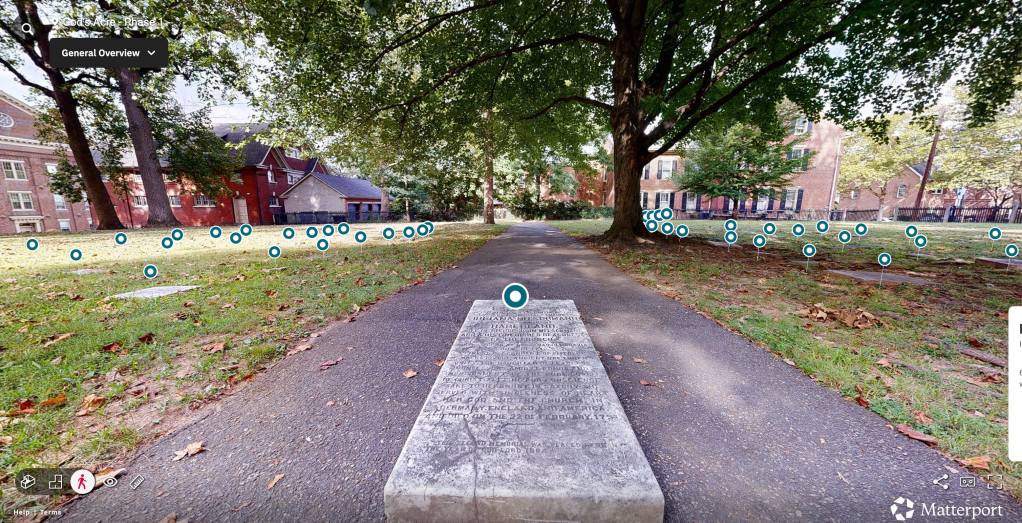
In conjunction with Cory Dieterly, Archivist of Reeves Library at Moravian College, a team of staff and students is developing a virtual map of the site ). Here, visitors can locate the gravemarkers easily and read more about the life stories of those buried there.
References
Map of Gottesacker DP f no 024 4
Baptismal Register of “Indians” Catalog of Baptized Indians 1742-1764.xlsx
 Moravian Studies and Digital Thinking and Praxis
