The Bethlehem Gottesacker (1742)

On September 6, 2025 the community of Bethlehem, PA celebrated the inscription of nine buildings and the God’s Acre onto the UNESCO World Heritage list as one of four transnational locations of the Moravian Church Settlements site.

The nomination document includes the criterion that “Moravian Church cultural tradition is characterised by the quest for an ordered communal Christian life, as well as by recurrent experiences of migration and a high level of mobility, the settlement congregations acting as places of support for local outreach and missionary work. The continuing presence of Moravian Church communities in each settlement ties the historic structures to the ongoing life of the larger Moravian Church community, which is based on the ideal of a universal fellowship of believers that cuts across all boundaries of nationality, ethnicity, gender, culture, and class.” (Executive Summary)

One of the elements of the World Heritage site is God’s Acre, the burial site started in 1742 by Nicholas von Zinzendorf on the occasion of the sudden death of a visitor to Bethlehem, Johannes Mรผller from New York. The site contains over 2700 graves of both Moravians and “Strangers”, friends of the community who has asked to be buried there. It follows the pattern established at earlier Moravian congregations where graves are arranged by choir (the homosocial groupings based on gender, marital status and age) and not by family. Each stone is flat, reflecting the Moravian ideal of democracy in death.

Gods Acre allows a visitor to witness something extraordinary. The orderly, flat stones map the global Moravian community that nearly 300 years ago stretched from Greenland to the Caribbean. Here the cultural bridges are visible: Native Americans who spoke multiple languages and navigated between worlds, serving as interpreters and teachers; European Moravians rest alongside African converts, enslaved and free,ย  who carried their own rich traditions into this new spiritual community; Indigenous community members who maintained connections to their Nationโ€™s heritage while embracing the Moravian faith created a fabric of radical integration that was revolutionary for its time. All of these diverse lives lie together in this cemetery, their flat stones embodying the Moravian principle of the “democracy of death.”

Visiting this place, an 18th-century world, where global networks of faith, trade, and cultural exchange converged in a single community, becomes a physically manifest. Each stone marks not only an individual life, but also a node in a vast web of relationships that spanned continents and cultures. This network was recorded in the “Catalog of Baptized Indians” (1742-1764) complied by Peter Boehler, John Heckewelder and finally Joseph Traeger and found in the Moravian Archives, Bethlehem Pa. (Item # 313.4) In a data visualization classes at Bucknell, this archival document became the basis for a database from which network diagrams of the relationships present in that data could be created. An example designed by CS student Khoi Le can be seen here:
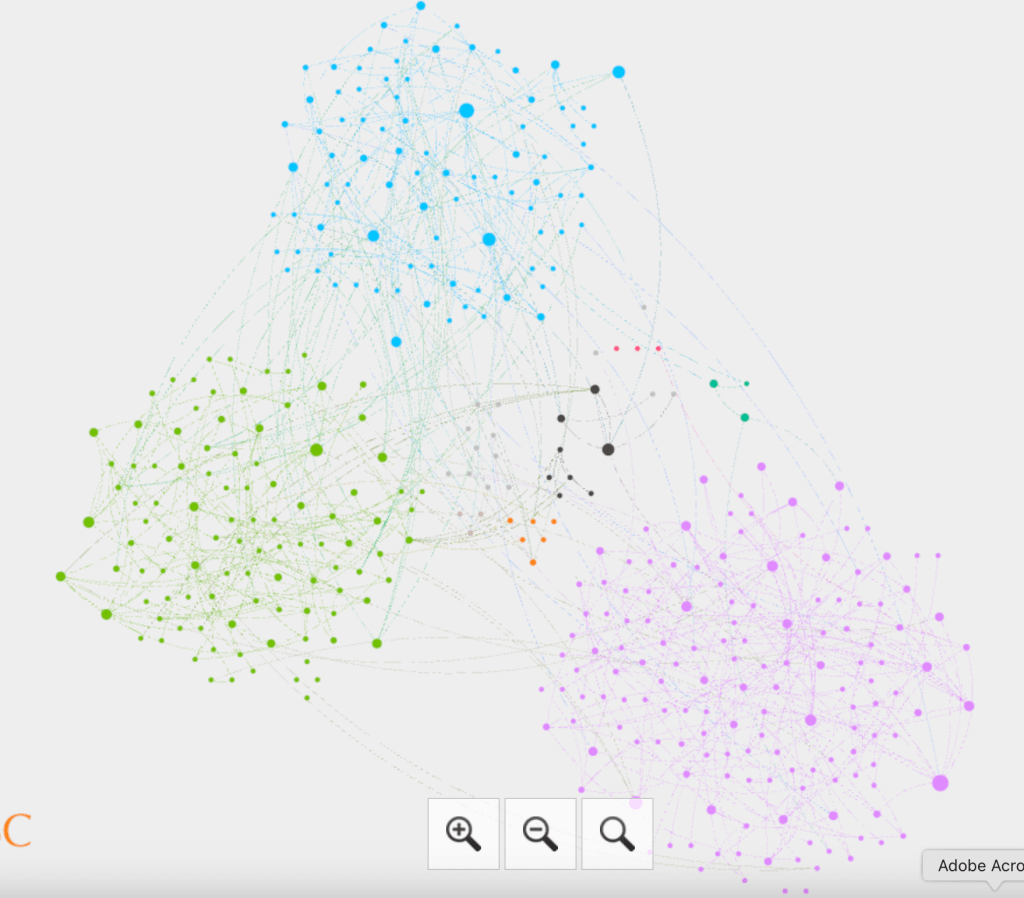
If you click on this image you can access the interactive visualization.

What makes Gods Acre truly remarkable is how it embodies what UNESCO recognized as “outstanding universal value to humanity.” The most powerful of these is the principle of equality and human dignity, manifested in what the Moravians called the “democracy of death.” Every person buried here – whether European settler, Native American convert, or African Moravian – receives the same simple, flat headstone. Social status, wealth, race, and background become irrelevant in this final resting place, creating a radical statement of human equality that remains profound today.

This physical equality reflects the broader Moravian commitment to what UNESCO identified as the “ageless values of education, equality, industry, integrity, and spirituality” that shaped this community from 1741 onward. The cemetery’s organization by choir rather than family demonstrates their democratic principles in action – people were grouped by life stage and spiritual community rather than blood relations or social hierarchy. This created a space where a Native American teacher might rest beside a German craftsman, where converted Indigenous families were fully integrated into the community’s spiritual and social structure.
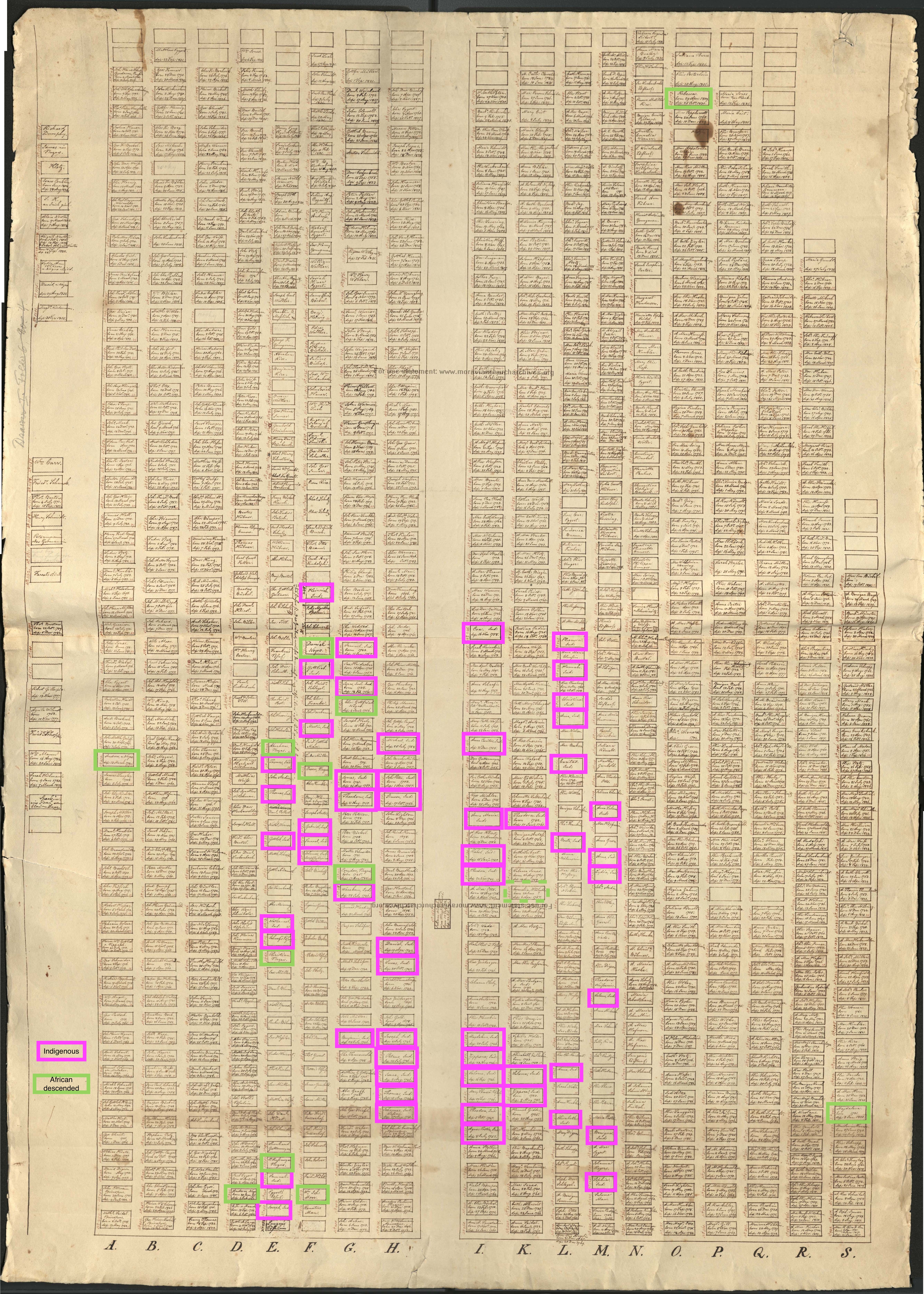
African and African descended peoples and Native American peoples buried in Gods Acre. Click on the image to enlarge it

The Moravians’ early vision for community represented a movement toward democratization that offered the same standard of living to all members and prioritized the common welfare over individual advantage. In Gods Acre, these values become tangible and permanent, creating a space where visitors can literally walk among the evidence of a community that successfully built bridges across cultural, racial, and linguistic differences. These universal human aspirations for equality, dignity, and community that recognize shared humanity regardless of earthly distinctions remain as relevant today as they were nearly three centuries ago.

Some of the life stories of those buried here:

Isaac โ€“ Wampanoag/Mahican (Grave #203)

Born at Shekomeko, Isaac’s early life was marked by both loss and the care of the Moravian community. His father was baptized by Brother Rauch at Oley in 1742, but following his father’s death, eight-year-old Isaac found a home in Bethlehem’s Single Brethren’s House, where Brother Cammerhof baptized him. In 1750, he traveled to Gnadenhรผtten to reunite with his mother, Rebecca, and remained with her until her passing. Afterward, other Native American members of the Gnadenhรผtten community looked after the orphaned boy. At sixteen, Isaac briefly returned to the Native American community in Wyoming Valley before making his way back to Gnadenhรผtten. The 1755 attack on that settlement forced him to flee once more to Bethlehem’s Single Brethren’s House. Suffering from consumption, Isaac died there at just eighteen years old, his short life a testament to the resilience of those who navigated between worlds during a tumultuous period in colonial Pennsylvania. 

Eva โ€“ Mohican (Grave #241)

Eva was an elderly Mahican widow from Shekomeko whose faith journey spanned some of the most turbulent years of the Moravian mission. Baptized by Peter Boehler in 1743, she and her husband Nicodemus first moved to Bethlehem before settling in Gnadenhรผtten, where Nicodemus served as Elder. Following his death in 1747, Eva remained in the Gnadenhรผtten community for eight years until the attack of 1755 forced her to flee. The elderly woman escaped into the woods and, after three days, arrived safely in Bethlehem. In 1758, she relocated to Nain, where she lived out her final years. Eva died at approximately eighty years of age, and in a testament to the bonds she had forged within the Native American Christian community, she was accompanied to God’s Acre by fellow Native converts and laid to rest by Brother Mack. Her life story reflects the extraordinary perseverance of Native American Moravians who maintained their faith through displacement, loss, and danger.

Michael โ€“ Minnisink (Grave #235)

Michael was a great warrior of the Minnisink nation whose appearance told the story of his former life. His face bore intricate tattoos marking his victories in battle: a snake, a totem pole adorned with faces, two crossed spears on one cheek, and the head of a boar on his jawline. Yet this warrior’s life took a dramatic turn when he was “awakened” to the Christian faith at Shekomeko in 1742. Four years later, he came to Bethlehem, and subsequently moved to Gnadenhรผtten, where he remained until the 1755 attack forced him to flee once more. Michael found refuge in Bethlehem’s Single Brethren’s House, living among the community until his death in 1758 at the age of seventy-two. He died surrounded by his Native American Brethren, who had walked alongside him through his remarkable transformation. To the Moravian community, Michael stood as a powerful example of spiritual conversionโ€”a warrior whose facial markings spoke of one life, while his peaceful final years testified to another. .

Simeon โ€“ Lenape (1686-1756) (Grave #209)

Born at Oak Harbor, New Jersey, Simeon was a renowned healer among his people, respected for his skill as a traditional doctor. His path to the Moravian community began when he moved to Meniolagomeka and encountered Moravian missionaries there. He later settled in Gnadenhรผtten, where his life was changed by the attack of 1755. Nearly blind, the elderly Simeon managed to crawl into the surrounding woods and hide. This experience may have deepened his spiritual conviction, for after reaching the safety of Bethlehem, he chose to be baptized. Simeon lived only one more year, dying in Bethlehem in 1756 at the age of seventy. .

Anna Maria โ€“ Lenape (Grave #151)

Anna Maria’s story is one of determination to return home in her final hours. She had been baptized at Bethlehem alongside her husband, Tobias, and their infant daughter, joining the Moravian community as a family. When she fell gravely ill while living in the forest across the Delaware River, Anna Maria made a request that members of her nation carry her back to Bethlehem. Anna Maria’s desire to die in Bethlehem was fulfilled and she passed away on October 28, 1753.

Anna Caritas (Nanny) โ€“ Shawnee (Grave #196)

Anna Caritas holds the distinction of being celebrated as the “First Fruit of the Shawnee” in the Moravian mission, though her path to Bethlehem was marked by hardship and displacement. While pregnant, she was captured by the Mohawk in North Carolina and taken to the Wyoming Valley, where she lived among the Shawnee community there. Seeking a new life, she left to live among white settlers near the site where Bethlehem would eventually be established, and in 1747 she moved into the growing Moravian town itself. Anna Caritas found work in the washhouse, as she had not learned to spin, and the following year she was baptized by Johannes de Watteville. She married Joseph, a Black brother in the community, and the couple relocated to Fredericktown to build their life together. When war troubles erupted, Anna Caritas briefly took refuge with the Sisters in Bethlehem. At her deathbed, the community gathered to sing hymns to her in both German and her native languageโ€”a fitting tribute to a woman whose life had bridged so many worlds. Her story reflects the complex journeys of Native women who navigated captivity, cultural exchange, interracial marriage, and faith during the colonial era.

Elizabeth โ€“ Arawak (Grave #56)

Elizabeth’s presence in Bethlehem’s God’s Acre is a remarkable testament to the far-reaching extent of the Moravian mission. Born among the Arawak people in Berbice, South America, she was baptized by Moravian missionaries in 1748 when she was approximately seventeen years old. The following year, she made the extraordinary journey from South America to Pennsylvania, traveling to Bethlehem with the missionary W. Zander. Her reasons for undertaking such a voyageโ€”whether for further religious education, to escape danger, or to serve the missionโ€”remain unclear, but the distance she traveled speaks to her commitment or the circumstances that compelled her northward. Elizabeth’s time in Bethlehem was brief. She died on June 18, 1750, far from her home and her people. Her story is unusual among those buried in God’s Acre, highlighting the truly international scope of the Moravian community and the diverse paths that brought Native peoples from across the Americas to this small Pennsylvania settlement.

John, alias Tschoop โ€“ Mohican (Grave #62)

Known among his people as Wasamapa, John was a Mohican from Shekomeko near the Hudson River in New York State whose influence extended far beyond his lifetime. Converted by Christian Rauch in 1742, John quickly emerged as a teacher among his people, sharing his faith with fellow Mohicans. When the Christianized Mohican community relocated to Bethlehem in 1745, John made the journey with them, but his life was cut short soon after by smallpox. Despite his brief time in Bethlehem, John’s legacy endured in powerful ways. He was celebrated as the “First Fruit of the Mohicans,” symbolizing the beginning of Christian conversion among his nation and is depicted on the First Fruits painting. His story and character are believed to have inspired James Fenimore Cooper’s portrayal of Chingachgook in the 1826 novel The Last of the Mohicans, ensuring that his life reached far beyond the Moravian community. He is buried next to Bishop Cammerhof.

Peoples of African descent 

Andrew, Ofodobendo Wooma โ€“ Igbo (Grave #474)

Andrew’s journey from West Africa to Bethlehem reveals both the brutal realities of enslavement and the unexpected paths some found within the Moravian community. Born in Igboland, he was sold as a child to settle his father’s debtโ€”a transaction that set in motion a life of displacement. Brought to New York and destined for sale and shipment to Madeira, Andrew’s fate changed when Thomas Noble, a merchant and early member of the Moravian Church in New York, purchased him. Noble brought Andrew to Bethlehem and gave him as a gift to Bishop Spangenberg, where he was baptized in 1746.

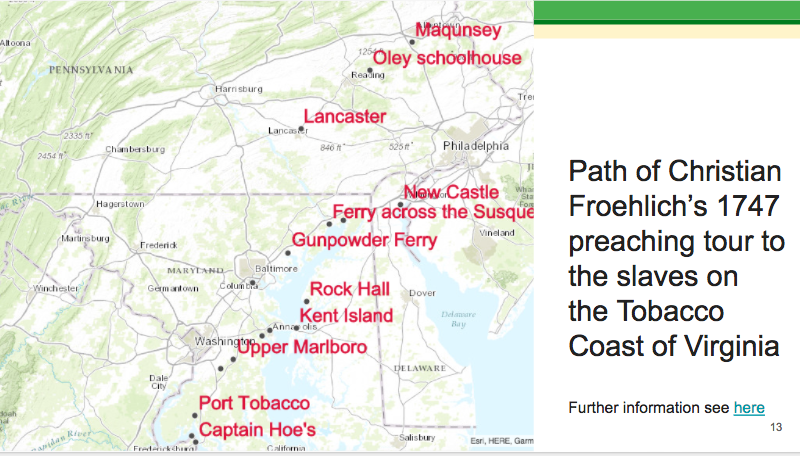
In Bethlehem, Andrew built a new life. He married Magdalene, a woman from Guinea, and together they raised three children. But Andrew’s story is particularly remarkable for the ministry he developed among his own people. Working alongside Christian Frรถhlich on itinerant preaching tours, Andrew traveled to iron industry sites in New Jersey and Pennsylvania, where he preached in Igbo to enslaved workers from his homeland. His skills and dedication earned him an extraordinary privilege: permission to travel alone to Philadelphia to minister to the Igbo community there. Through his preaching, Andrew offered spiritual comfort and connection to those torn from their African homes, speaking to them in their own language and sharing a faith he had found amid his own forced journey. He continued this work until his death in 1779, leaving behind a legacy as both a survivor and a spiritual leader.


Magdalene Beulah Brockdon (Grave #991)

Magdalene’s long life spanned nearly a century and bridged two continents, bearing witness to both profound loss and enduring faith. Born in Little Popo, West Africa, in 1731, she was enslaved at the age of ten and forcibly brought to America. She became the property of Charles Brockden, who partially manumitted her to the Moravians in 1748, allowing her to join the Bethlehem community. There she was baptized. Magdalene married Andrew (Ofodobendo Wooma). The couple had three children, but none survived to adulthood. Magdalene lived a long life, dying in 1820 at the age of eighty-nine.

Andrew (Grave #341)

Andrew was the infant son of Andrew (Ofodobendo Wooma) and Magdalene, born into the small but significant African community within Bethlehem. He died in 1767 at just one month old

Christian Gottfried “London” (Grave #197)

Christian Gottfried’s journey from the Guinea Coast to Bethlehem reflects the complex and often difficult intersections of Moravian mission work and the institution of slavery. Born on the Guinea Coast around 1731, he was presented as an enslaved man to Count Zinzendorf during the Count’s time in London in 1749โ€”a “gift” that revealed the moral contradictions at the heart of even religious communities. The following year, Christian Gottfried arrived in Bethlehem with a group of about eighty young men led by J. Jordan, and he was put to work as a tanner.

His early years in Bethlehem were marked by profound unhappiness, a young man far from home laboring in unfamiliar circumstances. But in 1751, while suffering from a fever, Christian Gottfried experienced a spiritual turning point and asked to be baptized. Afterward, he was sent to Christiansbrunn to live and work among the Single Brothers, where he appears to have found some measure of community. Despite his enslaved status, Christian Gottfried maintained a correspondence with Zinzendorf, whom he still addressed as his “master,” sending letters that hint at the complicated relationship between the two men. He returned to Bethlehem’s Single Brethren’s House in his final illness, dying of consumption in 1756 at approximately twenty-five years old. His nickname “London” and his letters to Zinzendorf remain as traces of a life caught between enslavement and belonging.

Corydon (Grave #111)

Corydon’s brief life ended far from his birthplace on the Guinea Coast, but not before he had actively sought a path he believed might offer him something better. Enslaved by Abraham Boemper, a Moravian brother who served as the agent for missions in Surinam and the West Indies, Corydon was between twelve and thirteen years old when he encountered the Moravian community in New York City. Remarkably, it was the young man himself who asked his owner to bring him to Bethlehemโ€”a request that reveals both his agency within the severe constraints of enslavement and perhaps his hope for what the religious community might offer.

Boemper, twice married and wed at the time to the widow Rachel Ysselsteyn, granted Corydon’s request and brought him to the settlement. Tragically, Corydon’s time in Bethlehem was cut short. The Bethlehem Diary entry of August 31, 1748, records his unexpected death from pulmonary edema caused by tuberculosis. Corydon died at approximately thirteen years old’

David (Grave # 1195) non Moravian, buried along Market Street, died 29.8.1831.

Lydia Ann Wilson, (grave # 1190) an African American child, died August 2, 1831, buried with the non-Moravians along Market Street.

James (grave # 1164) non-Moravian buried along Market Street.

Magdalene Anton (1751-66), (grave # 337) girl, born at Bethlehem, daughter of the African American Anton and the Indigenous woman, Elizabeth.

Daniel (Grave #179)

Daniel’s short life was shaped by the fractured realities of enslaved families in colonial Pennsylvania. Born in 1743 in the household of the Ysselsteins, who enslaved his mother, Hanna, Daniel entered a world where even family bonds were subject to the economics of human property. His father, Joseph (known as “Boston”), labored in the iron mines owned by William Allen, their family separated by the demands of different enslavers.

When Brother Bezold purchased Daniel from the Ysselsteins in 1745, the boy was able to join the Moravian Congregation alongside his mother. He lived in the Children’s Boarding School, where he grew up among other children of the community. In 1752, nine-year-old Daniel witnessed a moment that must have held deep significance: his father’s baptism, a rare gathering of their divided family within the spiritual life of Bethlehem. According to the records kept by Schulz, Daniel “did faithful service in the Nursery,” contributing to the community’s care of its youngest members even as a child himself.

Daniel died that same year at the age of nine and a half. His grave represents one of the many African children born into bondage in early America, yet his story also illuminates the ways enslaved families sought to maintain connections and find meaning within the constraints imposed upon them.

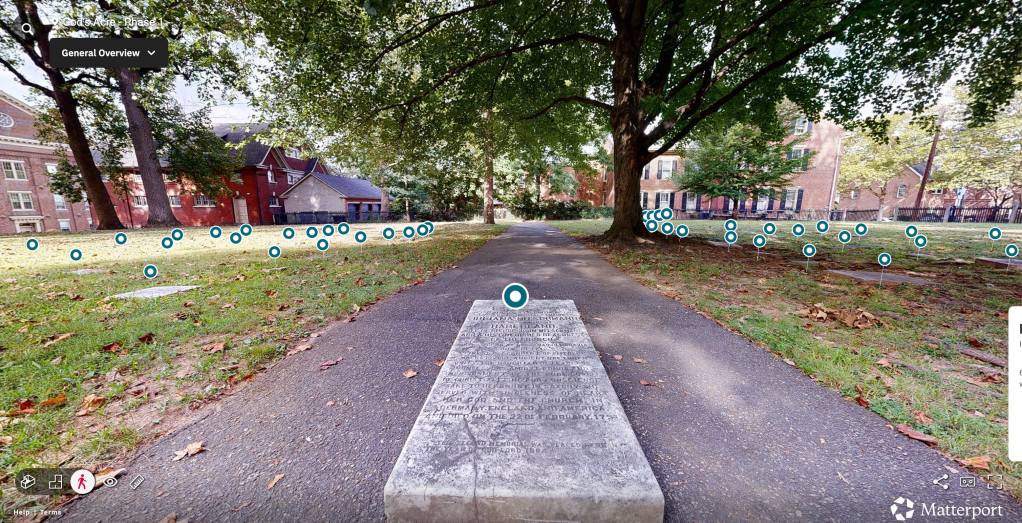
In conjunction with Cory Dieterly, Archivist of Reeves Library at Moravian College, a team of staff and students is developing a virtual map of the site ). Here, visitors can locate the gravemarkers easily and read more about the life stories of those buried there.
References

Map of Gottesacker DP f no 024 4

Baptismal Register of โ€œIndiansโ€ Catalog of Baptized Indians 1742-1764.xlsx
Network diagram of database 

Sacred Confluence: Place, Religion, and Cultural Exchange at the Moravian Mission of Shamokin, 1742-1755

Katherine Faull, Moravian University

American Association of Church History Annual Meeting, Chicago 2026

This week, members of the leadership team of the Institute for Moravian History and World Heritage presented a panel on “Moravians and Place” at the annual meeting of the American Association of Church History in Chicago. The panel was organized by Josh Follweiler, current PhD candidate at Princeton University and most recently Associate Pastor at Central Moravian Church, Bethlehem. Panelists were myself, Paul Peucker and Josh, and the chair and respondent was Craig Atwood. The papers provided a fascinating examination of how Moravians in the 18th and 19th century thought about place, whether as town planners, missionaries, or ministers. The specific places that were examined were Herrnhaag in the Wetterau, near Frankfurt in Germany; the early mission place of Shamokin, at the forks of the Susquehanna; and planned Moravian town congregations in Pennsylvania.

In my presentation, I focussed on the recently published Shamokin Diaries, analyzing the language of the text to build visual models of relationships between people, place and emotion. These visualizations allow us to explore the change in sentiment related to specific places (the river and the smithy) and people over the period the Moravian missionaries were working at the confluence. I reproduce these visualizations and the talk here.

The River as Metaphor and Realityย 

In 1747, as the Moravian missionary Johannes Hagen was returning up the Susquehanna from a trip to the grist mill at Quittapahilla, he described the river as “no different to look at than a town full of houses, the rocks lie in the water and the water flows criss-cross between them [like a warp and weft]”.ย  Five years earlier, Count Nikolaus von Zinzendorf on his way to the forks of the Susquehanna at Shamokin, Pennsylvania had also described the river in lyrical terms, the “water [was] beautifully transparent, and were it not for smooth rocks in its bed, it would be easily fordable. In crossing, we had therefore to pull up our horses and keep a tight rein.” I begin this investigation of the notion of a sacred confluence with these two quotations from Moravians to set the scene, literally and figuratively, for trying to understand how this group, which in the 18th century was spread across the globe from Greenland to the Caribbean, and from Kazan in Central Asia to Pennsylvania, understood the power of place. For them, did landscapes play a role in the choice of mission in a way that was not only defined by utility and strategic advantage? Did landscapes themselves hold sacred value? And if so, how did this concept differentiate itself from indigenous concepts of sacred landscapes?

Methodology

The River as Metaphor and Reality 

In order to address these questions, I have turned to the language of the Shamokin diary. As a philologist, I work with words. As a digital humanist, I use that language as data to recognize patterns and visualize them. As a translator, I know well that translation is โ€˜the most intimate act of reading’ (Gayatri Spivak).  So, with these tools, while transcribing and translating the Moravian mission diaries from Shamokin, Pennsylvania, I was struck by how the mission diarists described the landscape around the confluence (river, islands, bluffs, riffles, riparian buffers) as central to understanding their role. The physical geography of Shamokin constituted a confluence that required constant negotiation, with the forces of nature made manifest in floods and snowstorms, late frosts that destroyed newly planted crops, storms, and even an earthquake. This place shaped a unique mission encounter in which Moravians operated under the Indigenous authority of the Haudenosaunee. This adaptive mission strategy, centred on work rather than worship as primary witness, contrasts sharply with later Moravian missions on the North Branch of the Susquehanna (1765-1772), where mission places were built as intentional communities of worship and work and reveals how place determined religious praxis in colonial contact zones.

This paper explores the relationship between emotion, agency, and topography that emerged at Shamokin through the Moravian mission presence from 1742 to 1755, in the critical years preceding the French and Indian War. Drawing on the recently translated and published mission diaries (Faull, 2024), I examine how Shamokin differed from other Moravian settlements in colonial America. Unlike Bethlehem or Gnadenhรผtten, which were established as intentional communities, Shamokin existed as what Count Zinzendorf recognized as a spiritually strategic location where Moravians operated under explicitly negotiated Indigenous constraints (Merritt, 2003; Pointer, 2020).

The Moravian presence at Shamokin represented a central part of Zinzendorf’s mission plan for North America, which emphasized strategically practised humility and cultural respect (Atwood, 2004). I will show how this humility and respect was manifested in the mission through the lens of indigenous agency. The physical place directly influenced religious practice, with European hymns sung alongside sweat lodge ceremonies, pastoral visits conducted across the frequently swirling, ice-filled river, and Shikellamy, the Oneida sachem with oversight over Shamokin, finding spiritual and physical refuge in the Moravian loghouse while maintaining Indigenous practices. Through the 1747 formal agreements establishing a blacksmith’s shop, the Moravians created a shared sacred space where work itself became a form of witness.

Building on the work of Jane Merritt, Richard Pointer and Rachel Wheeler that challenge the older historiographical view of Shamokin, where Shamokin was described as a โ€œplace of the prince of darknessโ€, the Moravian mission diarists describe a place of challenge, both physical and spiritual, but also of cultural and spiritual exchange. Similarly, Rachel Wheeler describes Mohican Christianity in New England, which she argues represented an intentional spiritual choice that transformed both Native and non-Native spirituality, claiming that the Moravians succeeded where Congregationalists failed partly because they were “culturally non-aggressive” colonial outsiders who lacked expansionist ambitions. This approach enabled genuine mutual learning and spiritual exchange between missionaries and Native peoples. In his recent study of Moravian theology on the margins, Ben Pietrenka claims that these liminal spaces radically upturned hierarchies of power. Indeed, such ruptures have been described by Katherine Gerbner in her new book โ€œArchival Irruptionsโ€ as subversive discourses of power that are documented in the archives and require a radical counterreading of the traditional narratives of mission, race, and colonialization. It is against this backdrop that I investigate today the relations of agency and religion in the marginal place of Shamokin,  Pa. 

The town of Shamokin had long functioned as a crucial hub in a vast network of Indigenous mobility. The Moravian mission diaries of the 1740s and 50s reveal a constant movement of Indigenous peoples up and down the Susquehanna River: Tuscaroras, Cayugas, Oneidas, Mohawks, Nanticokes, and Lenape peoples are constantly arriving, departing, hunting, and passing through. Thus, Shamokin was not a static settlement but a dynamic crossroads where multiple Native nations intersected with European traders, missionaries, and colonial officials.

The Moravians’ attitude towards Shamokin evolved through contradictory emotions that traced the broader tragedy of Indigenous dispossession in the Susquehanna Valley. Initially, Zinzendorf well understood the importance of the forks of the Susquehanna as a strategic touchpoint with the powerful Haudensaunee Confederacy and its spiritual possibilityโ€”a place where their message of salvation could be spread, where communion could be celebrated, where the gospel might take root among multiple Native nations gathered together. Yet this hope coexisted with frustration over a place that never quite became what they envisioned, where missionary efforts yielded limited lasting results, and safety couldn’t be guaranteed. 

Shamokin served practical (if ethically challenging) purposes: a place to develop a relationship of trust with the Haudenosaunee, through building a blacksmithโ€™s shop for gun repairs for Indigenous peoples. The diary is replete with references to a working landscape where Indigenous economies intersected with colonial trade networks, though increasingly on terms dictated by land sales and territorial encroachment. Whereas previous European visitors, such as John Bartram on his visit in 1743, described the place of Shamokin as ideal land for settlement, with its “peach trees, plums, excellent grapes,” and also described the Indigenous people of the area as unable to cultivate it for themselves, the Moravians saw the Indigenous population as politically sophisticated, technologically capable, and spiritually discerning, understanding and respecting their reasons for not cultivating the land according to colonial rules as being rooted in resistance to colonization.

Interactive Visualization at this link

The mission diaries reveal the dark reality of such colonial encroachment, evidenced primarily through the chaos of violence and disorder fuelled by alcohol. The diarists record regular drinking & carousing” (9/17/1745), “all night dancing & howling” (11/2/1745) where “Everybody [is] drunk” (6/5/1748, 6/9/1748) with “drunken brawls & fighting” (2/24/1749) causing “Sleepless night for missionaries” (1/11/1749) and culminating in the Penns Creek “Massacre of white neighbors” (10/16/1755) by the Western Delaware who were allied with the French. 

The Moravian missionaries at Shamokin thus lived a paradox of witness and persistence amid overwhelming chaos. Between 1747 and 1755, they engaged in relentless physical laborโ€”constructing two mission houses, laying floors, building chimneys, repairing bridges, and erecting a smithy that became central to their relationship with the Indigenous community. Their documentation of measurements, dates, and improvements suggests both immense commitment to their work and an attempt to create order in an environment beyond their control.

The forge operated as more than a blacksmith shopโ€”it was a tool of engagement and a testament to pragmatic adaptation. The missionaries fixed guns, made charcoal, accepted payment in hides and pelts, and deliberately kept cultivation “at the level of the Indigenous economy” rather than imposing European agricultural models. Yet their economy remained perpetually precarious: starvation diets, crops ruined by frost and hail, with chickens and horses stolen or lost.

Yet amid this distress, the Moravians maintained remarkably disciplined spiritual practice. They held communion services, foot-washing ceremonies, and, in the 1750s, lovefeasts requiring sugar and tea, Easter dawn services at the turnip field where Brother Hagen had been buried, and services that ran until 2 a.m. The stark contrast is captured in Christmas observed with lovefeast while chaos reigned outside. Their principled Sabbath observanceโ€”refusing to let Indians demand that they work at the forge on those daysโ€”led to “astonishing questions” even as it was criticized for interfering with economic needs. One poignant detail reveals both their vulnerability and their peaceful intervention: a brawl “silenced by missionary’s singing.”

By 1755, the mission’s fragile stability collapsed. Advised to flee (advice “disregarded”), threatened with land claims, facing “bloody action by hostile Indians,” they finally witnessed the “massacre of white neighbors” in October. The mission house and forge were offered for sale with no date givenโ€”a poignant detail suggesting the uncertainty of when they could actually leave.

The archival evidence clearly shows that the Moravians at Shamokin operated within Indigenous political and cultural frameworks, adapting themselves to Native authority, while simultaneously navigating colonial politics. When Shikellamy held a Nanticoke Council in 1747 to address the issue of two Nanticokes who had been shot with arrows, the Moravians participated by preparing food “which they placed before the council”โ€”thus serving the Indigenous political process rather than directing it. Significantly, when the Nanticokes showed reluctance to listen to Shikellamy, the Moravians attributed this to “not to some essential notion of their race but rather to them being surrounded by traders,” placing blame on colonial disruption rather than on any inferred Indigenous characteristic.

Cultural exchange flowed in multiple directions. In 1757, Moravian visitors to a Shawnee village on the North Branch were invited to a sweat lodge and accepted, afterwards enjoying an evening concert of European chorales and music for strings played on violins provided by the Indiansโ€”a remarkable scene of reciprocal hospitality and shared musicality. Medical practices also bridged cultures: on July 10, 1747, several Indians came to Brother Hagen to be bled, reflecting a shared humoral worldview where both Moravian and Indigenous medicine understood the body as a system of flows requiring balance.

Yet the missionaries also practised strategic isolation, maintaining strict “aloofness from traders” who were “strictly kept out of the house.” This wasn’t cultural superiority but a survival strategy in an environment where traders brought the twin scourges of alcohol and violence. The Moravians navigated a careful path: adapting to Indigenous authority and participating in Native cultural life while protecting their mission space from the destabilizing forces of the colonial economy. Their approach recognized that the greatest threats to peaceful coexistence came not from Indigenous peoples but from European traders whose liquor traffic undermined the very communities the Moravians sought to serve.

Interactive visualization is at this link

The smithy at Shamokin was clearly the economic and relational heart of the mission. The Moravians structured its operation to align with Indigenous economic patterns rather than imposing European models. Indians were “kept on the preferred list,” receiving priority service, while payment came in hides and pelts through immediate exchange, avoiding the debt relationships that characterised exploitative trader practices. The forge offered practical services: repairing guns, manufacturing charcoal, and meeting community needs on a self-supporting basis. This economic philosophy extended to their agricultural practices: they explicitly kept “farming activities on the level of Indian economy” and maintained “agricultural enterprises at a minimum.” Rather than establishing a European-style plantation that would signal territorial claims and economic dominance, the Moravians adapted to Indigenous economic patterns, using the smithy as a tool of engagement that served the community without attempting to transform it. 

On August 2, 1747, letters from Bethlehem arrived (always a source of joy), but this time with the critical news that agreement had been reached with the Colonial government to build the smithy. Shikellamy calls a council of the Indigenous leaders, which permits Bishop Spangenberg to speak through his letters, composed in Onondaga and signed with his Haudenosaunee name, Tโ€™girhitonti. That same evening, the Moravians celebrated their first communion, thus demonstrating that work and sacred life were intertwined. Hagen writes in the diary, “How we felt at this communion with our Lord I cannot describe. It was also important to us because it is the first one here in the wilderness, perhaps as long as the forest has stood.” 

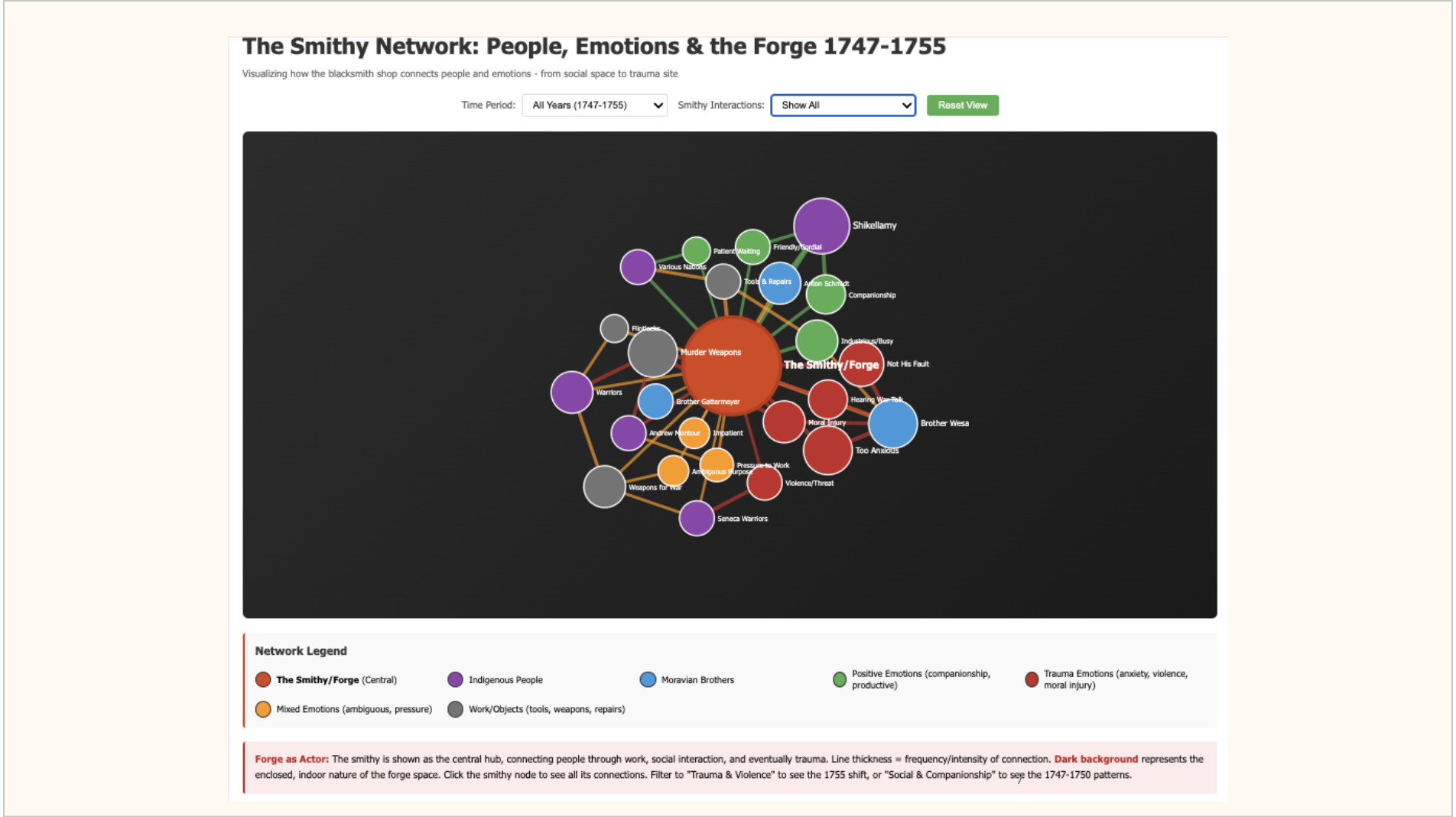
But the smithy was much more than a place of work- it was central to the Moraviansโ€™ mission at Shamokin, constructed and operated by them. In this interior space, they controlled who could enter and when, and who could have work done and when. According to the agreement with Shikellamy, it was Indigenous agency that decided whether the warriors needed to pay for the work. The space of the smithy, also, demanded a moral position in which the Moravians could not avoid complicity in the repair of arms. Every decision they made demanded a moral choice and left them no space for passivity in the face of conflict. 

Looking at the smithy as a fulcrum of emotion and agency, we can view this diagram which us designed to show emotions connected to the smithy over time. For example, if one wants to talk of an emotional register, the smithy in 1755 is a place of impossible choices for Brother Wesa. A place that had once been a space of Shikellamyโ€™s companionship (1747-8) had become a site of trauma (1755) where Wesa is forced to repair the bloodstained weapons of war.

Interactive visualization is at this link

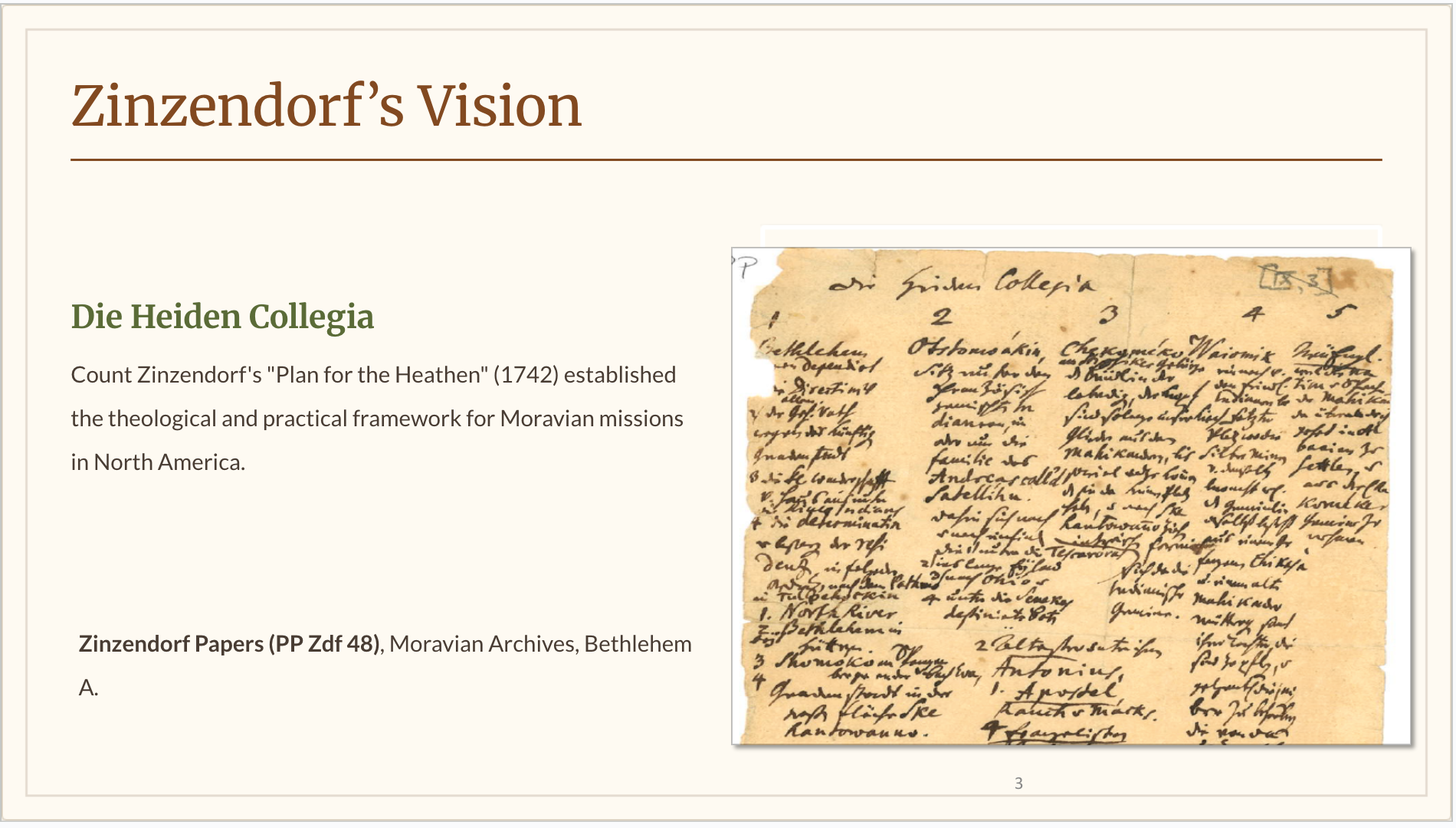
If we perform the same analysis for the Susquehanna River, we can see that the river serves as an antidote to the ethical conflict in the smithy. It belongs to the realm of nature, an open force of nature beyond human control in a pre-existing landscape. It acts independently of human will, flooding, freezing, and flowing. Moravians respond to it but do not control it. It also offers a morally neutral territory, carrying warriors up and downstream. It offers danger through its rocks, riffles, and ice floes. Yet it is also deeply embedded in colonial geography, defining the boundaries of lawful settlement. The river has a social function, too, linking Shamokin with the Wyoming Valley (one of Zinzendorfโ€™s original Heiden Collegia).

Interactive visualization at this link

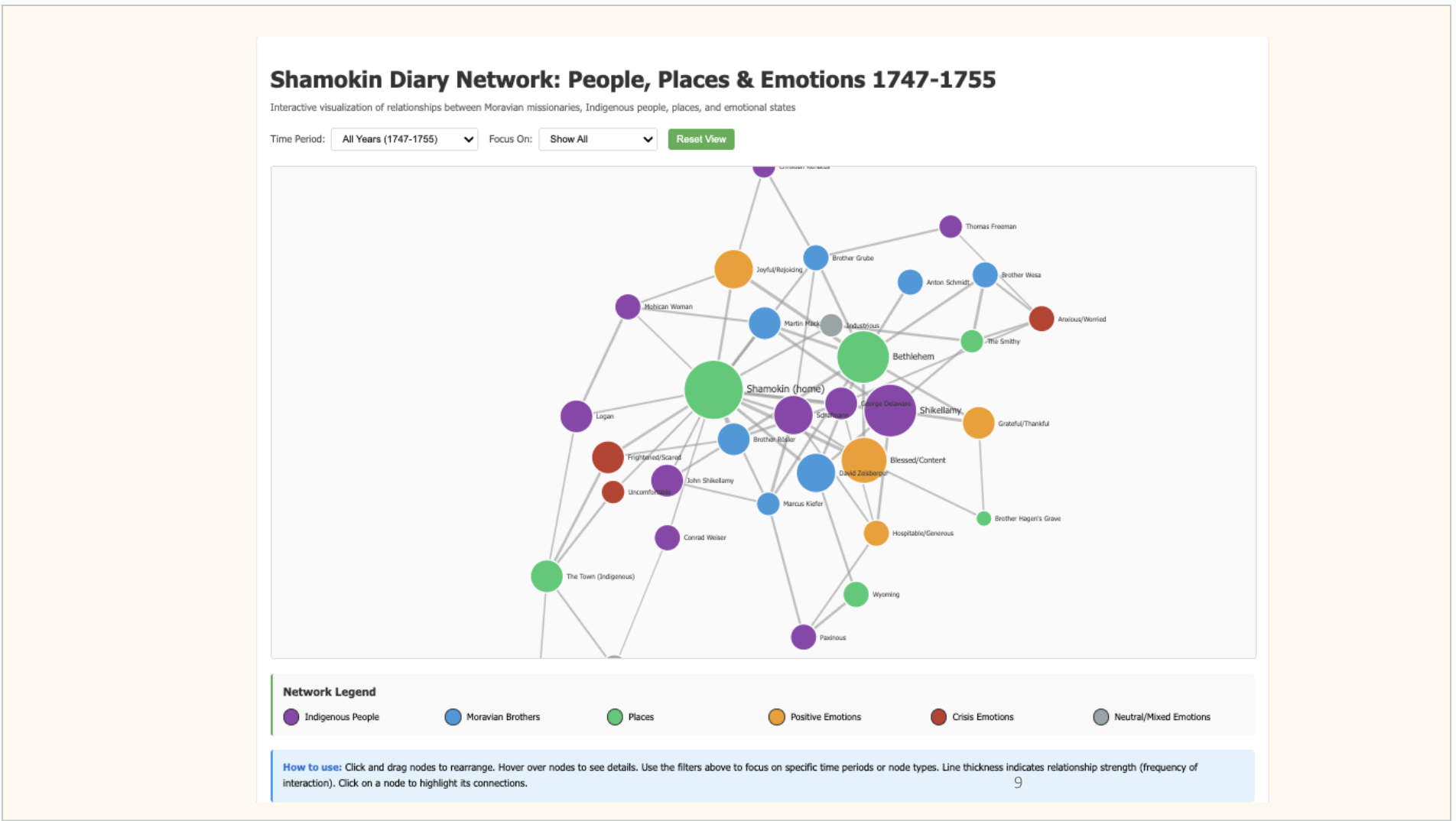
But not only are places linked to emotion; so are people. First, references to specific places are accompanied by specific sentiments in the diary narrative (of course, there are multiple diarists, and their reactions to people and places also determine the emotional index).

Interestingly, Bethlehem is always seen as a place of refuge, frequently referred to during this period by those on mission work as โ€œdas Kripplein,โ€ the little manger. People are also associated with emotions: Shikellamy is always a friend and protector, and when he dies, his sons, Johan and Logan, inherit his role but are not as intimately involved in the work of the smithy.

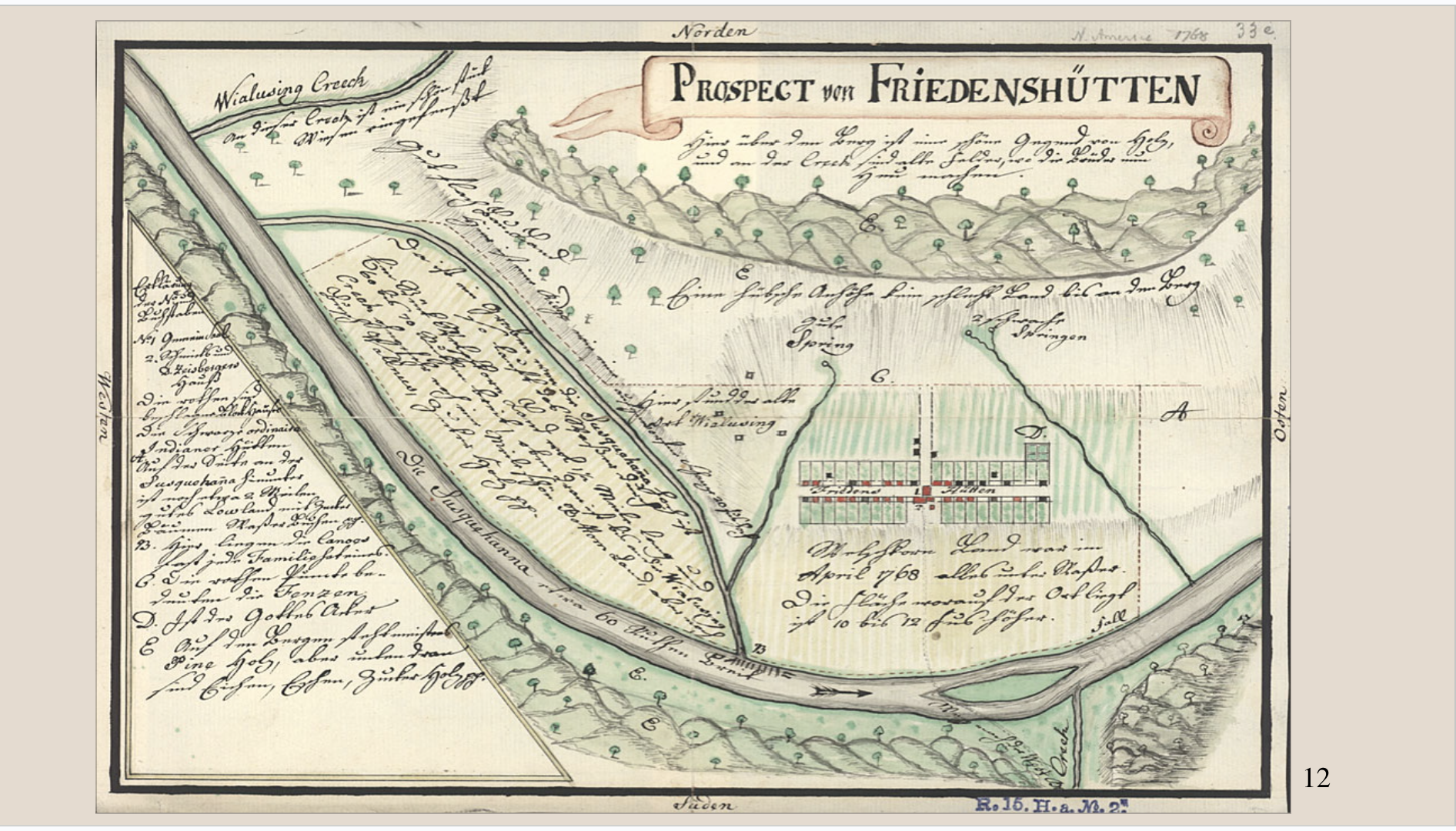
The sense of sacred place at Shamokin contrasts sharply with that of the Moravian North Branch mission sitesโ€”particularly Friedenshรผtten (“Huts of Peace”) (1768-1772) and Scheschquehannunk (1769-1772)โ€”both established between Pontiac’s Rebellion and the American Revolution. These later “Places of Peace” were intentional Christian communities led by converts such as Johannes Papunhank (a Munsee religious leader baptised by David Zeisberger). Friedenshรผtten embodied the Moravian mission vision that had eluded Shamokin: a thriving mission town with substantial infrastructure, agricultural prosperity, and a vibrant liturgical life that earned admiration from colonial officials and Indigenous leaders alike. The community erected impressive buildings, including a meeting house with glass windows and a belfry, produced abundant harvests that fed both residents and countless visitors, and grew from fourteen to forty-seven communion participants. Their sophisticated governance structures, bilingual education, and extraordinary hospitalityโ€”extended even when it strained their own resourcesโ€”demonstrated Indigenous Christian agency and strategic cultural competence. Yet this success contained its own vulnerability. Built on disputed land, caught between competing political pressures, and ultimately forced to abandon everything on May 3, 1772, Friedenshรผtten revealed the brutal reality that no amount of prosperity, spiritual commitment, or colonial admiration could protect Indigenous peoples from the violence of expansion and the fundamental insecurity of their land rights. Where Shamokin had struggled against chaos, Friedenshรผtten achieved everything the Moravians envisionedโ€”and still could not survive.

To return to the questions with which I began this presentation: did landscape play a role in the choice of mission in a way that was not only defined by utility and strategic advantage? Did landscapes themselves hold sacred value? And if so, how did this concept differentiate itself from indigenous concepts of sacred landscapes? I would argue that landscape of Shamokin was selected strategically but became sacred though the 8 years of the mission being active there. Shamokin was selected strategically: Shikellamy’s invitation, Six Nations council site, smithy opportunity. But eight years of dwelling transformed it.  The missionaries noticed the river’s beauty (“like warp and weft”), tended Brother Hagen’s grave with pre-dawn visits, called their new house “this dear little place” and composed a hymn for it. They left “not without little tear.” Thus landscape accumulated sacredness through relationship, not geography.

BETHLEHEM was a permanent sacred, always positive across all periods. Letters from there “like honey and balsam.” The place they couldn’t stop longing for.

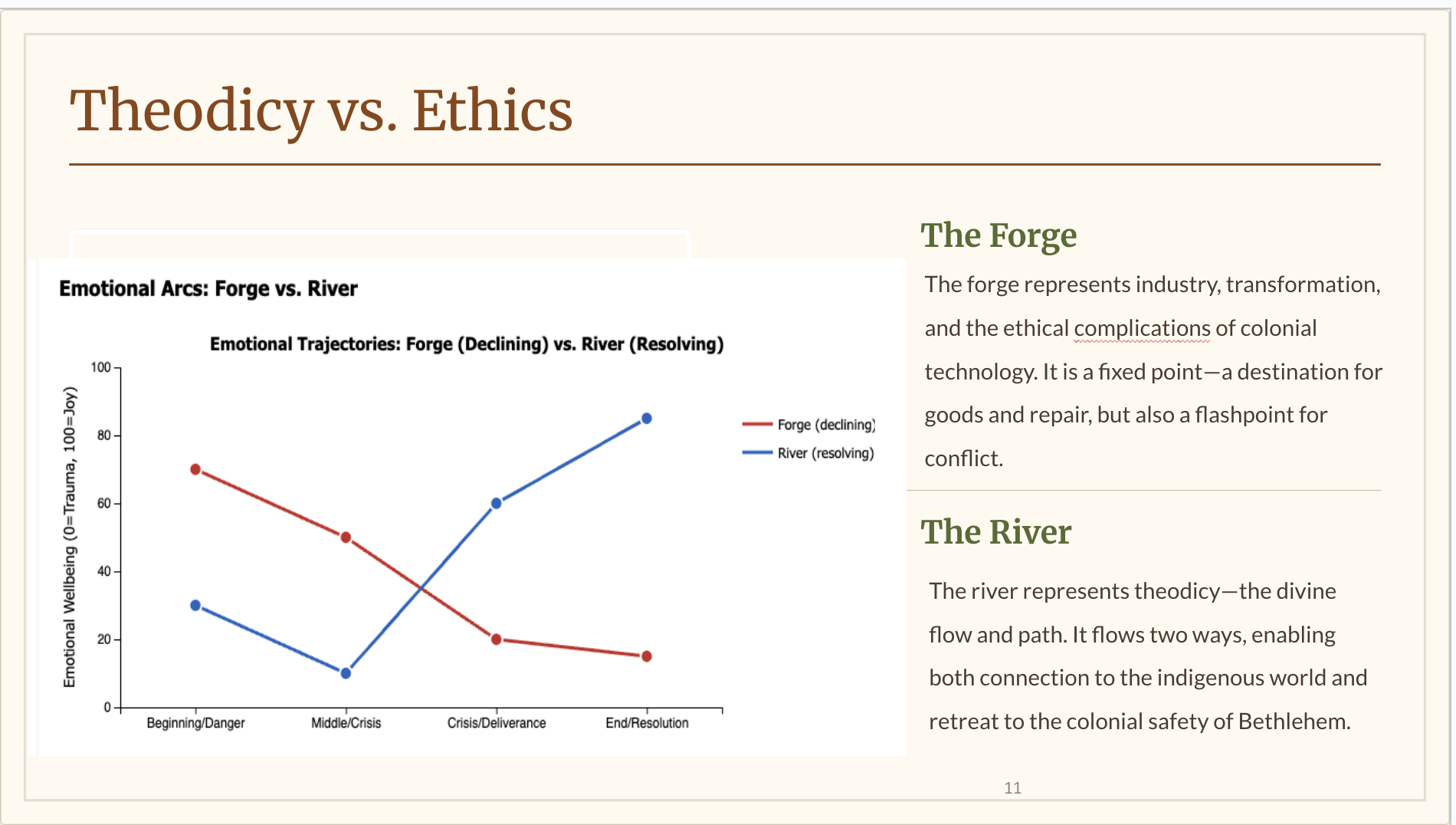
THE RIVER: Theodicy sacred. Sacred when God acted through it – the flood became Noah’s ark, dangerous falls became deliverance sites. Natural danger without moral culpability.

SHAMOKIN: Relational sacred. Sacred through Shikellamy’s daily protection, through communion’s “unspeakable proximity.” But this sacredness evaporated when relationships fractured in 1755.

The emotional geography reveals that the sacred for the Moravians wasn’t fixed in land but in relationships and divine action. How did this understanding differ from Indigenous sacred landscapes? The Shamokin diary shows that both groups navigated the tension between place and the need to be mobile. Therefore, the relationship to place was not simply “fixed” or “portable”. For the Moravians, Christ is portable (they can worship anywhere). However, through the text we can see that their emotions showed a strong longing for Bethlehem, and when crisis arose, it forced a flight to their permanent sacred centre.

For the INDIGENOUS PEOPLES, place was vital to rituals of identity. For example, the Nanticoke reburied their departedโ€™s bones, the islands in the river were places for council fires and decision making, the land and forest and water were places for the hunt and trade. At the same time the indigenous people demonstrate strategic mobility (seasonal migration, dispersal under pressure) and also, most importantly, exercised agency over who could stay, who had to leave Shamokin. The critical difference was that Moravians could leave because Bethlehem remained secure. Indigenous people maintained protocols through displacement because colonial violence destroyed their sacred places.

The Moravians sought a “portable sacred” – Christ present anywhere. But the emotional geography of the Shamokin diary reveals they couldn’t escape place through theology, in that they couldn’t worship safely without Indigenous protection (Shikellamy made devotion possible); they couldn’t resolve moral complicity in one place (the forge), so they fled to another (the river) where suffering could be explained theologically. And finally, they couldn’t stop longing for one specific place (Bethlehem).

Meanwhile, Indigenous people maintained sacred obligations to specific places (returning bones, ritual sites) while strategically adapting to colonial violence – demonstrating not attachment vs. mobility, but agency under impossible circumstances. Colonial violence, not theology or culture, determined who kept their sacred places. The Moravians fled to Bethlehem. Indigenous people were displaced from Shamokin. Both groups’ relationship to landscape was relational, adaptive, and vulnerable – but only one group had a secure sacred center to return to.

Therefore, landscape mattered beyond utility, but it became sacred through dwelling, not through inherent geography. Landscapes held sacred value for the Moravians – but through relationships, divine action, and community, not fixed spiritual power. This differed from Indigenous concepts – but both groups navigated place/mobility more than simple binaries suggest. The emotional geography reveals that vulnerability, not belief, shaped the sacred landscape. And, at least for a while, Indigenous agency determined who could stay.

Places of Peace: Moravian Missions on the North Branch of the Susquehanna 1769-1772

Lecture delivered at the Dietrich Theater, Tunkhannock, PA on October 15, 2023

Thank you for the invitation to speak today at the Dietrich Theater in Tunkhannock, standing on the traditional lands of the Munsee, Lenapehoking and Susquehannock Indians. 

I titled this talk โ€œPlaces of Peaceโ€ and intentionally did not add a question mark. As I will try to show, there were certainly tensions on the North Branch of the Susquehanna River, both in the Moravian Indian villages of Friedenshรผtten and Scheschquehannunk between the Mahican and Delaware (Unami and Munsee) residents, and with their neighbours, both settlers and Native Americans,  and also in outward-facing discussions with the Haudenosaunee to the north, specifically the Cayuga nationโ€™s chief and the Colonial Superintendent of Indian Affairs, Colonel William Johnson. But, since the outbreak of the French and Indian war and the subsequent Pontiacโ€™s Rebellion, the villages were places of relative peace in comparison with the violence and bloodshed that was occurring as a result of increasing racial tensions between the white settlers and ANY Native Americans further down the Susquehanna River.

What I would like to discuss today is how this place โ€“ from the mouth of theย  Lackawanna up to what is now the New York/Pennsylvania border – was briefly a place of relative stability and environmental wealth for groups of displaced Moravian Indians, Mohican, Unami and Munsee speaking, who were caught up in both the religious awakening that swept up and down the Susquehanna River in the 1740s and the redefinition and renegotiation of tribal identities in Native communities in the Susquehanna Valley.

To help me in this work, I draw on my own long involvement with the records of the Moravian Church in the North American missions, in particular the deep research for my forthcoming book on the Shamokin mission which predated these North Branch missions by 10-15 years but which contains some of the same actors. Common themes for that research project and this one include the historical work of scholars such as Jane Merritt on the contribution of women missionaries to the intercultural exchanges in Pennsylvania, my own work on trade and missions in early Pennsylvania; the recent revisioning of this time and place by scholars such as Richard Pointer, in his remarkable โ€œbiographyโ€ of Papunhank, the Munsee religious leader that was published in 2020. Also vital to my work is Amy Schuttโ€™s important essay on tribal identities in Moravian missions on the North Branch; and, as we end today,ย  Rachel Wheeler and Sarah Eyerlyโ€™s reconstructions of the soundscapes of Moravian mission landscapes. Much of this work is based on the deciphering of the archival records of the Moravian Church, held in Bethlehem PA and also available through Gale Cengage online (if you can read archaic German script).

There are also certain central figures that pervade this work:

  • The Moravian missionary, David Zeisberger
  • The Munsee “Prophet” (John) Papunhank, baptized into the Moravian Church by Zeisberger
  • Job Chillaway and his brother Billy, residents and later title holders to the lands of Wyalsuing
  • John Woolman, a leading Quaker whose work with Papunhank was central to his religious vision
  • The Moravian missionary couples who worked in Friedenshรผtten and Scheschquehannunk: Johann and Margeret Jungmann (fluent in Mahican), 
  • Johann and Johanna Schmick (who was fluent in Mahican and wrote a Mahican dictionary)
  • Johannes and Marie Roth (who was learning Munsee dialect of Delaware)

First, who were the Moravians and why were they establishing missions to the Native Americans of the North East in the Colonial period? 

Count Nicholas Ludwig von Zinzendorf was born in Dresden, the capital of Saxony in 1700.  Zinzendorf was a descendent of Protestant Austrian nobility and was raised by his grandmother, Henriette Catharine von Gersdorf after his fatherโ€™s death and his motherโ€™s remarriage.  His grandmother, an educated and talented woman, exercised great influence on the politics and pietism of the day.  Zinzendorf was educated at Franckeโ€™s school in Halle where he first encountered missionaries returning from the Lutheran mission in Tranquebar, India. 

During this period in Halle, he most likely heard about emigration to North America, as in 1702 an entrepreneurial German who had lived in Pennsylvania, Daniel Falckner, had met with the leader of the school and discussed subjects as far-ranging as where the other German settlers lived, to what Native Americans ate, how they hunted, how they raised their children and how one might trade and make money. By 1727 over 20,000 Germans had settled in Pennsylvania in search of financial wealth, and religious and political freedom. 

Zinzendorf developed a quite unique approach to mission work. For example, Zinzendorf claimed that the refusal of some missionaries from other denominations to mix with the non-Christians, or to live at their level of poverty, was contrary to the spirit of Christ and accordingly, baptisms were to be performed individually and not en masse, that the individualโ€™s path to salvation was charted by means of frequent โ€œspeakingsโ€ with spiritual Helpers from the same cultural and linguistic background as the candidate, and that each person was a member of a small band of people who came together regularly to discuss their spiritual growth, exchange confidences about their personal problems, encourage and forgive each other, and help each other. Such an individualistic approach toward conversion had both its benefits and drawbacks.  The benefits showed themselves in the success of the missions. The drawback was that the number of converted remained small.

In 1742 Zinzendorf travelled to North America and stayed first in Philadelphia and then came up into the Lehigh Valley. From there he made several trips into Indian Country, first to the Mohican village in Shekomeko, Dutchess County NY, then he visited unsuccessfully the Shawnee in the Wyoming Valley, and also he visited Shamokin and met Shikellamy, Madame Montour and Andrew.

The Moravian mission project was just one of many vectors of colonization of Native American religion and lifeways, but arguably, the most well-meaning. Other groups had already proselytized the Native Americans of the North East, such as the Jesuits and the Presbyterians. Some Native Americans (like Madame Montour) were baptized multiple times and some, like the Oneida, Shikellamy had been baptized in his youth but was drawn to the Moraivans, perhaps especially David Zeisberger, and might well have been baptized before his untimely death in December 1748. The Moravian understanding of conversion and baptism required that each individual non-Christian should feel the call to convert within his or her heart because of the model provided by other Moravians (European or Native American) and also the need to repent. This meant that Moravian conversions were small in number, individualized, and yet also more deeply internalized within Native American communities, to the extent that when asked to move within the vicinity of other non-Chrstian Native villages in the aftermath of Pontiacโ€™s War, leaders such as Papunhank refused, citing the difficulty of maintaining their lives of faith when having to live with non-Christians.

The mission at Friedenshรผtten was the result of years-long negotiation and discussion with both the Colonial authorities and also with Papunhank, the Munsee religious leader who had built up a substantial town at Wyalusing in the 1750s. Born probably in 1705, maybe in upstate New York, Papunhankโ€™s life has been masterfully pieced together by historian Richard Pointer who draws heavily on many different manuscript sources in the Moravian archives. Pointer outlines not only his biography but also the context in which he lived: an incredibly complex world of colonial expansion, Native American negotiation, betrayal, trickery, increasing racial tension, a discovery of faith, renewal, and alliance building. His story is definitely that of the Delaware peoples, as they were displaced and removed, โ€œadoptedโ€ and made into rhetorical women and children by the Six Nations. Renouncing alcohol after the death of his father, Papunhank campaigned to ban the trade in rum. He visited the Society of Friends in Philadelphia (especially Anthony Benezet, the abolitionist and author of influential tracts on the shared humanity of both enslaved Africans and colonized Native Americans) and, according to Pointer, possibly met Shikellamy in Shamokin and witnessed how this effective diplomatic and negotiator for the Six Nations managed to effect a delicate balance between his peopleโ€™s culture and priorities and the rapidly changing landscape of the Colonial period.

Papunhank desired to found his own village, where his rejection of alcohol and his awakened spirituality could determine the rhythm of life. The availability of good hunting and fertile land and access to the waterways that served as the major routes for trade led him in 1752 to settle on land at Wyalusing and build a substantial settlement. But it was not long before the hostilities of the French and Indian War which erupted in 1755 and the Delawares were split in their loyalties between the French and the British.

The fate of the Indian Moravians who had been expelled from New York state in 1744 and had moved to Gnadenhรผtten on the Mahoning and Nain near Bethlehem has been told many times. The hostilities of Pontiacโ€™s Rebellion and the ensuing attacks on any Native American groups in 1763-4, converted or not, meant that the safest place for them was deemed by the Colonial authorities to be the barracks in Philadelphia. The attacks of the Paxton Boys as they were known on the Conestoga Indians in Lancaster County and then the ensuing march on Philadelphia made it clear that the โ€œPeaceable Kingdomโ€ that William Penn had envisaged was now an impossibility.  The perpetrators of the massacre defended their actions in a remonstrance published in 1764, claiming that the violations of the โ€œdistressed and bleedingโ€ frontier were an affront to the brethren and relatives of the murdered whites.  They also accused the Moravian Indians of Nain of sending messages to the Shawnee living on the Great Island to plot further murders of the white settlers along the Susquehanna River.  According to historian Kevin Kenny, the Paxton Boys were not the only ones to suspect that the Moravian Indians of Nain were secretly trading with enemy Indians and supplying them with guns and ammunition.  The Assemblyโ€™s commissioners also believed that โ€œthere is much reason to suspect the said Moravian Indians have also been principally concerned in the late Murders committed near Bethlehem, in the county of Northamptonโ€ (Kenny, p. 133)  In response to these accusations, in October 1763 restrictions were placed on purchases of gunpowder in Nain, and the commissioners recommended that the Nain Indians be removed to Philadelphia so that their โ€œbehavior may be more closely observed.โ€ (ibid.)  To this end, on November 8 1763 a party of 127 Indians from the missions of Nain, Wechquetank, Nazareth and Bethlehem set out for Philadelphia.  

As I have discussed in another talk, the non-Indian residents of Bethlehem viewed the departure of the Indians, not only from the mission villages but also from within the very choirhouses of Bethlehem with ambivalence. Kate Cartรฉ has argued that the removal of the Nain and Wechquetank Indians was something accepted by the Bethlehem non-Indian residents and that they did not fight this decision because they had never seen them as part of their community (Engel,ย  For Religion and Profit, p. 184)ย  And, a few weeks after the Moravian Indians arrived in Philadelphia on November 11, they were greeted by a furious mob ready to murder them. Afraid that the Philadelphia barracks would not protect them from the mob, the Moravian Indians were moved to a former โ€œpestilence houseโ€ on Province Island in the Delaware River.ย  And there they stayed for fifteen months.ย  Conditions were terrible in the prison. Disease was rampant.ย  By the end of 1764, 56 of the Indians had died, nearly half of them children.ย ย 

The fate of the Nain Indians in the Philadelphia barracks was a constant source of concern for the Bethlehem Moravians.  Given the political unrest and racial hatred now rampant in the Pennsylvania backcountry, that was spilling into the crowds of the cities of Philadelphia and Lancaster, it was clear that Nain could no longer be the home of Christian Indians.  In September of 1764, before even a clear decision had been made as to the fate of the Indians, plans were drawn up to dismantle the buildings.  After the leaders of the Indians in the barracks petitioned for their own release, they were permitted to leave the city and arrived on March 22 1765 back in Bethlehem in deep snow.  They were allowed to briefly stop for a week at what remained of their old homes. Six of the fourteen houses were sold to individuals in Bethlehem on March 30, (according to Levering, one was the chapel) and then the following day a farewell lovefeast was held and on April 3 the Moravian Indians left Bethlehem for the apparent safety of Papunhankโ€™s village of Wyalusing on the North Branch.

How come these baptized Indians, Delaware and Mohican, were invited to come to the North Branch? According to Pointer, the Muncee prophetโ€™s village was losing its inhabitants in the early 1760s; some no longer wanted to hear his message, some were worried at the violence on the frontier and as close as the Wyoming Valley where Teedyuscungโ€™s village had been attacked. At this point of crisis, the Moravian missionary David Zeisberger turned up in Papunhankโ€™s village and accepted his invitation to preach. This fortuitous appearance in 1763 led to Papunhank inviting the Moravians to send a missionary to the upper North Branch; also Papunhank requested that Zeisberger baptize him into the Moravian Church. Upon baptism, he received the name, Johannes. Now a Moravian and also still the leader of his village he also recognized the threat that his people were under and for this reason joined the Nain Indians in the Philadelphia Barracks. Negotiating with the Six Nations and also the Colonial authorities, Johannes Papunhank should also be credited with arranging the removal of the remainder of the Nain Indians to Wyalusing. According to Pointer, Papunhank assumed the leadership of this new Moravian community in June 1765, preaching in the Muncee dialect of the Lenape language and also, it is thought, able to communicate with the Mohican Moravians due to his time at the Philadelphia Barracks.ย 

The village that became known as Friedenshรผtten was built in 1766 in a position closer to the river than Papanhunkโ€™s Wyalusing. The mission diary reveals the day-to-day activities that sustained the community both physically and spiritually. From its beginnings in the spring of 1765, when food was scarce, to its dissolution in the summer of 1772, the town supported itself with its gardens of produce, and seasonal hunting and shad fishing.ย  It hosted numerous parties of visiting Indian nations, some very large and very hungry, many coming for political parley, some coming to visit their family members who had converted. Reading the mission diaries that still exist only in manuscript form, a picture emerges of a vibrant community with a multi-lingual school, a Gemeinhaus (church) complete with oil paintings and a bell, log houses with glass windows, bark houses for those who preferred them, fertile kitchen gardens, and canoes tied up along the river bank.

The numbers in this community kept growing. By the end of 1765 the number was 146, by the end of 1766, 172, and by the end of 1767, 185. The population was made up of almost a third of non-baptized Native Americans, Delaware, Mohican, and also visitors from the Nanticoke, Tuscaroras, and the Cayuga, under whose oversight the lands in Wyalusing fell. Disputes did occasionally arise about the language of worship in Friedenshรผtten, with the Lenape speakers feeling as though they were at a disadvantage with the preponderance of services being held in Mohican.ย 

And perhaps for that reason in 1769 a delegation of Delaware Moravians discussed the transfer of their members to the already existing village of Schih-shi-quan-nink (a Delaware name meaning a rattle made of a tortoise shell)ย  about 13 miles upriver (or 3.5 hours on a good day). As Amy Schutt has discussed in her work on tribal identities on the Upper Susquehanna, the possible separation of the two congregations into their linguistic groupings in fact went against the Moravian mission philosophy of converted Indians seeing themselves as โ€œone people.โ€ However, the separation into two congregations helped relations between the two groups.ย 

Schechschequanunk was a smaller mission village, numbering only 53 individuals, most of whom were not communicant members, and up to half of whom were not baptized. The geographical location of the village, over 20 miles closer to the Munsee settlements on the Chemung River, meant that it attracted frequent visitors from there, many of whom were relatives of those living in the Moravian village. Some visits were also from the extended family of the Montours, especially the granddaughter of Madame Montour, Esther. The picture of โ€œQueenโ€ Esther that emerges from the mission diaries is not of the bloody avenger of the Wyoming Valley but rather of a leader of the Munsee at a time of political turmoil, colonial negotiation and eventually, with the 1768 Treaty of Fort Stanwix, the prospect of imminent displacement of Native Americans, Christian or not, to lands either under the oversight of the Cayuga (todayโ€™s Ithaca, NY) or further west.ย 

Regardless of the threat of imminent removal (surveying of the lands began in June 1769) in both communities, the inhabitants sustained themselves according to the hunting and agricultural traditions of their cultures. There are frequent mentions of the hunting parties coming back with deer, bear and elk meat; but also of the interdiction of hunting on Sundays and the abolition of the celebration of the โ€œbisonโ€ or magic hunting medicine ritual in October 1769. The communities are both plagued by wolves who attack livestock repeatedly and thus necessitate the building of a fence around the Friedenshรผtten village. In March, the inhabitants (women) would leave for the sugar camps where maple sap was tapped and boiled day and night. Corn was planted in late May, when shad were also fished for. Schoolbooks for English spelling were distributed, and the children were reported to be eager learners, and a new schoolhouse was erected to hold the growing population in Freidenshรผtten. Johannes Roth would bring communicant members of Scheschquinunk down to Friedenshรผtten for Communion and Easter celebrations.ย 

But in amongst all this activity directed towards building a secure and sustainable settlement, the Moravian Indians were frequently reminded of the insecurity of their right to be on this land. Job Chillaway had filed a legal claim to the lands with the Colonial authorities; Chief Gagohunt of the Cayuga was encouraging the Delaware to move north out of Pennsylvania; David Zeisberger was heeding the invitation of other Delaware chiefs to move west into Ohio country, where the precarity of the property rights in Wyalusing would be unimportant. Johannes Papunhank was however committed to staying put. 

Then in September 1771 out of seemingly nowhere, Job Chilloway and others brought accusations of witchcraft against Johannes Panpunhank. This was the final straw in the fight over the land and rights, and although in October chiefs from the Conoy, Nanticoke, Minisink, and Cayuga all refuted the lies told about Papunhankโ€™s sorcery, the distrust stuck. Three weeks later the moving plan to Ohio country was announced which was to be completed by the end of May 1772.  Chief Netawatwees of the Delaware council at Gekelemukpechรผnk had received reports that the way in which the Indians at Wyalusing could live as both Christians and Indians was good and therefore invited them to come west. The message was delivered through Delaware leader Wangomen and then through another leader, Killbuck.

As the 19th-century historian of the Moravian Church William Reichel writes, โ€œThe order for the survey at Wyalusing in favour of Job Cilloway is dated the 20th of May, 1772.โ€ The survey was made by John Lukens, Surveyor General. 16th Sept 1773. As we can see from this beautiful digitally restored image of the original survey, completed by Bob Lissa here in Tunkhannock and donated by David Buck, the land covered 623 acres and began on the eastern side of the North Branch at the mouth of the Wyalusing Creek, extended up the side of the creek 139 perches and then over and back to the river. It was part of the Proprietories โ€œManor of Pomfretโ€ but was called Dundee Manor. The price was 784 pounds.

Why should we be concerned about this history today? 

First, this history of complexity and multi-layered identities compounded by place is still with us today; in the place names, the landscapes, the environment that survives from nearly three hundred years ago. As you know, progress towards restoring the environmental health of the river is being made with the help of DCNR and other non-governmental bodies: dams are being removed and fish ladders are being built to allow for the shad to return. New state parks along the river are being created (Vosburg Neck and PA Highlands โ€“ last site of Susquehannock village down in York County).

Also scholars are using the internet to open up new public-facing research. Indigenous artists, filmmakers, musicians, are writing this history from their perspective for the audience of today. An example is this powerful retelling of the Conestoga Indian massacre.

Other recent public-facing work that focuses on the links between contemporary Native American populations and this history of peaceful coexistence can be found in the work of Rachel Wheeler and Sarah Eyerly (https://oireader.wm.edu/open_wmq/singing-box-331/).

They write of this project: โ€œReading more deeply in the mission records made clear that these hymns were a significant element of congregational life in Mohican-Moravian communities such as Shekomeko, New York, and Gnadenhรผtten, Pennsylvania, in the mid-eighteenth century. They were sung to and by the sick and the dying. They were sung at gravesides. They were sung by men while hunting. They were sung at communal feasts. They were sung for visitors and when traveling to other communities, both Native and European American. They were sung to bring comfort, to call spiritual power, and to create and fortify community.1 And as written documents, the hymnbooks have become important cultural and linguistic records, silently preserving this tradition of Mohican-Moravian hymnody for more than 250 years. As material objects, the hymnbooks in Box 331 are an important, but limited, representation of what was once a living, aural tradition of hymn singing.โ€

Careful historical research allows us to reconnect and rework the past into the present. Again, Eyerly and Wheeler have worked with the Stockbridge Mohican Munsee population to โ€œresound the compositions of Josuaโ€ so we may listen to the past. And in fact today in Nazareth, Dr Eyerly is giving the Zug lecture at the Moravian Historical Society on her book Singing in the Wilderness which includes a collective singing of Moravian hymns in multiple languages. Don’t worry, I wonโ€™t ask you to do that!

Conclusion

I conclude my talk today on places of peace in amongst daily reports of war from Ukraine and most recently from Israel and Palestine. One could say that both of these conflicts have at their core claims to land, whose claims predate whose, and who has a right to live on which lands. As one political scientist has recently said in relation to the issue of economic development in the Global South, without clear title to land, no one will or can invest in building industries and infrastructure. This problem is at the root of economic underdevelopment in countries like Haiti. And indeed one can say the same for the desire for economic development here in Colonial Pennsylvania.

The survey map I show here, also digitally restored thanks to Bob Lissa here in Tunkhannock, is from a collection published by the State of Pennsylvania in 1895 that brought together as many of the land surveys from the Colonial period that had survived a fire in the state printing shop. The volume is entitled Draughts of the Proprietaries Manors. About ten years ago I was handed a copy of this volume with its cover tattered, some pages missing, others covered in river silt from the 1972 flood after Hurricane Agnes inundated the Susquehanna Valley. The donor told me to take it and make good use of it as he knew that I worked on the history of the Susquehanna River.  For a long time, the maps lay on the kitchen table of a colleague of mine, waiting for him to help to locate the places on these beautiful drafts on a map of Pennsylvania today. Well, he never quite got around to it. So I showed the volume to another friend, Dave Buck, and, once, thanks to Dave, Bob’s daughter Alianna had done her digital magic, we could work with digitized printouts of the maps. So together we poured over the maps, trying to work out where each Manor might lie. Dave had been trained as a surveyor so he pulled out a pencil and started making calculations about rods, and perches, and chains (which was all quite foreign to me) and turned the maps this way and that to try to make them fit. But they just wouldn’t. So I did some digging around in some databases and found a very helpful article about surveying in early Pennsylvania that confirmed our fears. Some of these terrains were just so hard to traverse, let alone lay down chains to measure, that the surveyor just made it up. Ugh! 

The reason I bring this up is that the non-Native or non-indigenous notion of land ownership is predicated on surveys and measurements and limits and boundaries that give us โ€œrightsโ€ over that area. But if those boundaries are fictions then what happens? Wyalusing and Friedenshรผtten were abandoned because the land on which they stood had been โ€œsoldโ€ or signed over by multiple agents; the Proprietaries, the Six Nations, the Chilloways and Johann Papunhank. The places of peace that were for a short time here on the North Branch became sites of contention. When the Moravian Indians left Friedenhรผtten for Ohio country, they tolled the chapel bell as they floated the canoes down the river until they turned the bend in the river below Sugar Run and lost sight of their homes at the Huts of Peace.

Thank you!

Race, Religion, and Iron: African Moravians and Knowledge Networks in the Colonial Mid-Atlantic

Screen Shot 2018-02-07 at 9.07.11 PM

While recent scholarship has focused on knowledge transfer from African cultures to the Americas concerningย inter aliaย rice productionย  (see Judith Carney,ย Black Rice)ย there has to date been little work that traces the links between the technology of iron production in West Africa and the small Colonial iron forges of the mid-Atlantic region.ย  This paper asks the question about the connection between labor practices in the nascent Colonial iron industry, enslaved peoples of African descent, and the networks of itinerant (Euro- and African-American) Moravian preachersย in the mid-Atlantic area in the mid-18th century.

Using the methodologies of archival research, GIS mapping and network theory, this paper reveals the relationships between enslaved African populations of the Delaware Valley, iron production, and the organization of African American congregations in Philadelphia and New York, and attempts to trace the way in which these populations were agents of material and spiritual change for peoples of African descent in the Colonial mid-Atlantic

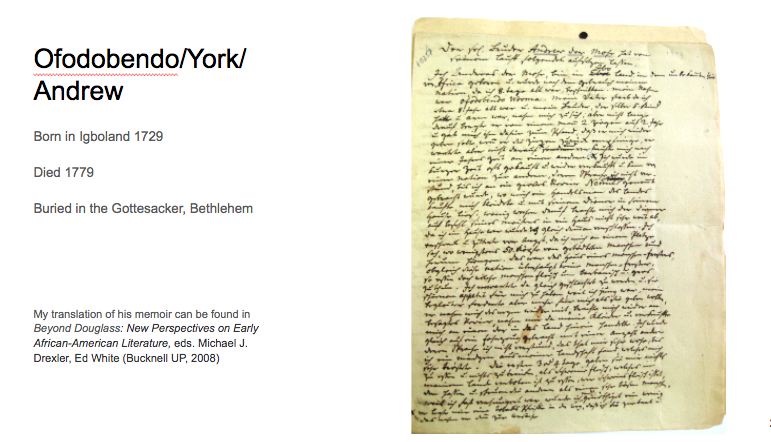
There are two beginnings to this paper. ย One lies in a manuscript memoir I found in the Moravian archives in Bethlehem about 25 years ago that was written by a 20 year old Igbo man who gave his name as Ofodobendo Wooma. ย The first line caught me: โ€œI, Andrew the Moor, was born in Ibo land in the unknown part of Africa and was circumcised according to the custom of my nation when I was eight days old. ย My name was Ofodobendo Wooma.”

Screen Shot 2018-02-07 at 9.10.45 PM

At that time, I carried out extensive research into the history of West Africa, especially Igboland, to try to understand the context into which I could place this unique document. At that time I was also working on the volume that would become โ€œMoravian Womenโ€™s Memoirsโ€ and had already found, transcribed, and translated Magdaleneโ€™s memoir, written/dictated by the woman from West Africa who would become Andrewโ€™s wife in 1762. ย The discovery and subsequent discussion in print of that document invited me into the Atlantic world of the 18th century through African eyes.ย  My article on this memoir and that of Ofodobendoโ€™s later wife, Magdalene, also from West Africa, placed the life writings of these two enslaved Africans firmly within the genre of the slave narrative and traced how Ofodobendo signified (to use Henry Louis Gatesโ€™ term) his life in the tropes of the Christian conversion narrative. ย That interpretive path led me into an examination of that other very famous Igbo life narrative, Olaudah Equiano, the authenticity of which has been most famously challenged by Vincent Carretta. ย Even prior to Carettaโ€™s work, I had noted with interest that the first chapter of that work echoed or actually quoted Anthony Benezetโ€™s description of the coast and inland of West Africa in his widely read abolitionist work. ย Where I wondered had Benezet learned about West Africa? ย From the Africans on the quayside in Philadelphia? ย From his daughters who lived in Bethlehem as members of the Single SIsters Choir and who lived with Magdalene? And as I began to dig deeper it became more and more clear that the networks of the Colonial period between Quakers, Africans, Moravians, were strong and influential.

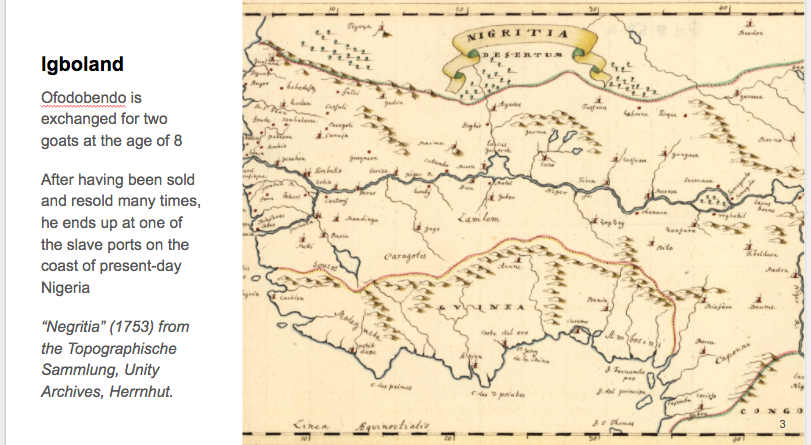
The story of Andrew/York/Ofodobendo Wooma is an exciting find. ย Although the exact date of composition of his memoir is not known, it breaks off after his baptism in 1746, which would mean that he may well have told his life story at the age of 17. ย His childhood memories are still fresh, telling of how, at the age of 8 he was exchanged for two goats by his brother, and then sold and resold many times before he was transported on a slave ship to Antigua, sold to a captain from New York, sold again and then again. At the age of about 12, Ofodobendo–now named โ€œYorkโ€– was purchased by Thomas Noble, a wealthy merchant in New York with whom the Moravians were well acquainted and with whom members of the congregation who were traveling between Europe and North America would stay. ย This is of course the New York of the infamous โ€œSlave Rebellionโ€ and one wonders, when York describes his life running the streets, how many of the enslaved Africans he met. ย However, York is deeply affected by the faith and love of the Moravians in New York City ย and begs to be allowed to go to Bethlehem and be baptized. And then, after numerous entreaties and twists of fate and circumstance, he ends up as the property of Spangenberg in 1746 and is accepted into the congregation in Bethlehem.ย 

Screen Shot 2018-02-07 at 9.16.17 PM

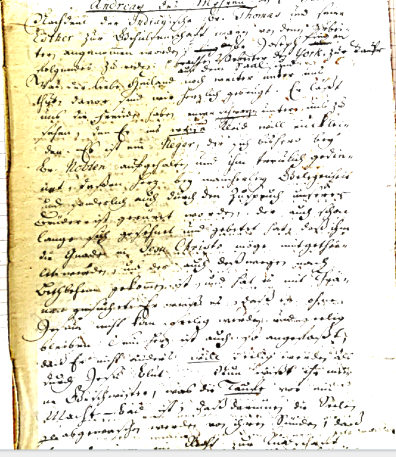
Andrewโ€™s baptism was the first of an African by the Moravians in Pennsylvania. ย The fact of his being the first such fruit meant that a description and indeed transcription of his baptism was sent to Herrnhut. On February 4, 1746, Spangenberg (his owner) opens the ceremony with these words:ย โ€œWas der liebe Heiland noch weiter unter uns thut, davor sind wir herzlich gebeugt. Er lรคsst uns die Freude haben , einen schwarzen unter uns zu sehen, den Er ins weisse Kleid will einkleiden.โ€œ

We are humbly prostrate before the works of the dear Saviour among us. ย He has given us the joy of seeing a Black man among us, whom He wants to dress in white robes.โ€

Spangenberg ย then goes on to ask whether Andrew wishes to be baptized and performs the rite of exorcism and then baptism

Frage:ย Is this yet the Desire of thy Heart to be baptized in the Name of Jesus Christ?

York gab Antwort. Yes.

Frage. ย Wilt thou be saved by that Blood which he has shed on the Cross?

Antwort yes

Frage, wilt thou be ruled by our Saviour and follow his Steps?

Antw. Yes.

Now our blessed Saviour is so gracious and loving to Sinners that whoever will be helpd, and wants to be set free from Satan and all his Power, such a one may be free in the Name of Jesus.

Ges. O Jesu Christ all Praise to thee

Die Gemeine stund auf u. Br. Joseph trat zum Tรคufling und sprach:

In the Name of our Lord and Master Jesus Christ who has purchased thee with his Blood, that thou dost not belong to the Devil and the World. ย But thou art hisโ€™n. In this powโ€™rful Name I command all/// the evil Powers to depart from thee (and leave thy heart to be his Temple and Habitation) and in His name thy Sins are Forgiven unto thee

Why was there such joy to see Andrew, the Black man in the white baptismal robes? Why was this account so carefully transcribed and sent to Herrnhut to Zinzendorf?ย  Most obviously, Andrew’s baptism was a milestone in the success of the Bethlehem congregation in fulfilling its mission to proselytize to the enslaved and indigenous populations of North America. Andrewโ€™s desire to join the Moravian congregation was the direct result of hearing the preachings of Awakened ministers, such as George Whitefield, and lay people in New York. But, as I have argued elsewhere, Andrew may well have had his own reasons for wishing to join the Moravians.

Andrew may well have been the Erstling, but he was not the only African to join the Bethlehem and Nazareth communities.

And here we come to the second beginning of this paper. ย About two years ago I was asked to give an interview to the Moravian Historical Society on Andrew as a new exhibition was being mounted on โ€œOther Voicesโ€ in the Moravian settlements of Bethlehem and Nazareth, and Andrew was to be featured as a representative of the enslaved and free Africans and people of African descent in the colonial period. So I looked into the Moravian Archives again for documents about enslaved people and came across a travel diary by Brother Christian Froehlich which recounted his visit to the “Negroes of Brunswick and Long and Staaten Island in February and March 1752. ”ย 

Screen Shot 2018-02-07 at 9.26.58 PM

The Moravians had a mission not only to the Native Americans of Pennsylvania and New York but also to the enslaved peoples of the mid-Atlantic. ย Prominent in this mission was Christian Froehlich, an itinerant preacher, whose โ€œPlanโ€ it was to visit the enslaved Africans who were living on the Eastern seaboard, from the plantations of Virginiaโ€™s Tobacco Coast up through Maryland, New Jersey, Pennsylvania, and New York. ย In the northern states, many enslaved Africans worked in the forges of Colonial Americaโ€™s ย early iron industry, where the iron ore in the hills was extracted and forged into pig iron for export back to England.

Froehlichโ€™s earlier travel journals of his preaching trips to the enslaved peoples of the mid-Atlantic reveal many things: the frequent antipathy and suspicion in the south towards the very goal of the Moravian itinerant preachers along the Kingโ€™s Waggon Road; the logistical difficulties that needed to be surmounted ; passes that needed to be obtained from the local justices; permission to meet with the enslaved peoples on the plantations or foundries; and fortitude and patience to traverse enormous physical distances, crossing rivers, swamps, and the Chesapeake Bay.ย  These experiences I had already encountered in an earlier 1747 travel diary in which he described his attempt to visit the enslaved peoples on the tobacco plantations on the western shore of the Chesapeake Bay. that had been the focus of a DH class here at Bucknell.

Screen Shot 2018-02-07 at 9.31.03 PM

ย 

Screen Shot 2018-02-07 at 9.33.50 PMThis 1752 document, however, described Froehlichโ€™s visit to the enslaved Africans of New Jersey and New York, a subject that within Moravian studies has hardly been touched at all. ย Where there are studies of race and religion, they are of the South and rarely mention the populations of Africans living in the mid-Atlantic. ย Froehlichโ€™s first stop on his journey is to the โ€œEisen Schmelzeโ€ or iron foundry near Bethlehem, the Durham furnace, owned by Mr Wiliam Allen. He describes his meetings with Africans working in the iron industry. He writes:ย That evening I came to the Iron Forge. It was night. ย I saw one of the Negroes who brought me to the overseer. ย He accepted me in all friendliness. ย He told me that Master Ellen (William Allen) had spoken to him about the Negro Boston and that he wanted to be baptized. He gave him a good report and said he was worthy. He was looking forward to becoming a Christian. Yes, much more than the so-called Christians. ย He could trust them all. He had Boston brought to him. ย He was happy to see me. ย When I told him that he should be baptized he was beside himself. ย After supper, I visited the Negroes in their house. I told them something about the dear Lamb and how much he loved also the hearts of the Black people, and that He had spilt his Blood for them also. ย They were very quiet and attentive and asked me to visit them more and hold an assembly for them. ย They said they were poor Negroes and nobody asked after them much, and about the welfare of their poor souls. I could do nothing but promise them to visit them more often. But I first had to let their masters know. They said they thought their masters would have nothing against it, if they improved themselves, so I commended them to the little Lamb and laid myself happy down to sleep.

From there Froehlich ย travels into New Jersey to several other foundries to speak to the Black iron workers, then on to New York, Long Island, Staaten Island to speak to the enslaved peoples who were owned by the Van der Biltโ€™s and the Van Flecks.

So why was Froehlichโ€™s first stop at the Durham Foundry to discuss the baptism of Baston?ย  I wanted to find out more about this man, so I began to work my way through the baptismal records in the archives for the first 60 years of the community.

According to his memoir and also the baptismal register, Baston or Boston was born in approximately 1715 in Santa Crux, Guinea and was sold at around the age of 13 by his own people to slavers. ย At that age he endured the Middle Passage with about 300 of his people and was brought to Charlestown in South Carolina. ย There, according to his memoir, he was bought by a shipโ€™s captain because of his being so handsome and taken to England the year that George II ascended the throne (1727). ย In 1732 he came back across the Atlantic to Monserrat in the West Indies where he was sold to an American and brought to Durham Furnace in Pennsylvania. ย It was here, as the property of William Allen, that he married Hannah, the property of the Ysselstein family who had just moved to Bethlehem. ย This marriage was difficult not least because Boston could see Hannah only when on the weekend he could walk the eight miles from the furnace to Bethlehem to see Hanna. However they had a son, Daniel. ย Baston was moved by Allen to Maryland to work in a furnace there, but was returned to the Delaware Valley once Allen met Hannah and the child.

So this was the reason Christian Froehlich was visiting the Durham Furnace. ย Baston, having visited Bethlehem several times, wanted to be baptized. ย Froehlich was securing his ownerโ€™s permission for baptism, which then happened on May 16, 1752 a few months after Froehlichโ€™s visit.

Baston is baptized as Joseph and, after the congregation collects 50 pounds to buy him from William Allen, he is able to join his wife in the congregation. ย Hannah and Joseph have seven children, none of whom have children. ย Hannah is bought by the congregation and they require Joseph to pay the interest on the loan for her freedom. ย If he doesnโ€™t she will be returned to the Ysselsteins.

So what about Andrew? At the end of his memoir the choir helper mentions the fact that he likes to speak with his countrymen about being saved. ย What however is not mentioned is that at the synod in Germantown in 1747 Andrew petitioned to be Christian Froehlichโ€™s assistant in his ministry to the Africans of the Delaware Valley. ย In fact, according to the Single Brethrenโ€™s Diary Andrew not only visits the slaves in the iron forges of the Delaware Valley, he also goes to Philadelphia in 1749 where he works as the Spiritual Helper of the Black population there. ย 

What effect might Andrewโ€™s ministry have had on both Baston working in the Durham Forge and the other Africans in Philadelphia? ย According to John Catron, Andrew made numerous trips to Philadelphia between 1748 and 1753, some with either Christian Froehlich or with Brother Boemper and some alone, at times for up to four months. ย His work in the city seems to have had some effect on the Black population. 25 Black men and women appear in the Philadelphia Moravian church registers at that time, only six of whom were enslaved peoples. ย The Black members identify themselves as โ€œIgboโ€, or from โ€œGuineaโ€ or from St Croix.ย 

That Andrew would have attracted Igbo to the church is not surprising as in later records it is shown that he preferred to keep networks of his โ€œLandsleuteโ€ alive and would use Igbo to speak to other Igbo in the Delaware Valley and Philadelphia. ย In fact, in 1762 he asks to leave Bethlehem so that he can go to these countrymen and live.

African-Iron Forges

In the scholarly literature on the colonial mid-Atlantic iron industry it has been claimed that the Underground railroad, that knowledge network of safe places on the road up North to freedom, would frequently pass by iron forges because of the large African labor force that was known to be working there. In 1752, Christian Froehlich makes a point to visit the forges near Bethlehem where the production of iron necessitated large amounts of timber to be felled and a plentiful supply of freshwater close to the source of the iron ore. ย One contemporary visitor to the Durham Furnace where Joseph/Boston is working marvels at how efficient the forge is in production as all necessary raw materials are within a close distance from each other and no lengthy hauling is necessary. ย 

For many historians of the Colonial mid-Atlantic iron industry the presence of enslaved Africans is a passing footnote, mentioned as part of the issues with the lack of a skilled and unskilled labor force to work in the industry. ย However, there is also evidence that the enslaved Africans, such as Joseph/Boston came from West African cultures where the production of iron had been an integral part of the social and economic culture of their societies for centuries. ย Where the production of iron was embedded in the traditional religions of the Igbo people from whom Andrew came, for example. ย There is evidence for iron production in West Africa since the 6th century, with major shrines around Ife to the god of iron โ€œOgunโ€. Within these traditional religions, the forge was considered to be a female space, to be worked only by a male forgemaster, although women were permitted to perform other tasks outside the forge. (http://www.metmuseum.org/toah/hd/iron/hd_iron.htm)

Thus the iron forges of the Delaware Valley were the location of high densities of African enslaved workers, and thus also one of the destinations of Andrew and Froehlich. ย In the scholarship on labor history in Pennsylvania in the colonial period, researchers have pointed out the problems ironmasters had in keeping white workers in the forges. ย Pay, hard work and tough conditions coupled with the distance from urban centers all meant that free labor moved away from iron centers quickly. ย Thus forge owners such as William Allen looked to their enslaved workers to produce iron. ย However, although earlier scholarship assumed that enslaved Africans would be forced to perform the hard and unskilled labor of extracting and preparing the raw materials, more recent research into the Delaware Valley iron industry draws a contrast with the more southerly Chesapeake iron production industry. ย In the Delaware Valley ironmasters trained their African workers to refine and draw iron in their forges, to the point, as John Bezis-Selfa argues โ€œthat slaves were disproportionately represented among forgemen.โ€ (J. Bezis-Selfa, 277) ย The presence of so many highly skilled African forgemen has led to speculation that African metallurgical skills played a large role in this phenomenon. Indeed this is another instance of knowledge transfer from Africa to North America.ย 

ย 

Looking at the map of West Africa again, this time with the identification of sites of iron making, we see the correlation with Andrew and Josephโ€™s origins.

Iron had been worked in West Africa since at least 500 CE and European travellers in Africa such as Mungo Park noted the smiths there used tools and methods similar to those in British North America. ย It is also not lost on me that Bethlehem was to become the site of the largest blast furnaces in the country. ย 

Investigation into Andrew as a paradigmatic figure for the diverse voices in early Bethlehem and Nazareth is a vital step towards asking further questions. ย There is by some the assumption that slaves would only perform menial forced labor, both in the congregation and outside. ย But to claim that is to prolong the prejudiced assumption that Africans could only perform menial tasks and brought with them no skilled knowledge from their homelands. ย That, I argue is an error.

The Helpers Conference minutes show lengthy and in depth discussions about the best way to ensure that EVERY member of the congregation could fulfill Godโ€™s (and the Congregationโ€™s) โ€œPlanโ€ for them. ย Subject to the way in which the Lot decided, like every other member of the Congregation, Africans worked in Bethlehem in the colonial industries, trades, and choir houses. ย BUT they could also become instrument makers and preachers. ย They could hold firearms during times of trouble. ย They were also educated and valued for their national knowledge. Hence Andrewโ€™s โ€œPlan, after baptism, to be Christian Froehlichโ€™s Helper and preach to his โ€œLandsleuteโ€. ย 

ย 

Primary Sources

  • โ€œAndrewโ€, โ€œJosuaโ€ โ€œMagdaleneโ€ โ€œRebeccaโ€ Memoirs, Moravian Archives, Bethlehem
  • Bethlehem Diary, vols, 7, 16, 17, 27, Moravian Archive, Bethlehem
  • Single Brethrenโ€™s Diary, 1744-1752, Moravian Archives, Bethlehem
  • Box marked Slaves, Moravian Archives, Bethlehem
  • Travel Diary, Christian Froehlich, 1752
  • Travel Diary, Christian Froehlich, 1744

ย 

Secondary sources

  • John Bezis-Selfa, โ€œSlavery and the Disciplining of Free Labor in the Colonial Mid-Atlantic Iron Industryโ€ Pennsylvania History 64 (1997) 270-286
  • Arthur Cecil Bining, Pennsylvania Iron Manufacture in the Eighteenth Century (PHMC, 1973)
  • John Catron, โ€œEarly Black-Atlantic Christianity in the Middle Colonies: Social Mobility and Race in Moravian Bethlehemโ€ Pennsylvania History 76.3 (2009), 301-345
  • Katherine Faull, โ€œโ€œSelf-Encounters: Two Eighteenth-Century African Memoirs from Moravian Bethlehemโ€ in Crosscurrents: African-Americans, Africa and Germany in the Modern World, eds. C. Aisha Blackshire-Belay, Leroy Hopkins, and David MacBride (New York: Camden House, 1998), 29-52; reprinted in Michael J. Drexler and Ed White, Beyond Douglass: New Perspectives on Early African-American Literature, Aperรงus: Histories Texts Cultures. Lewisburg: Bucknell University Press, 2008
  • Michael Kennedy, โ€œWorking Agreements: The Use of Sub-Contracting in the Pennsylvania Iron Industry 1725-1789โ€ Pennsylvania History 65.4 (1998), 492-508
  • Anne Kelly Knowles, Mastering Iron: The Struggle to Modernize an American Industry 1800-1868 (University of Chicago Press, 2013)
  • Theodore Kury, โ€œLabor and the Charcoal Iron Industry: The New Jersey-New York Experienceโ€ Material Culture 25:3 (1993), 10-33.
  • Jill Lepore, New York Burning: LIberty, Slavery, and Conspiracy in Eighteenth-Century Manhattan (Random House, 2005)
  • Joseph Levering, A History of Bethlehem, Pennsylvania 1741-1892 (Times Publishing, 1903)
  • Ronald Lewis, โ€œSlavery on Chesapeake Iron Plantations Before the American Revolutionโ€ 59.3 (1974), 242-254
  • Harry Stocker, A History of the Moravian Church in New York City, New York City, 1922
  • John Thornton, A Cultural History of the Atlantic World 1250-1820 (Cambridge UP, 2012)
  • Joseph Walker, โ€œNegro Labor in the Charcoal Iron Industry of Southeastern Pennsylvaniaโ€ The Pennsylvania Magazine of History and Biography 93.4 (1969), 466-486

ย 

Race, Gender and Feelings: Moravian Religious Sentiments in 18th century North American Memoirs

Paper given in November 2021 to mark Professor Wolfgang Breul’s Birthday. A small portion of the results discussed here are published in the Fall 2022 issue of the Journal of Moravian History.

Thank you for invitation to present a paper on the subject of โ€œFromme Gefรผhleโ€ to celebrate Professor Wolfgang Breulโ€™s significant birthday (albeit a year late!) As we share a birth year, I am well aware of the passing of this milestone myself, but am fortunate enough to be about six months older and therefore marked its passing in the company of friends with good food and wine before Covid forced us all into lockdown!

We are here to show our indebtedness to Professor Wolfgang Breul for his lifelong research into aspects of Pietism that were not the norm when he began his academic career. Like him, I am intrigued by the questions of how Pietism, as a religion of the heart both challenged Enlightenment concepts of what it means to be human, whether in terms of reason, writing, and scientific enquiry, and also extended the possibilities of human fulfilment to those denied by the philosophers of reason. Those considered not to be fully human because of their sex and race by thinkers such as Kant and Hume, and who were excluded from arenas of political, educational, cultural and economic agency through the hue of skin, hair type, breadth of forehead, or the possession of a uterus, enjoyed perhaps the liberatory potential of Pietismโ€™s promise of universal salvation through a personal relationship with Christ.

I have devoted much of my professional life to the study of autobiography, gender and race and in particular the genre of the Moravian memoir (Lebenslauf) with its promise to deliver an authentic record of an individual’s life. The custom, introduced by Zinzendorf in the 1750s as a means to bid farewell to the Gemeine, was widely practised throughout the Moravian world and also in the North  American congregations of the 18th century. 

What I would like to briefly discuss today is whether an examination of specific corpora of memoirs undermines or confirms the notion of โ€œemotional communitiesโ€ in the ethnic and cultural groups that made up Colonial and early American congregations. Drawing on a North American corpus, written in German and English by Moravians of European, African, and Native American descent can we detect common emotional responses to recorded life experiences?  In what ways do these North American documents reveal fundamental differences in the execution of the promise of the Moravian memoir when we include historically disenfranchised and minoritised populations? In this preliminary examination, I will be using both analogue and computational methods of reading and analysis of archival documents from the digitized and manuscript collections of the Moravian Archives in both Europe and North America (moravian.bucknell.edu).

Although an enormous corpus (over 65,000) of memoirs exists and is housed primarily in archives in Herrnhut, Germany and Bethlehem, Pennsylvania in the US, but also in smaller less researched collections of documents in many of the Moravian settlements across the world, less than 10% of the material composed between 1750-1850 has been published.  

Over the last 25 years, scholarly interest in the genre of the Moravian โ€œLebenslaufโ€ has been fueled by first the recognition of autobiography as a genre worthy of scrutiny and second by easier physical access to the main repository of the manuscript sources in the Unity Archives in Herrnhut, Germany. Concurrent with this have been changes in conceptual models in social and religious history, and gender/race theory that see such โ€œego-documentsโ€ as valuable primary sources to gain a perspective from the social classes that do not usually have a voice in the writing of history, such as women and men of the artisan classes and marginalized peoples who were enslaved or driven from their lands by settler colonists. One constant focus of the critical gaze has been the question of the degree of expressive and emotional freedom allowed each individual to record authentic and unique reflections on lived experience within the memoir.  Whereas some critics have argued that the very institutional edict to write a self-narration necessarily limits that act in terms of form, formulation, and individuality, others have argued that the Pietistic environment in which these self-relations were created, encouraged, at least in the 18th century, a balance between the demands of the community and the self.  As Peter Vogt has so aptly stated, the Moravian memoir constitutes โ€œa dynamic of reciprocity between individual witness and community identity.โ€ Paul Eakin also discusses such reciprocity in the narration of the self and argues that without a story there is no self, and, in the age of the digital, this self is โ€œnot only reported but performed, certainly by any of us as we tell or write stories of our lives, and perhaps to a surprising degree by the rest of us as we listen to them or read them.โ€ (Eakin 2014, 24)

So how does this dialectic between the demands of the individual and the community play itself out in the North American memoir in light of promises of liberty in both the US Declaration of Independence and formalized in the motto adopted by the US Moravian Church, ‘In essentials, unity; in non-essentials, liberty; and in all things, love’? The origin of the motto is thought to have come from the 16th-century thinker, Peter Meiderlin, who apparently adopted it from an earlier Catholic bishop, Marc Antonio de Dominis (1560-1624) himself embroiled in the vibrant disputes of the Reformation and Counter-Reformation. It is thus a motto that is not exclusive to the Moravian Church but is rather entwined in the confessional and denominational conflicts of the 16th and 17th centuries, and, according to Craig Atwood, it is a motto also used by other religious groups, such as the Quakers and Evangelical Presbyterians. It is clearly then not a motto that the 18th-century Moravians would have known, either in North America or in Europe. Considered an attempt to transcend sectarian differences, this dictum was first cited in a Moravian context by Augustus Schulze, a professor at Moravian Theological Seminary in 1902 and was then quickly adopted by the American Moravians, with its obvious echoes of the language and intent of foundational documents of the United States. Despite this external origin, the motto serves as a useful summary of the ethics of the Moravian Church in America: e pluribus unum.

Mottos serve as an externally and internally directed signifier. To outsiders of a group, they signal important beliefs held by the insiders, To the insiders, they act as a reminder of the way in which they live, acting as a kind of shorthand to identity, a glue. Scholars of Moravian history, when analyzing the identity and modes of cohesion of the Moravian Church, draw heavily on Benedict Andersonโ€™s crucial work, โ€œImagined Communitiesโ€ (1983). For example, in her foundational study of the โ€œHerrnhuter Brรผdergemeineโ€ as a global community, Gisela Mettele (2009) employs Andersonโ€™s concept of the necessity of โ€œsimultaneityโ€ and โ€œcommunicationโ€ (highly appropriate for todayโ€™s Zoom environment) coupled with the importance of language (German) to construct an intellectually satisfying picture of the Moravian Church as an entity that could thrive in the realization of its motto โ€œIn essentials unity, in non-essentials, liberty and in all things loveโ€. Similarly, Peter Vogt, in his essay, โ€œEverywhere at homeโ€ (2006) outlines the pillars on which the transatlantic Moravian Church founded its work.  For Vogt, these consist in 1) strong leadership, 2) an effective network of communication, and 3) a uniform system of belief and worship. Vogtโ€™s essay outlines clearly those aspects that he considers most important for such unity in belief and worship.

If we think of a unifying force within the Moravian Church, let us take as an example, the terminology of Moravian identity. How many of us Moravian scholars have had to include a glossary of terms in any monograph on or edition of Moravian materials? What to Moravians and non-Moravians who have immersed themselves in this history may not need explanation is quite baffling to outsiders. What is a Lovefeast? A Choir? A Singstunde? A Pedilavium? A Sickwaiter? This specialized terminology which exists in German, English, and many of the other languages of the people of the Church, provides, as Vogt argues, โ€œthe connectedness between the members of the community in terms of fraternal kinship tiesโ€ (Vogt 2006, 18): a kinship based not on blood ties but on a shared vocabulary of faith. Vogt argues that the very concept of the โ€œGemeineโ€ โ€œimplies the awareness and the concrete experience of being connected to fellow believersโ€ (19).

The organization of the Moravian Church was first held together (argues Vogt) by the charismatic personality of its founder, Count Zinzendorf and after his death the Unity Elders Conference saw the organization of the Gemeine as providing a strong and universally recognizable structure within which members could continue to feel connected globally. This โ€œhomogeneityโ€, Vogt continues, was also present in the unity of worship and faith. The Singstunde in Salem is the same as the Singstunde in Herrnhut, or Neu Herrnhut in Greenland or Australia, or the Singing Hour in Fulneck, Yorkshire. Coupled with this uniformity of ritual structure is the fact of its communication to all other places in the Moravian world through the Gemeinnachrichten or its successor publications. Extracts from mission reports, memoirs deemed of universal interest, diaries, letters were sent out to the Moravian congregations around the globe. These same reports were read out loud to the congregations, if not completely simultaneously to the hour, but on the same Sunday at the monthly Gemeintag (Vogt 24: Mettele, 145-7). In this way, Onondago and Lenape peoples in Central Pennsylvania could hear about the mission to the Inuit in Greenland; a young Friedrich Schleiermacher in Barby could learn about Heckewelderโ€™s travels through Ohio and up to Detroit; and Anna Anders in Bethlehem could hear about the life of the child, Peter West, born in London in 1751 and who was buried in Fulneck in 1760, in the Gottesacker where Anna herself would be buried in 1803. This unifying ritualistic action of writing, reading, and listening to the lives and actions of others provides, according to Vogt and Mettele, the stability and unifying strength of the expanding Moravian Church across the globe.

But what about that other tenet of the North American Moravian motto, โ€œin non-essentials, libertyโ€? What are such non-essentials, and how did liberty manifest itself in the lives of the Moravians? To return to the 18th century: in the light of the origins of this motto, it is clear that the notions of โ€œessentialsโ€ as outlined by Peter Vogt and Gisela Mettele can be agreed upon. But, in an era prior to the political revolutions of the late 18th century, we must remember that โ€œlibertyโ€ or โ€œlibertasโ€/Freiheit occurred in more of a confessional realm than political. So how might this motto apply to the memoirs from this early period? Critics, such as Gisela Mettele, Stepahnie BรถรŸ, Christine Lost (and myself) have argued for the importance of the Moravian memoir as a social and theological practice within the church. Mettleโ€™s examination of the memoirs that were circulated in the Gemeinnachrichten and later published in the Nachrichten aus der Brรผdergemeine argues for the importance of the uniformity of the published lives to show โ€œsimultus iustus et peccatorโ€, the publicly communicated salvific history of the individual as sinner and redeemed. Thus, the individual differences in terms of details of where s/he was born, into which social class s/he was born, which language s/he spoke could all be considered insignificant in comparison with the essential consciousness of oneโ€™s need for salvation. This last point is especially bewildering to those of us in the 21st century when we read autobiographical documents by enslaved peoples or those whose lands were occupied by settler colonists. The commonality with white Moravians consists in the โ€œslavery to sinโ€ and not in the question of being enslaved or dispossessed and colonized. Within the language and symbology of the Moravian church, there might be a place where some form of liberty has been exercised. I would agree with Peter Vogt about the role of ritual in cementing the far-flung communities together. However, as we have seen from recent work by Rachel Wheeler and Sarah Eylerly, Moravian hymns still are expressions of faith whether they are sung in Mohican, Delaware, German or English.  But when it comes to the composition of a memoir, there is inherent within that very act the tension between the individual life and the universal pattern of salvation.

The worldwide reach of the Moravian church means that Moravian archives preserve some of the earliest โ€˜ego documentsโ€™ produced by eighteenth-century Africans and Native Americans. And archiving these documents has fulfilled a twofold purpose; that is storing and ordering them in the institutional archival memory of the Church and also, for those who access this archival memory, as a locus of presence and interactivity in the lived memory of the Church. (Haskin 2007, 401) As noted above, the relation of the lives of exemplary believers, as Peter Vogt argues, helped to create โ€œa tangible impression of the invisible church community.โ€ (Vogt 2017, 39) In an examination of several centuriesโ€™ worth of Lebenslรคufe from the Herrnhut archives, Christine Lost describes the communicative structure of Moravian experience. (Lost 2007; Mettele 2009) as both inwardly and outwardly directed; that is, it serves as a means of self-examination for the writing โ€œIโ€, as well as participating in the construction of a communal identity. This dialectic of individual/community (that so influenced Friedrich Schleiermacherโ€™s concept of religious consciousness and ethical action) reflects very much Zinzendorfโ€™s own understanding of the function of the Lebenslauf. The relation of oneโ€™s life within this community serves as an act of witness and testimony to the invisible host of those who had gone before and who were still to come.  Additionally, the intersection of religion, cultural and personal memory, (Jan Assmann 2008) introduces a narrative tension into the writing oneโ€™s memoir, as the author balances demands of a personal desire to belong to a social group with the lived realities of one life. 

And maybe we also need to ask, to what extent can there be liberty, what might it look like, and what role does this balancing act play in creating the โ€œuniversal historyโ€™ of the church, as Zinzendorf envisioned it. What happens when the authors of those self-relations belong to otherwise disenfranchised groups within the 18th century; groups such as the enslaved peoples of Africa, the freed and formerly enslaved, the Christianized indigenous peoples from the Moravian mission movement, and women? In what way can the Moravian memoir act as an โ€œauthentic relation of the selfโ€ and not instead represent the acquisition of a new argot that signals membership in a new group?

The development of tools in the field of digital humanities affords researchers a way of not only approaching these questions but also of thinking in new ways about how to conceptualize notions of self, narrative, and language. Corpora of memoirs have already been constructed by researchers interested in demographics, religious community, missions, and memoirs in Moravian history (see, for example, Smaby 1988, Mettele 2009, BรถรŸ 2016, Lost 2007, van Gent 2012, and Faull 1997 and 2017). The development of digital tools in text analysis, such as Voyant and Antconc, permits the investigation of large corpora in search of topic models, keywords, lexical โ€œkeynessโ€ in comparison to non-Moravian corpora.  Looking for meaningful patterns in the exercise of distant reading transforms digital tools into integral parts of the process of understanding the study of Christianity.  Furthermore, extracting tagged entities from marked-up texts leads to the possibility of both network visualization and geospatial analysis, allowing such work to expand and ask new questions and find new answers. In many ways, re-enacting the archival drive of the Moravians in the 18th century, the methods of DH permit analyses of both the metadata and the text of large amounts of information that allows the other function of memoir to be fulfilled, the function of lived memory in which the archived materials of the past may become present and interact with others. (Haskin 401) 

The Moravian Lives project is aimed at realizing the potential of DH approaches to opening up the memoir corpus, namely through the construction of a searchable database of the memoir metadata of all the holdings in the main archives of the Moravian Church in Bethlehem, PA and Herrnhut, Germany, and also linking the metadata visualizations with the facsimile and transcribed memoirs and their extracted named entities. 

The Moravian Lives platform provides a means of accessing and analysing corpora with specific parameters of time period, geographical location, gender. As digitized memoirs in the Bethlehem archives have been linked to the search interface, we can access the memoirs of Native American and African American members of the Congregation, members such as Peter and Mary Titus. 

For example, if we search for Mary Titus in the map interface we find the record exists and is linked to the digitized original. The transcription has also been completed, and thus we have access to a digital text

Slide 15

Similarly, if we search for her husband, Peter Titus, we find his memoir on the transcription desk, and it has already been transcribed and also Andrewโ€™s memoir which I have published and discussed previously. 

Much work is to be done on the topic of what I have termed โ€œBlack Bethlehemโ€ but we have been able to digitize the memoirs I have been able to locate so far in a collection on the Moravian Lives transcription desk. Being able to make collections of memoirs allows us to create โ€œcorporaโ€ or bodies of text on which we can perform computational or algorithmic readings in an attempt to describe and analyse possible patterns of normative expressions. 

 As Jacqueline van Gent has argued in the context of Moravian ego-documents, the expression of emotion in textual sources (letters, memoirs etc) does not necessarily allow us to know what emotion a subject was feeling at the time of composition.  Rather, salient emotions reported in these sources adhere to the language rules and expectations of a linguistic (and emotional) community.  In the context of the memoirs of enslaved peoples (Andrew and Magdalene), converted non-European peoples can adopt the emotional vocabulary of the Moravians in order to display their membership in the group.  The question as to the authenticity of those emotions is a much harder one to answer. However,  as mentioned above, as one part of the unity of the Moravian motto, the โ€œnormsโ€ of Moravian language adhere to expectations for norms that are set through specific practices (praxes within the Moravian congregations).

Results for key terms from Bethlehem’s English language memoirs
Results from African-descended men’s memoirs in Bethlehem

Furthermore, if there are limits to the authenticity of expression, especially within marginalized groups, then can linguistic expression reveal something about our subconscious states? Given the limitations expressed above as to the use of conscious selection of vocabulary, psychologist James Pennebakerโ€™s methodology provides a multidimensional lens to analyse language that relies not on the โ€œcontent wordsโ€ of what we say but on the โ€œfunction wordsโ€ or stop words, often stripped out of a text when using distant reading techniques, such as Voyant or Antconc.  These function words–the articles, prepositions, pronouns, negations, auxiliary verbs, conjunctions, quantifiers, common adverbs–are those parts of speech that we use unconsciously; they are used at very high rates, they are short and hard to detect, they are processed in a different part of the brain than content words, and they are very social. So can this method overcome the problems I outlined above with other computational (and non-computational) methods in the analysis of Moravian memoirs?  Can we access subconscious psychological states through the application of Pennebakerโ€™s methods? Running the corpus through the LIWC software we find: (results here)

Looking at this corpus, Women in Bethlehem Archive (German): there is a significant difference between memoirs by White American women and Native American in terms of positive emotions (including terms such as love, sweet, nice). However, the NegEmo measure (anxiety, sadness, hostility) shows not much variance. Maybe the absence of positive emotion does not necessarily mean that there is a presence of negative emotion. Of the womenโ€™s memoirs from Bethlehem that are in English, we find much more variation in the Authenticity measure — Burger, Baker, Powell, Quitt all show distinctly higher values.  Of the men from the Bethlehem Archive who are writing in German, the lowest PosEmo scores in the corpus include Andrewโ€™s memoir.  However, one of the highest PosEmo scores belongs to Peter Titus.  Andrewโ€™s memoir scores among the highest for NegEmo. Of the men in Bethlehem who write in English there is hardly any variation in PosEmo or NegEmo scores. 

 Moving now to a small corpus of 12 memoirs by Native Americans, how do these subconscious โ€œscoresโ€ look? As we know, such texts are very hard to find in the archives. Often the biographical information is hidden behind Europeanized names or racialized monikers, and of this corpus 20 are written in the third person and two in the first person. However, even within the third-person memoirs, we find direct quotations from the speaking or interviewed subject. Running the texts through LIWC we find among the Native American authors that the highest score for โ€œangerโ€ and โ€œnegative emotionโ€ is found in โ€œMichaelโ€™s memoir (it can be found on the BDHP website). 

Michael (we do not have a record of his Native name) came from the Minnisink people and was baptized in Shekomeko by Brother Bรผttner. Described as a โ€œgreat warriorโ€ in his memoir, his bravery was depicted on his face in a series of tattoos: a snake, scalps on a pole, two crossed spears and a boar. The Choir Helper of the Single Brethren who records the memoir says โ€œall of it was done very neatly.โ€ Michael, according to the text, refuses to consider the proposed relocation of Christianized Native Americans to the Wyoming Valley. During the French and Indian war, he bolsters up the spirits of the Single Brethren (who were posted on the fences around the Bethlehem settlement) and urges them not to be afraid but rather says, “If you are in good stead with the Savior, you would not be so nervous.  Your bad hearts are responsible for your anxiety.” Michael is considered the โ€œcrown of all our baptized in this part of the world, because his holiness progressed after his baptism without many changes and transformations.โ€ So we need to ask ourselves where does the negative emotion and anger come from that reveals itself in the use of function words in Michaelโ€™s memoir? His resistance to being moved out of Bethlehem? His bravery? His choice to become Christianized? 

Or we might look at why the memoir of โ€œIsaac,โ€ a young Mahican/Wampanoag man who died at the age of 18 having been baptized at the age of 11 scores so low for โ€œauthenticity?โ€. His mother and father had both been baptized by the Moravians. By 14 he had lost both his mother and father to smallpox and fever and was taken in by friends who moved with him first to the Wyoming Valley and then to the Moravian mission of Gnadenhรผtten. He escaped to Bethlehem after the attack on the mission in November 1755 and was taken into the Single Brethrenโ€™s house where he died the following year of consumption. On his deathbed, the choir helper notes, โ€œAt his request a number of little hymn verses in Indian were sung to him by the Indians present.  Shortly before his departure Br. Schmick asked him if he felt Jesusโ€™ Blood in his heart and would gladly go home. To which he responded; โ€œQuame,โ€ that is, โ€œYes.โ€  After that he stretched himself out, laid his hands on his breast and went to sleep for a while.โ€  What I find so interesting in this description is the language in which the verses are sung and that his last words are recorded in Wampanoag.

Conclusion

If we return to the nature of the practice of unity and liberty within the Moravian Church of the 18th century, can we perhaps test those claims by examining the recorded lives of those who belong to non-European groups, especially women? I have tried to show in this brief talk first, the main ways in which scholars have tried to understand the creation of unity within the Moravian Church of the 18th century, through neologisms, specific linguistic tropes, ritual, and simultaneous communication. Then, I examined one of the main means to create unity, that is the writing of a memoir, that definitely follows a specific narrative and emotional pattern which is composed to be read to others. Beyond reading individual memoirs out of primarily genealogical interest or for the subjectโ€™s perceived exemplary significance to the movement, studying the large corpus of Moravian memoirs is only possible if they are published. The Moravian Lives digital project aims to make available through the publishing of the original archival document and its transcription thousands of memoirs. By creating a digital text we make these sources available to scholars to test the claims of universality, of liberty, of unity and love. We make available the lives of those whose very chances at liberty or life at the birth of the United States was not guaranteed and who are indeed still fighting to โ€œbecome Americanโ€.

The Hidden Work of Moravian Wives

The Hidden Work of Moravian Wives:

A Conversation with Anna Nitschmann, Eva Spangenberg, Martha Spangenberg, and Erdmuth von Zinzendorf

Moravian Archives, Bethlehem

February 13, 2018


Katherine Faull, Bucknell University


Introduction

Thank you for the invitation to talk this evening on the subject of Moravian womenโ€™s work and how it has been โ€œhiddenโ€ in the records and from the eye of those who study labor history. I am going to talk tonight about the concept of โ€œlaborโ€ in the colonial period of the Moravian Church, with a special focus on where womenโ€™s work was deemed to occur, how it was described and valued, and how in the historiography of the church this work has been described. I am going to look at the role that female leaders of the church played in defining what constitutes work in the church and how that contribution was later obscured.

The notion of concealed labor or hidden work is nothing new to scholars of gender and race where in the historiography of knowledge making and invention, the work of women and minorities has been regularly elided. One only needs to look at the history of discoveries in the field of science to repeatedly come across the trope/meme of the white male scientist working with a lab team that is remarkably male and white in a Nobel Prize winning discovery. See, for example, the discovery of the structure of DNA at the Cavendish laboratories at Cambridge University in 1953, credited to James Watson and Frances Crick which in their own relations of the discovery, hid the contributions of Rosalind Franklinโ€™s earlier research into the crystallography . Or the case of the discovery of the Epstein-Barr virus that can lead to lymphoma also leaps to mind, where the hours of work done by both microbiologist Yvonne Barr and Trinidadian electron microscopist Burt Achong in the laboratory also go without recognition.

Within Moravian historiography the contributions of Zinzendorfโ€™s first wife, Erdmuthe Dorothea, have certainly been recognized, probably a product of her class position coming from the nobility. Her contribution to the history of Pietism is investigated in the thoroughly researched, if dated, work of Wilhelm Jannasch. This 1915 biography of the Countess tells the story of her life, marriage with Zinzendorf, her mostly hands off approach to the establishment of the early Gemeine, her willingness for numbers of the Moravian exiles to be employed in her household, her gradual assumption of a working role in the leadership of the congregation, her growing role in the financial management of the church, her assumption of fiscal leadership during the time of Zinzendorfโ€™s exile from Saxony, her assumption of leadership during his time in America, with the travels to London, Denmark, and the Baltic states and then her withdrawal, as Jannasch terms it, upon his return and the ascension of Anna Nitschmann to the role of โ€œMutterโ€ in the church. etc. Although Jannaschโ€™s work has been more recently supplemented by the appearance of Erika Geigerโ€™s short volume (translated by Julie Tomberlin Weber) it is heavily derivative of the earlier work.

Of far more significance to the revised appraisal of the Countessโ€™s work is the scholarly focus on the correspondence networks and the importance of the Reuss family that is being carried out in the University of Jena by Martin Prell; and also the research being carried out on the Countessโ€™ and Benigna von Wattevilleโ€™s correspondence, performed by Marita Gruner at the University of Greifswald.

Erdmuthe von Zinzendorfโ€™s willingness to open her household to the members of the fledgling community directly benefited the three other leading women of the early Church I am discussing today. Best known is her support of Anna Nitschmann, who was employed in the Zinzendorf household as a servant and errand girl and then as companion to Benigna von Zinzendorf with whom she later travelled to America. At the same time as Anna Nitschmann is in the Berthelsdorf household, both of Spangenbergโ€™s future wives are also in the fledgling Herrnhut community. Eva Immig, as she was then, was already widowed, was employed as nursemaid to Christian Renatus, and was counted among the first โ€œLaboressesโ€ of the community among the widows. Like Anna, Martha Spangenberg (or Miksch as she was then) came into the service of the Zinzendorf family in 1727. It is interesting to imagine all four of these leading women in the Moravian church living and /or working under one roof in the late 1720s.

As I have outlined in several of my other lectures in Bethlehem last year, evidence of Anna Nitschmannโ€™s work was, after 1760, deliberately hidden by destroying records that pertained to her central role in the leadership and development of the church. Annaโ€™s work consisted of both labor in a material and spiritual sense.

In a series of miniatures, presented to Anna to celebrate her 30 years as Eldress to the Gemeine, Anna is depicted as spinning while also receiving the visitation of several leading male theologians of the time. As I discussed in my Zug lecture, this trope is significant as a representation of the intersection of both material and spiritual realms of work. The image of Anna receiving the two prominent churchmen at the spinning wheel and in front of the floor loom encapsulates the idea, promoted by Zinzendorf, that the choir houses were the workshops of the divine. In the SS choir houses the spinning and weaving of cloth were two of the most prevalent economic and artisanal activities. I would also argue that in addition to producing vital goods (and income) for the Gemeine and the Choir, spinning and weaving as traditional tropes of womenโ€™s wisdom, also were imbued with spiritual worth.

Is this idea put into practice within the congregation? Let us turn to Spangenbergโ€™s first wife, Eva Maria. Maria, as she known within the Gemeine, had been born in Dresden and married her first husband Dr. Christoph Immig, a lawyer, before coming to Herrnhut in 1727. They had two children, one of whom โ€œwent astrayโ€ and the other died. Eva Maria was one of the first 12 Laborers in the new community and then became the nursemaid to Zinzendorfโ€™s son, Christian Renatus. When her first husband died at the age of 77, Eva Maria became the Pflegerin of the Widows Choir for 12 years. During Zinzendorfโ€™s exile Saxony she became the Vorsteherin of the whole Gemeine, assisting Martin Dober for two years. In 1739, she left Herrnhut and went to Wetteravia, where she married Spangenberg in 1740.

Alongside Spangenberg, she was central to the foundation of the Moravian congregations in London and Yorkshire, and worked extensively in England and then in America where she was General-ร„ltestin from 1744-1749. According to her memoir, which was written by Spangenberg, she was much loved among the mission populations in America, and in the mission diaries and travel journals, Spangenberg is repeatedly asked by members of the Iroquois and Delaware nations alike, where his wife is and how she is doing. When Eva Maria and Spangenberg left Bethlehem in October 1749, the Brothers and Sisters bathed the streets in tears (to quote from her Ll). Eva Maria died in 1751 in Herrnhuth. Before she died, her lost child, the daughter, came back to her and tended to her in her final illness. She was in her 55th year.

So what would have made Eva Maria so beloved to the Bethlehem congregation (although there are signs that this was perhaps not such a universal emotion)?

The Spangenbergs arrived in America in October 1744 and came straight to Bethlehem. Anna Nitschmann had left at the turn of year 1742-3, so the memory of her work at the Forks of the Delaware was still strong, and had been regularly kept alive by the reading of her letters from London and Yorkshire. According to the Bethlehem Diary for 1744, Eva Maria immediately travels to Shekomecko (following in the footsteps of Anna) and celebrates a Love feast with the mission workers (the Bรผttners and Macks) with rolls and chocolate (which we presume she had brought with her from Bethlehem/New York). Upon her return to Bethlehem on December 2, Eva Maria conducts her first Married Sisters ยผ hour service, and then a blessing for pregnant sisters and nursing sisters, and finally a ยผ hour service for the German and English sisters in Bethlehem. Eva Mariaโ€™s work also includes conducting the Speakings for the sisters (of all marital statusโ€™), leading Lovefeasts for the children, married sisters, and widows.

All of this is quite expected for a woman leader in the Moravian church at that time. However, Maria also conducts Lovefeasts for specific groups of women workers. Sisters who work in the laundry, or who spin, or weave, or knit, or sew also have a lovefeast dedicated to them respectively, and this appears to have been Mariaโ€™s own idea. In Oerterโ€™s translation of the 1745 diary he states, โ€œMary made some orders and regulations for the Sisters spinning wool, cotton, flax and tow.โ€ (Jan. 4 1745) At these lovefeasts for the different forms of womenโ€™s work, Maria apparently speaks so powerfully that the Sistersโ€™ production is significantly increased (for example, on January 29 1745 50 sisters at a spinners lovefeast produced record amounts of yarn and also volunteered to strip feathers for the beds of the newborn).

Putting to one side the resonant echoes of Ernst Troeltsch and Max Weberโ€™s appraisal of the Moravians economic activity, (Protestant Ethic and the Spirit of Capitalism) for one moment, I would like to think about the spiritualization of womenโ€™s work not in terms of how to produce more for the community but as a foregrounding of the work that the SIsters did. This work, noted in the Diary, is seen as a form of โ€œGottesdienstโ€, a service to God and is valued as essential to the mission of the whole community as spiritual work as well as encouraging the ethic of production.

Does this concept of womenโ€™s work operate outside the choirhouses? What effect does it have on the missions, for example? I would now like to draw on the manuscript material that informs my work on the Shamokin mission diary. Shamokin, on the forks of the Susquehanna River, was a strategically important point for Native Americans, colonial agents and traders, and Moravians alike. Zinzendorf, Anna Nitschmann, Benigna, and Spangenberg had all visited this place, not least to foster a relationship with Shikellamy, the vice-regent of the Six Nations.

In a conference held at the confluence of the North and West Branches of the Susquehanna River in August 1747, the Moravian married couples, Nathaniel and Anna Hagen and Anton and Catharine Schmidt sat down to discuss how the blacksmith’s shop that was to be established there was to be run. The first article on the agenda that had been drawn up by Spangenberg was the stipulation that “When the Indians bring something for our Sisters to sew, they will accept it with thanks, and willingness and require nothing as payment.”FOOTNOTE: Footnote Five months later, when they were joined by the married couple Joseph and Martha Powell, this same topic appeared as the first item of business in their conference. The Sisters were to accept sewing from the Indians and require nothing in return.

While this might seem like a small incidental detail in the larger artisan economy of the Pennsylvania Backcountry, I would argue that the work and skills of the Moravian Married Sisters who came with their husbands to the “frontier” country of Pennsylvania in the first half of the eighteenth century were central to the Moravian and Native American understanding of how an exchange of services and goods, whether it be sewing, blacksmithing, shoe or mocassin making, grinding corn and baking could take place. The Married Sistersโ€™ participation in an artisan economy both extends the previous notion of โ€œwomenโ€™s workโ€ that I have outlined and also challenges the long held notion that women’s role in this early settlement period was primarily as part of the “household economy,” in which women were employed in the raising of crops, production of food and clothing, within an autarkic economy of the settlersโ€™ log home.

Because of the Moravian notion of the โ€œmarriage militant,โ€ many of these Brothers took their Sisters (wives) with them into the mission field to work with the female indigenous populations . ย However, the Moravian mission in Shamokin, Pennsylvania (1747-55) was not set up as a mission village but rather as a blacksmithโ€™s shop to serve the Iroquois and their protected tribes, the Delaware, Tutelo, Conoy, and Shawnee. The Moravian smithy at Shamokin was established because of its usefulness to the Six Nations, and, as such, its existence at the confluence of the North and West Branches of the Susquehanna River, the intersection of eleven Indian paths, offers an interesting and anomalous microstudy of the artisan in the backcountry.

Shikellamy was quite explicit in his expectations of how the smithy would be run. In a slightly earlier conference with Brother Martin Mack in April of 1747 held at Shamokin, the Oneida chief and emissary of the Five Nations, stipulated that the work done at the smith for the Five Nations should be done for free when the Iroquois are travelling down river to war with the Catawba. He stated explicitly, “I desire, T’girketonti (Spangenberg’s Iroquois name) my brother, that when something is done to their flints that it is done for free, because they have nothing with which to pay. However, when they return, and they have something done, then they would have to pay for it.”FOOTNOTE: Footnote

In August 1747, at the conference held at Shamokin to set down the conditions of the establishment of the smithy there Spangenberg prescribed that the Moravians were to maintain themselves there “auf Indianisch Art.”ย  That meant that only the Three Sisters (beans, corn, squash) could be planted, no wheat, rye, or oats, and nothing that would make the place seem like a European plantation. All accounts were to be held by Brother Hagen or Joseph Powell; the blacksmith Anton Schmidt had to meet with him at the end of every day and go through the transactions of the day. The price of services had to be set so that one Indian does not get charged more than another, and the accounts were then sent on to the Sozietรคt fรผr die Heyden (the Society for the Heathen), that paid for the blacksmith’s supplies.

At the Confluence, there was also the presence and agency of the Moravian sisters. In the literature on Moravian artisans and missionaries there is plenty of discussion of the role the men played in the development of settlements, a rural economy that goes beyond that of exchange, but almost no mention of what their wives were doing, what kind of work did they have and did it contribute to this rural economy? While the literature on Moravian missions is large, the multiple challenges and opportunities for cross-cultural trade and knowledge transfer that the Moravian sisters enjoyed, has only recently become the focus of study for historians such as Jane Merritt, Amy Schutt, Gunlรถg Fur, Rachel Wheeler, and Alison Duncan Hirsch.FOOTNOTE: Footnote In the Shamokin Diary we find evidence of Native, mรฉtis and Euro American womenโ€™s involvement in trade, care, and mission on an intimate level. Despite the dearth of official records of womenโ€™s activities, speech, and agency, from mission diaries we are able to delineate womenโ€™s experience as moving beyond the traditional notion of them as refugees for financial, religious, or ethnic reasons or as silent companions of fathers, husbands, masters, or maybe brothers. In Merrittโ€™s discussions of Anna Mack, Anna Smith, and Rowena McClintonโ€™s studies of Moravian womenโ€™s mission to the Cherokee women, and Alison Duncan Hirschโ€™s study of some of the women around the Susquehanna Confluence, the discussion focuses on women and cross-cultural communication, the inter-relation of religious concepts, notions of gender, and medical and pastoral concepts of the body.

Based on evidence from the Moravian mission diary from Shamokin I argue that there existed an artisan economy of sorts in which the skills of both the brothers and the sisters were sought after and exchanged with the Native American and Euro-American population. From the archival records, it is clear that the Married Sisters participated in an exchange economy, where sewing skills, for example, were vital in order to receive gifts of food and medicine from the local Native population. Married Sisters were central to the mission both because of their knowledge of Native American languages, their ability to communicate with the Native women around the blacksmith’s shop, and also because of their own artisanal skills, such as sewing and baking. These skills brought them into an economy of trade and also knowledge.

So how might this relate to the lovefeasts for the knitters, spinners, weavers, and launderers? In her 1995 book on artisans on the North Carolina backcountry, Johanna Miller Lewis argues (somewhat controversially) that women who practiced traditionally female skills such as spinning, sewing, weaving, or knitting for profit commonly have not been classified as artisans by historians.โ€FOOTNOTE: Footnote Miller Lewis ascribes this to the fact that women did not receive the same training as male artisans, and if they did, it was within the home, invisible to the historical record of craftsmenโ€™s books, journeymenโ€™s passes, and guild records. Furthermore, many historians considered womenโ€™s artisanal skills as โ€œmerelyโ€ part of the housewifeโ€™s duties and therefore not an income-generating skill. However, recent studies of rural populations in, for example, Ireland during the Great Potato Famine, have shown that womenโ€™s skills were central to the survival of rural populations in times of crisis and famine (Irish famine and women lace makers, for example).ย  Challenging the dominant notion of the โ€œhousehold economyโ€ that has held sway over early modern economic history and its autarkic self-sufficiency, Miller Lewis argues for a more nuanced understanding of womenโ€™s participation in a backcountry economy where their skills in textile production and repair was also key to the survival of the family and also the community.FOOTNOTE: Footnote I would like to argue that what is presented as a paradigm for womenโ€™s work in the image of Anna Nitschmann spinning as she receives the eminent theologians, and in Mariaโ€™s institution of lovefeasts celebrating the work of women, provided many of the Married Sisters at Shamokin (and elsewhere) with precisely the model of work as Gottesdienst that women outside the Moravian church might have received within the household economy. The difference in the Moravian training was that womenโ€™s artisanal skills were taught not for the benefit of a more nuclear โ€œhousehold,โ€ but rather for the larger โ€œoikosโ€ of the mission settlement; and, as such, these skills were both a form of womenโ€™s spiritual knowledge and income generating.

So, how crucial were the women’s contributions to this artisan economy? Did the sewing, the baking, the interpreting and negotiating help the mission in Shamokin?

Towards the end of the existence of the mission at Shamokin, the picture of the place has changed. The Moravians now have livestock, cows and calves, and are thinking about getting a bull. A new mission house has been built further from the river and closer to a spring. Letters between Shamokin and Bethlehem talk of the need for sugar and tea (for the Moravian Lovefeasts), of wine and bread for communion; new trousers and shirts; the skins received in payment (racoon and deer) are being transported back to Bethlehem through intermediaries, such as Michael Schรคffer, a shoemaker who lives 5 miles down the Tulpehocken Path.

The Married Sisters have gone. The mission has become a plantation, it services the flints of the traders and white settlers and its original purpose has been lost. Spangenberg wonders if they shouldn’t just shut up shop, sell the house and its contents that are no longer needed to Conrad Weiser, slaughter the livestock and sell the meat.

The end of the Shamokin mission almost coincides with the arrival of Martha Spangenberg in America. In the little literature that exists on her, scholars such as Beverly Smaby and Hartmut Lehmann concur that she understood โ€œwomenโ€™s workโ€ in a very different manner than her husbandโ€™s first wife. Where Eva Maria was seen as a leader, much after the model of Anna Nitschmann and Erdmuthe von Zinzendorf, Martha is described as quiet and staying in Spangenbergโ€™s shadow.

Martha Elisabeth Spangenberg was born in 1708 in Berthelsdorf and came into the service of Benigna von Zinzendorf 1727. In 1730 she married Mattheus Miksch and they had two children. In 1733 Mattheus was sent to St. Croix as one of the first missionaries there but Martha was very reluctant to go and preferred to stay behind with their two children in the congregation in Herrnhut. When Mattheus died in St. Croix in 1734 Martha moves into the Widowโ€™s House as their Laboress for sixteen years until in 1750 she is called to London in 1750 to work with the widows there. Then in 1752 it is suggested that she marry Spangenberg. Martha is initially reluctant because she is very happy living and working with the widows. However, she finally agrees and in 1754 proceeds to work with him in North America. As Craig Atwood has outlined in his article on Spangenberg in colonial America, Martha and Joseph worked here to stabilize and consolidate the communityโ€™s affairs through the difficulties of the French and Indian War and after the deaths of Zinzendorf and Anna, the dismantling of the General Economy. They return to Europe via Philadelphia in 1762.

As I have argued in the introduction to my recent translation of the Instructions to the Choir Helpers, it is clear that Martha worked with her husband in the composition of the Instructions for the Single, Married, and Widowed Sisters. In 1764, she is one of the Sisters who is given the task of discussing womenโ€™s issues in the synod when they come up. However, Marthaโ€™s work with her husband appears to have not always been so welcome to the sisters. For example, in 1771 after the Spangenbergs have returned to Herrnhut, the Single Sisters write a letter to the Unity Elders Conference complaining that Brother Spangenberg and Martha are conducting the monthly Speakings with them rather than their Choir Helpers. Although I need to examine the archival record still to unearth more of Marthaโ€™s work, it is already clear from the Instructions and then this letter, that it consisted in implementing the Choir Principles and Instructions that she and her husband were formulating. At the close of her wonderful article on Female Piety in Bethlehem, Beverly Smaby makes the point that the dismantling of womenโ€™s power and valued work as spiritual leaders was the work of Spangenberg, and that if it was a man, Zinzendorf, who gave women this power, it was also a man, Spangenberg, who took it away. I would refine this claim somewhat and argue that the positive and vital value ascribed to womenโ€™s spiritual and material work was modeled and encouraged by Erdmuthe von Zinzendorf and followed by a multitude of extraordinarily talented women and also integrated into the economic and spiritual economy of the congregations and missions. And it is also a woman who helps to redefine what womenโ€™s work should consist of after Anna Nitschmannโ€™s and Erdmutheโ€™s deaths, and that seems to be Martha Spangenberg.

Anna Nitschmann in the World

Anna Nitschmann in the World: Leader, Preacher, Sister

Zug lecture

Bethlehem, October 2017

At the news of the deaths in May 1760 in Herrnhut of both her closest companion and colleague, Anna Nitschmann and the leader of the Renewed Church, Count Nikolaus von Zinzendorf. Anna Piesch Seidel writes in her memoir,

โ€œNow I was completely orphaned, and the grief and worry in my poor soul was great, not only because of these two people, but also primarily because the settlements and choirs had now lost their lead sheep and [because of] how things would go in the future. My anxious thoughts and premonitions did unfortunately come true in considerable measure, and to my inexpressible pain, I had to witness that these dear people were almost completely forgotten, especially the dear Mama [Anna Nitschmann].โ€ (MAB)

I begin my lecture today with this poignant quotation not to retrace the steps taken by scholars before me, such as Beverly Smaby (in whose article this quotation appeared) and Paul Peucker, to show both how and why the Moravian church leadership after 1760 took deliberate steps to not only dismantle female leadership in the church but also to purge the archival record of an traces of that leadership (that passage is actually heavily scored out in the original memoir of Anna Piesch). Rather I would like to begin to rebuild the picture of Anna Nitschmann as a religious leader, who in other times might not have had her legacy scrubbed away and her influence denied.

In my previous lectures on Anna Nitschmann, held here in Bethlehem last spring during my tenure as Visiting Scholar at the Centre for Moravian Studies, I began this exploration. I outlined first how Anna Nitschmann had been depicted in the scant scholarship that exists on her to date. I spoke about how Anna Nitschmannโ€™s time in America changed both Zinzendorfโ€™s estimation of her abilities as leader and led to her subsequent elevation to Mother of the Church. I also investigated in more detail Anna Nitschmannโ€™s activities in America, that led to her change in role in the church. I have delineated the way in which Anna Nitschmann was sent out to America with her father before Zinzendorf and was tasked with speaking to the disparate groups of Lutheran and Reformed emigrants here whom Zinzendorf wished to unite in a vision of his โ€œphiladelphian churchโ€. Here, Anna Nitschmann learned English in the space of a year, held conferences with Lutheran and Separatist leaders of religious communities such as Ephrata Cloister, the Dunkers, the New Mooners, the Schwenkfelders (with whom she actually lived in Falcknerโ€™s Swamp). Her presence attracted unmarried young women to listen to her speak of Christ. She met the Delaware Indians who lived around what was to become Nazareth, and, once Zinzendorf and his party arrived in Philadelphia, she worked with all these groups to attempt to secure acceptance of Zinzendorfโ€™s bold plan.

Although my research is still at its early stages, the documents that I have found here in Bethlehem and also in Herrnhut, serve to contradict the traditional image of this extraordinary woman in Moravian history. Most often depicted as a โ€œshepherdess of soulsโ€ or as the companion of Zinzendorf, almost never is she described as a female religious leader in her own right. The iconography of Anna Nitschmann is one laden with ribbons, and flowers, and little birds, hearkening back to the symbology of the Sifting Period. Scholarly comment on her recently discovered sermons to the Single Sisters remark on the importance of finding a womanโ€™s homilies to other women but also tend to dismiss them as derivativeโ€ โ€œtypically Moravian and โ€œnothing new.โ€

Those of us who have been involved in feminist scholarship for most of our careers will recognize these terms as ones that a male-dominated critical discourse has traditionally used to dismiss womenโ€™s contributions to art, literature, science, music, engineering and religion. One only has to read Virginia Woolfโ€™s classic โ€œA Room of Oneโ€™s Ownโ€ to see that her incisive criticisms of patriarchal historiography are still unfortunately valid. Whereas the leaders of the post-Zinzendorfian church may have used as an excuse the need to improve the image of the Moravian Church to its contemporaries (see Smaby, 164 Female Piety) what excuse can todayโ€™s church posit? Why, when the Moravian Church has ordained women bishops for twenty years, is there no mention of the woman who preceded them all?

Slide 2 Sammelbild

Clearly, Anna Nitschmannโ€™s contemporaries thought of her very differently than those that came after her. Let us take this picture as a paradigm of their esteem. Here we see a picture presented to Anna Nitschmann in 1745 by the Single Sisters on the occasion of her 30th birthday. 18 scenes from Annaโ€™s life up to the age of 30 are included that are clearly considered to be iconic for the single woman who now, in 1745, was considered the โ€œMother of the Churchโ€.

Starting from top left we see Anna as a 7 year old being forced to attend the catholic church in Moravia; next right, as the shepherdess of her fatherโ€™s sheep while still in Fulnek; then her exile walking three weeks through the forests and mountains to Herrnhut in 1725; being received by Countess Henriette Katharina von Gersdorf.

On the second row we see Anna living in the castle in Berthelsdorf with her parents and working as an errand girl: here she is warming a little soup for Benigna von Zinzendorf (who is in Annaโ€™s care); next, Anna attends a meeting of the womenfolk of Herrnhut led by Erdmuthe in 1727 and is deeply moved; next, Zinzendorf comforts Anna after the news of her brother Melchiorโ€™s death in 1729; next we see Anna being elected to the position of Eldress of all the Sisters in 1730 by Erdmuthe v. Z.

The next row shows Anna being introduced to the Single Sisters by Zinzendorf; then, in 1735 Anna at the spinning wheel (with a floorloom in the background) receiving distinguished visitors, such as here Zinzendorf, Layritz, Steinhofer and Oetinger (I will return to this picture); Anna attending her first Communion service in the church in Berthelsdorf in 1727; Anna with Zinzendorf, Benigna and Christian Renatus at the foot of the Ronneburg in 1736.

On the fourth row we see Anna travelling with Erdmuthe v.Z. through Holland to London in 1737. This is supposed to be the coast of CAlais, from whence they are departing for Dover; then we see Anna visiting Zinzendorfโ€™s mother in Berlin with her second husband, Prussian field marshal Dubislav Gunomar von Natzmer. In miniature #15 we see Anna saying goodbye to the Single Sisters Choir in Marienborn in 1740 (note the handkerchiefs) prior to her departure to America, then her leaving on a ship with her father for America in late 1740. The miniature is quite famous as it shows Anna โ€œpreachingโ€ to a group of Quakers in Philadelphia after her arrival, and then the final picture is of a meeting between Zinzendorf and Anna in a Pennsylvanian forest in 1741, that even the artist admits never took place. At the center bottom of the series we see an angel holding a portrait of Anna Nitschmann, which is being admired by a group of non-Europeans. We will also come back to Annaโ€™s meaning for the non-European world.

This exquisite artwork reveals not only the esteem in which Anna Nitschmann was held by her Choir-the Single Sisters- but also the events of her life to date that caused them to hold her in that esteem. Her simple beginnings, her flight to Herrnhut at the age of 10, her election at the tender age of 14 to the office of Eldress, her closeness to the aristocratic Zinzendorf family, the fact that she is visited repeatedly by leading church figures, her preaching to both men and women, and her bravery in the mission field.

What I would like to talk about today are two moments in Anna Nitschmannโ€™s life between 1735 and 1742, (so while she is still in her 20s) when she displays those characteristics of a leader of the church, as a leader of women, and as a religious leader in the model of other women religious leaders in the western church; figures like Hildegard von Bingen, Mechthild von Magdeburg, and the 17th century Madame de Guyon. There is evidence that Anna Nitschmann studied these medieval mystics and later Pietistic thinkers before she left Herrnhut with the Zinzendorf family. Not only was she visited by leading figures of pietism to discuss these ideas, she also corresponded with them. So, rather then look at the depiction of Anna at the spinning wheel in the presence of Oetinger and Steinhofer as a kind of visual translation of the trope of the visitation of the Magi to Christ, maybe we could re-interpret that moment as a pivotal one in Annaโ€™s life.

After that meeting, Anna Nitschmann considered taking the path of contemplation and seclusion but was persuaded by Zinzendorf to take the path of Christian action in the world as we can see from her memoir, which has served as the basis for much of the scholarship on her to date. Unfortunately, this precious document did not appear in print in German until 84 years after her death (and then in extracts) and the only translation into English is 139 years old, appearing in the Messenger in 1878, again in abstracts. However, of this visit at the spinning wheel in 1735, when she is just 20 years old, Anna writes (in the translation published in the Messenger):

โ€œOn the 24th of November, 1735, my twentieth birthday, the Savior revealed himself in a most powerful manner to my soul. A short time before, some brethren had advised me to read the life of St. Theresa, by Madame Guyon, a French mystic writer. I was delighted with the book and wished to follow in St. Theresaโ€™s footsteps. There were precious truths set forth in the volume: but the all-essential point was wanting-that point in which all the other doctrines of Godโ€™s Word centre-the ransom price paid for our sins, the atonement made by our Savior for a guilty world. Conventual life, I gradually perceived, would not have suited me, though I was not insensible to its attractions. I saw that to spend my days immured in a cell would ill become one whose calling it is to work and do battle for Christ. OUR SAVIOR LED ME TO SEE THIS, THOUGH FOR A WHOLE quarter of a YEAR my mind was more or less unhinged and distracted by various thoughts and fancies which call for shame and humiliation. Thus I had my trials; but the Friend whom my soul loved helped me out of all my difficulties , and showed me that my safest course was to become as a little child.โ€ (Messenger p. 447)

I find this passage remarkable for several reasons. First, what spurred this contact with her from two of the leading figures in Wรผrttemberg Pietism at that time? Why would they not only have written to her but also made the trip across the German states to visit her (at her spinning wheel and loom)? Second, Anna here recognizes the need for spiritual leadership in the practise of her faith and the need for a revised theology of action. Oetinger and Steinhofer were already well known to Zinzendorf and his family. Friedrich Christoph Oetinger (1702-1782) had studied philosophy and Lutheran theology at Tรผbingen University and was a devout reader of Jakob Boehme, the German mystic. In 1730, he had already visited Count Zinzendorf in Herrnhut where he had remained for a few months, teaching Hebrew and Greek. ย He is best known perhaps as the German translator of Immanuel Swedenborgโ€™s works, an involvement that brought him censure from his church superiors. His second cousin, Friedrich Christoph Steinhofer (1706-1761) was also a Lutheran theologian who visited Herrnhut and Zinzendorf for the first time in 1731. Zinzendorf accompanied Steinhofer on his trip to Wรผrttemberg in 1731 and recognized that he was a potential ally of the Moravians and saw that he received a position in Ebersdorf as the Court Preacher of his brother in law, Heinrich XXIX von Reuss-Plauen zu Ebersdorf. From 1735 on, Steinhofer was the minister in Ebersdorf in the Vogtland. Although Steinhofer later left the Moravians, he was for a time, a bishop in the congregation for the โ€œLutheranโ€ tropus.

This visit, represented on this miniature, was apparently not a singular occurrence. From newly catalogued records at the Unity Archives in Herrnhut, we find that the correspondence between these two churchmen and Anna Nitschmann stretches over a period of at least two years, between 1735 and 1737. Unfortunately, Annaโ€™s responses are not available. I cannot wait to read these letters and try to work out what was siad during these conversations.

A clue might be given in scholar of Pietism Doug Shantzโ€™s essay on โ€œWomen, Men, and their experience of Godโ€ in which he examines Anna Nitschmannโ€™s early memoir in the light of the history of spiritual narratives, looking for ways in which male and female discourse about the relationship to Christ might differ. Comparing August Willhelm Francke and Anna Nitschmannโ€™s pietistic autobiographies, and drawing on the theories of scholars of the genre such as Paul Eakin and James Olney, Shantz highlights the images and tropes typical to mystical womenโ€™s writings in Annaโ€™s memoir. He describes Anna as โ€œfollowing the wayโ€ set out for her by her โ€œBridegroomโ€. As we can see from Annaโ€™s own words cited above, she is deeply moved by the writing of St Theresa. She is, according to Shantz, also following the way set out for her by these Catholic mystics because a Protestant tradition โ€œwas not yet available to herโ€ (p. 35) Although Shantz does not follow up on this insight in any way, Anna herself does in her memoir. She sees the need to enhance the writings of Catholic mysticism with a deeply Lutheran consciousness of the debt she owes to Christ for salvation. Interestingly it is at exactly this time that Anna Nitschmann to compose her own hymns. She was especially productive as a hymn writer between the years of 1735 and 1748, composing while in Germany, England and North America. In fact, the 1741 Herrnhuter Gesangbuch contains 56 hymns of her composition, the most famous of which is Nr. 1027 “Verlobter Kรถnig”. Hymn writing, according to Zinzendorf, is humanityโ€™s way of speaking to God. And I would argue that after this meeting in 1735 one of the choices to Chrsitian action that Anna Nitschmann makes is to provide a devotional and linguistic model for the Single Sisters to express their devotion to Christ, their commitment to service, and their sisterhood to her.

If we take a brief look at the hymns that are composed by Anna Nitschmann during this period that are still in the German Herrnhuter Gesangbuch, we find eleven are still included. Thematically, the texts speak of humility, dependence on Christ for protection and guidance, the sacrifice of Christ, the nature of a Christian life of action (described by Anna as โ€œlike a lamb in the home, and a lion, when I roamโ€ Hymn 385), and devotion to the Congregation.

The second moment that I would like to examine is that which follows five years after Annaโ€™s โ€œcrisisโ€ of 1735; namely, Annaโ€™s activities in America. According to Aaron Foglemanโ€™svolume, Jesus is Female, Anna Nitschmannโ€™s โ€œbeing like a lion when she roamedโ€ occasioned some of the most virulent opposition to the Moravians among the Lutheran settlers and their leaders in Pennsylvania. He takes as evidence for this claim, Alexander Volckโ€™s 1750 anti-Moravian tract, where one of deeds that proves the โ€œBosheitenโ€ or wickednesses of the sect known as Herrnhuter, is that women performed the sacrament of baptism. Volck writes that when Anna Nitschmann was here in Pennsylvania there are accounts, some eye-witness, of her administering the sacrament of baptism to women: Anna Maria Seybold in particular. As there is plenty of evidence, Volck continues, for Moravian women participating in the โ€œdistributioโ€ of the sacraments at communion, so why would anyone doubt that Anna Nitschmann also would perform baptisms? Of course, to take the words of one the most virulent opponents of the Moravians as reliable would be risky; were it not for the ample evidence of Anna Nitschmannโ€™s remarkable ministry prior to this point in 1742.

Early on, the leaders of the Moravian church recognized Annaโ€™s abilities as a potential leader in the nascent mission field of North America. In 1740, both Zinzendorf and August Spangenberg decided that Anna (at age 25) should accompany her father to the American colonies to work among the German-speaking people here. Both men considered Annaโ€™s gender to be a decisive factor in their choice, in that it would allow her to better speak with the โ€œhaughty and independentโ€ colonists (FRIES 1924). So, in July 1740, Anna wrote her farewell letter to the Gemeine, in anticipation that she would never return.FOOTNOTE: Footnote

As I have argued before, Anna Nitschmannโ€™s years in America were pivotal. They were a turning point in her own realization of her calling, in Zinzendorfโ€™s estimation of her abilities, and also in the practice of her female leadership of the church. Although in 1740, before coming to America, Anna Nitschmann resigned from her office as General Eldress of the women because she was uncertain what would greet her in the New World, her time in North America solidified her reputation as one of Pietismโ€™s most important women leaders. Anna Nitschmann left for America with David Nitschmann Episc., her father, David Nitschmann Sr, Christian Frรถhlich, and Johanna Molther in late summer 1740. After an arduous journey, they arrived in Philadelphia on December 15, 1740 and travelled immediately to the Moraviansโ€™ newly purchased lands in Nazareth, Pennsylvania. Their arrival was known to many of the other German sects settled in the province, such as the Brethren at Ephrata Cloister, and they subsequently came to visit with them. Annaโ€™s โ€œplanโ€, set out for her by Ziznendorf, was to work with these disparate groups, in the hope that her words, rather than those of a man, would bring them together in a truly โ€˜philadelphianโ€™ ideal. To this end, Anna and her father travelled around Pennsylvania in the summer of 1741, visiting inter alia Conrad Beissel at Ephrata Cloister and the Associated Brethren of Skippack.

During her time here in Pennsylvania, Anna regularly wrote letters back to Herrnhut, to Benigna von Zinzendorf, to the Single Sisters Choir, and to those she had left in charge of that choir. In a letter dated April 1741, she described her activities among the peoples of Pennsylvania, a place that is a huge confusion โ€œein gar grosses Gewirreโ€ of different sects and varying religious opinions. Despite this โ€œAtlantic Babel,โ€ Anna recognized that the German-speaking people here were waiting for salvation. In the three months since her arrival, she had already gathered 20 young women who sought the Savior; and eagerly anticipated the school that she and Benigna were to found. (R.14.A.no.26) Although she was living with and working for one of the Brethren of Skippack, she visited the Nazareth tract regularly, and noticed the many Native Americans who visited her. As she was working to clear the land, she was helped by the Native girls and young women to carry wood and water. O Benigna, she wrote, if only you were here to work with them!

Annaโ€™s magnetic presence attracted many other young women. So, despite the plan that a single sisters choir should not be founded in Bethlehem, Anna had other ideas. Not only did she gather 20 young women together, she was quite militant in her defense of their unmarried state (remember, she herself had refused marriage several times at this point). For example, in another letter back to Herrnhut in April 1741, Anna congratulated Sister Brosel that she has refused the offer of marriage. In November 1741, Anna returned to Germantown to set up the Girls School with Anna Margarethe Bechtel and to await Zinzendorfโ€™s arrival. On December 9, 1741, almost exactly a year after Annaโ€™s arrival in America, Zinzendorf and his daughter, Benigna, arrived in Germantown. Due to his lack of both financial and linguistic preparation, the Count deferred to Anna, who used the unspent money she had been given in Herrnhut to help the Count. Zinzendorf also relied heavily on Annaโ€™s knowledge of English to communicate with the other German settlers in the province. As Zinzendorf embarked on his plan to proselytize to the Native Americans and to try to unite the German sects in the colonies, Anna became a crucial factor in his success.

In the year of working with Zinzendorf in America, Anna Nitschmann accompanied him on his three journeys to the backcountry to meet with the Native American nations and also with the women who were either already working as interpreters for the Colonial government or who could work as missionaries because of their linguistic skills in Native languages (such as Anna Rau, later Mack, who spoke fluent Mohican. In January 1743, just over two years after she arrived in America, Anna embarked on the return trip to Europe. Her work in Pennsylvania was foundational: “If others reaped the harvest it was she that sowed the seed, and her name should be written in capitals in the church history of Pennsylvania, instead of being only casually mentioned !” (FRIES 1924, 134) On board the ship from New York to Dover, Anna writes back to Bethlehem: โ€œAs I never shall forget Pensilvania in generall so I think I shall remember thee alsoโ€ฆ an ever Dear Church of Sinnersโ€ฆ.. It is very weighty to me, that even from out of the English Nation, which hath Erred for so many years, trying many and various ways the Lord should gather a little Flock and bring it to rest on his Holy Wounds.โ€ Life on board was rough, but in a separate letter to Brother Anton Seiffert dated March 1743 Anna describes her journey back to Europe. They Set sail on January 20 from New York and within 6 days had formed a Sea Cong. (they chose Elders). Everyone was seasick except Br Andrew the Negro and his wife. After experiencing two great storms that washed them onto a sand bank where wicked sailors tried to take advantage of them, they arrived Feb. 17 1743 in Dover and then continued on to London on Feb. 19.

As outlined in my previous lectures, the leadership that Anna showed in North America came to the fore in her work in England directly after that North American trip. After a brief stay in London with Brother Hutton, Anna travelled with Zinzendorf and his daughter north by stage coach to Yorkshire, where Anna began her work among the single sisters. Anna writes of this time that the people (sometimes in crowds of over 1000) were e like โ€œhungry beesโ€ , eager to hear her speaking about her experiences in Pennsylvania, and especially her stories of the American Indians. Once back in London, Anna met with and preached (in English) to a group of 30 young women in the Fetter Lane Chapel, where she once again captivated them with her words. If they were not already members of the Fetter Lane Society, they now quickly joined. Anna writes: โ€œOn Sunday I held a Qr of an Hour with 30 young women together with 3 Bands. I with 10 Laborers and the 2 others with each 10 Sisters. I can make use of my little English here very well.โ€ And, she tells these English women, perhaps as a form of challenge,, โ€œDonโ€™t you know, my Dr. Br. that the Bethlehem Brethren and Sisters are remarkable above all others?โ€

All this success had its results. At the 1744 Synod at Marienborn it was decided that from then on, that Anna Nitschmann, as General Eldress of the women should receive the title โ€œMutterโ€ of the whole Congregation. Anna was considered to be working as the Vice-Regent of the Holy Spirit. By so doing she finally ousted Zinzendorfโ€™s wife, Erdmuthe, from this position.

Conclusion

In his precious, slim 1919 volume on Zinzendorf and women, that contemporary debates on womenโ€™s voting rights within the Moravian church occasioned, archivist of the church Otto Uttendรถrfer researched the tradition of womenโ€™s agency within the Unity of the Brethren. Uttendรถrfer cites at great length Zinzendorfโ€™s speeches and sermons to the married and single men and women on the topic of gender. In this volume, Uttendรถrfer is not interested in discussing the โ€œmarital mysteryโ€ of Zinzendorfโ€™s theology or Sifting period language. Rather he focuses on the theory and practice of women in the church. The earliest extant text on this topic, Uttendรถrfer claims, is Zinzendorfโ€™s speech to the women in Philadelphia in 1742 where he expounds on the moral and religious ideal of women. Women in Christianity, he argues, are blessed by the fact that they can hold inside them, contained and gestated, God, the Divine. Resonant of the Orthodox name for Mary, the Theotokos, Zinzendorf calls on women to conceive of themselves as carriers of the Divine. His sermons on women should also be heard by men, as men need to learn from women the way of the divine. The single sisters choir houses are to be seen as โ€œPropheten-Schulenโ€, places where women lead not cloistered lives, but are educated to be leaders of faith.

I return to the image of Anna receiving the two prominent churchmen at the spinning wheel and in front of the floor loom. In these SS choir houses the spinning and weaving of cloth were two of the most prevalent economic and artisanal activities. I would also argue that in addition to producing vital goods (and income) for the Gemeine and the Choir, spinning and weaving are also traditional tropes of womenโ€™s wisdom. As we know from classical and medieval literature, the image of women at the loom has for 1000s of years signified an alternative realm of knowledge generation. Whether Penelope in the Odyssey, Clytemnestra in the Oresteia, or Christine de Pizan in the City of Women, the creation of cloth is also a creation of knowledge and narrative.FOOTNOTE: Footnote Anna Nitschmannโ€™s weaving, depicted in the celebration of her 30 years as an Eldress of the church, is an image of her other realm of knowledge acquisition and transmission. Listening to the words of the visiting Pietist scholars, Anna continues to work. If the choir houses are to be considered as the workshops of the divine, then it is no surprise that Zinzendorf also considers them to contain prophets and priests. By his definition, prophets are those who further the work of the choir; they have the authority to lead the choir in the right direction; and priests are those who work with the spiritual well-being of the choir. Thus for Zinzendorf, priestesses are eldresses, and prophets are female disciples (Jรผngerinnen). Uttendรถrfer himself points to Zinzendorfโ€™s extraordinary reliance upon women; a Quรคckerish trait not approved of by all the leaders of the church, and that later led to the restrictions of womenโ€™s roles. But for Zinzendorf, Anna Nitschmann was both a priestess and a prophetess,

Anna Nitschmannโ€™s legacy to the history of Pietism lies in her significant contribution to several branches of the Moravian Church; primarily mission work, hymnody, and religious leadership. And Annaโ€™s efficacy in the mission field was enormous. Although severely under-researched, archival evidence reveals that her interactions with American Indians in Pennsylvania were effective and long lasting, and her work establishing the Girls School in Philadelphia with Anna Margaretha Bechtel (m.n. Bรผttner, Jungmann) was foundational.

By 1755, just five years before her untimely death, the minutes of the Synod of Single Sisters Choirs, at which both Anna Nitschmann and Zinzendorf spoke, show that the membership around the world of the choir that Anna had founded totalled approximately 3000, with SS choirs in Greenland, England, North America, the German states, Ireland, the Baltic states (almost 800 just there). The registers for the following year show a growth to 4200. At this synod, Zinzendorf remarks that he himself wishes he were a single sister!

The depiction of the non-Europeans staring at Annaโ€™s picture with reverence is actually accurate. There is archival evidence from the diaries of the Single Sisters choirs established in the mission world that portraits of Anna were distributed as far afield as Greenland. We might well ask why when she never visited those places? And the archival records show that Anna Nitschmann corresponded with the Single Sisters throughout the mission world: North America, naturally, as she was well remembered for her leadership here; the Danish West Indies, Greenland, South Africa, West Africa, Persia and Egypt, and even in the diaspora, such as Poland,

Why is a reconsideration of Anna Nitschmann important? For women today she can act as a role model, as a paradigmatic female leader, as a pioneering female missionary to the Native Americans of Pennsylvania and New York, as the composer of hymns, as a woman who not only valued the agency of women but who worked with single women throughout most of her life to ensure that they saw their own strength and salvific value to the redemption of the world. Anna Nitschmann as a reader and thinker is perhaps a new icon that needs to be added to her gallery of tropes.

Anna Nitschmann in America

Anna Nitschmann in America

Katherine Faull, Bucknell University

Visiting Scholar, Centre for Moravian Studies, Spring 2017

Thank you for the invitation to talk about one of the best and least known figures in Moravian history, Anna Nitschmann. She and her father were among the founders of Bethlehem, Pennsylvania, 275 years ago. However, although her position as a leader among women in the Moravian Church of the 18th century is often cited, little has actually been written about her that is based on archival sources in her own hand. Scholar after scholar who has attempted to write her biography has come up against two major problems when working on Anna Nitschmann.

One is what we might call, the โ€œAnna Nitschmann legendโ€ according to which, even during her lifetime, she became the paradigmatic Single Sister, elevated through poetry, song, verse, and art to an icon. The other problem is the almost complete lack of a scholarly biography of her, due not least to the deliberate purging of her personal correspondence, diaries, and papers after her death in 1760.

Thus, when scholars have undertaken to write about her, they have relied heavily on Annaโ€™s own memoir, written in 1737 when she was 22 and which ends therefore before her emigration out of Saxony with the Zinzendorf entourage and, importantly for this talk, before her departure for America. Furthermore, this precious memoir (Lebenslauf) did not appear in print in German until 84 years after her death (and then in extracts) and the only translation into English is 139 years old, appearing in the Messenger in 1878, again in abstracts.

Why is a new look at Anna Nitschmann important? In my work on Moravian Womenโ€™s Lives for the last 20 years or more, the figure and name of Anna Nitschmann have come up again and again. As a role model, as a leader, as a pioneering female missionary to the Native Americans of Pennsylvania and New York, as the composer of hymns, as a woman who not only valued the agency of women but who worked with single women throughout most of her life to ensure that they saw their own strength and salvific value to the redemption of the world. In my volume of Moravian womenโ€™s memoirs, Anna Nitschmannโ€™s name comes up repeatedly in the memoirs of other women: whether Anna Johanna Piesch Seidel with whom she worked closely on the formation and guidance of the Single Sisters Choirs; or Margarethe Jungmann, nรฉe Bechtel, whom she met in Philadelphia and with whom she and Benigna Zinzendorf founded the Girls school that would later become Moravian College; or in conjunction with Anna Rosel Anders, another one the leaders of the Single Sisters Choir. She worked in close conjunction with brothers and sisters and, I would argue, moved easily in and out of mixed groups in terms of gender and race. She was an intrepid explorer, a gifted poet, an inspirational leader. But so little is written about her!

This semester, as Visiting Scholar at the Centre for Moravian Studies, I have been working in archives and libraries to research Anna Nitschmann and to bring in the lives of other Moravian women of the 18th century (such as Benigna v. Zinzendorf, Eva Spangenberg, Anna Johanna Piesch) to try to build up a full picture of this remarkable woman. Indeed, my research so far has taken me to the archives in Herrnhut, London, and here in Bethlehem, where I have begun to piece together textual evidence of Anna Nitschmannโ€™s life. I have found letters embedded within other letters, accounts of her travels attached to othersโ€™ accounts; I have found that even her autobiography has been neglected as an important source document that tells not only what happened in her life to the age of 22 but also looks at how she chose to describe that life in the context of the larger generic conventions of the Moravian memoir. I have gone through uncatalogued packages of papers in the London archives that revealed, quite by surprise, that someone else wanted to write a biography of her in the 19th century to celebrate the Single Sisters Festival. And that ministers in small British Moravian congregations are remarkably helpful when they discover what I am trying to do.

So, despite the ravages of post-Zinzendorfian archival culling and the 1940s London Blitz there is hope!


Respected scholars have seen in Anna Nitschmann a figure that deconstructs the traditional notion of womenโ€™s agency in the 18th century. Not a passive heroine, who allows things to happen to her, Anna is a doer, truly a mover and shaker, which is probably why her papers were all destroyed. At a time when to be a single woman in society meant either destitution, servitude, or cloistering, Anna Nitschmann refused marriage multiple times so that she could follow what she felt called to do; namely, provide spiritual guidance to women, especially young women. And her efficacy in this calling can be measured by, as Beverly Smaby has pointed out, the success of the Single Sisters Choir in the mission congregations, especially here in Bethlehem. Originally there was not supposed to be a large Single Sisters Choir here, as the Sisters who came from Europe were to be married in order to work in the mission field. However, Annaโ€™s success in attracting single women from the colonies meant that there had to be Single SIsters Choir here.

What was Annaโ€™s relationship to the much-lauded founding woman of Moravian College?

In 1734, Anna Nitschmann became the companion to Benigna von Zinzendorf, 10 years her junior (1725-1789) and thereby became even closer to the Zinzendorf family. In her memoir she writes that this was a difficult move for her, as she had to leave the solitude of her little room โ€œStรผbchenโ€ and join the company of the nobility. The following year, marriage was proposed for her with Leonhard Dober, but because of a mutual reluctance, these plans were abandoned.

In a desire to educate herself further within the concepts and history of Pietism and mysticism, Anna befriended Steinhofer and Oetinger, Wรผrttemberg pietists who were visiting Herrnhut at that time, and began her study of Mme de Guyon and St. Theresa of Avila (JUNG 1998). By her own account, these readings tempted her to follow the contemplative life, but Zinzendorf called her instead to a life of action.

Early on, the leaders of the Moravian church recognized Annaโ€™s abilities as a potential leader in the nascent mission field of North America. In 1740, both Zinzendorf and August Spangenberg decided that Anna (at age 25) should accompany her father to the American colonies to work among the German-speaking people there. Both men considered Annaโ€™s gender to be a decisive factor in their choice, in that it would allow her to better speak with the โ€œhaughty and independentโ€ colonists (FRIES 1924). So, in July 1740, Anna wrote her farewell letter to the Gemeine, in anticipation that she would never return.

In fact, Anna Nitschmannโ€™s time in North America solidified her reputation as one of Pietismโ€™s most important women leaders. (Here she is speaking to a group of Quakers before her departure from London to Philadelphia) Anna Nitschmann left for America with David Nitschmann Episc., her father, David Nitschmann Sr, Christian Frรถhlich, and Johanna Molther in late summer 1740. After an arduous journey, they arrived in Philadelphia on December 15, 1740, and traveled immediately to the Moraviansโ€™ newly purchased lands in Nazareth, Pennsylvania.

Many of the other German sects settled in the province, such as the Brethren at Ephrata Cloister, had heard of their arrival and subsequently came to visit with them. Annaโ€™s โ€œplanโ€ was to work with these disparate groups, in the hope that her words, rather than those of a man, would bring them together in a truly โ€˜philadelphianโ€™ ideal. To this end, Anna and her father traveled around Pennsylvania in the summer of 1741, visiting inter alia Conrad Beissel at Ephrata Cloister and the Associated Brethren of Skippack.

During her time here in Pennsylvania, Anna regularly wrote letters back to Herrnhut, to Benigna von Zinzendorf, to the Single Sisters Choir, and to those she had left in charge of that choir. In a letter dated April 1741, she describes her activities among the peoples of Pennsylvania, a place she says that is a huge confusion โ€œein gar grosses Gewirreโ€ of different sects and varying religious opinions. Despite her judgment of this โ€œAtlantic Babelโ€ she sees that the people here are waiting for salvation. She reports that in the three months since her arrival, she has already gathered 20 young women who are seeking the Savior; and they are just waiting for the school that she and Benigna are to found to open. (R.14.A.no.26) Although she lives with one of the Brethren of Skippack, she visits the Nazareth tract regularly, she notices the many Native Americans who visit her. As she is working to clear the land, she is helped by the Native girls and young women to carry wood and water. O Benigna, she writes, if only you were here to work with them!

Annaโ€™s magnetic presence attracts other young women. So, despite the plan that a single sisters choir should not be founded in Bethlehem, Anna has other ideas. Not only has she gathered 20 young women together already, she is quite militant in her defense of their unmarried state. In another letter back to Herrnhut in April 1741, Anna congratulates Sister Brosel that she has refused the offer of marriage. Anna writes, โ€I congratulate you, secondly, because you have refused your marriage with a conviction of your heart and want to remain a virgin as long as it pleases Him. I know well that we are not here for ourselves, but rather maidens of the Lamb. If He orders it otherwise, we cannot resist Him. But I have to confess, that this gave me not a little pleasure.โ€

โ€œZweytens, dass du hast โ€ฆ. Mit รผber Zeugung deines Herzens und mit โ€ฆ deine Heirath abgeschlagen, und Jungfer bleiben, solange es Ihm gefallen wordt. Ich weiss wohl dass wir nicht unsre sindt, sondern Mรคgde des Lammes. Wenn Ers uns anders befiehlt, so kรถnnen wir Ihm nicht wiederstehen: Aber Ich muss bekennen, dass es mich nicht wenig gefreut hatt.โ€

In November 1741, Anna returned to Germantown to set up the Girls School with Anna Margarethe Bechtel and to await Zinzendorfโ€™s arrival.

On December 9, 1741, almost exactly a year after Annaโ€™s arrival in America, Zinzendorf and his daughter, Benigna, arrived in Germantown. Due to his lack of both financial and linguistic preparation, the Count deferred to Anna, who used the unspent money she had been given in Herrnhut to help the Count. Zinzendorf also relied heavily on Annaโ€™s knowledge of English to communicate with the other German settlers in the province. As Zinzendorf embarked on his plan to proselytize to the Native Americans and to try to unite the German sects in the colonies, Anna became a crucial factor in his success.

During Bethlehemโ€™s earliest months, despite there being explicit plans to the contrary, Anna worked to establish the Single Sisters Choir (SMABY 1999). While Zinzendorf is having a mixed reception among the German Lutherans in Pennsylvania, maybe it was Annaโ€™s enthusiasm about the prospect of working among the Native peoples that convinces Zinzendorf that she (now 27 years old) and his daughter (17!!) should accompany him on his difficult and dangerous travels into Indian country. In 1742, much of the territory that Zinzendorf wanted to cover was known only to the Native peoples who hunted and lived there. Colonial agents, such as Conrad Weiser, were highly dubious about Zinzendorfโ€™s plans to meet with one of the most influential Iroquois chiefs (Shikellamy) who had just been sent by the Haudenosaunee to oversee the politically crucial confluence of the Susquehanna river. And here is this Count, with his teenage daughter and another young woman wanting to travel through Indian country to talk to the Shawnee who were very unfriendly towards anyone (even the Iroquois). Conrad Weiser agreed to help but I can only imagine him shaking his head at such foolishness.

In August 1742, she set off with Zinzendorfโ€™s party into the Pennsylvanian backcountry to meet the chiefs of the prominent American Indian nations, primarily the Iroquois (Haudenosaunee), the Mohican, and the Shawnee.

First, Anna traveled to the Mohican mission in Shekomeko, New York. Here she met with Jeannette Rau, who once married to Br. Martin Mack, quickly became a valuable missionary with her knowledge of the Mohican culture and language. The following month, Anna accompanied Zinzendorf to Shamokin, Pennsylvania, to meet with Shikellamy, the Oneida chief to discuss the possibility of Moravian missionaries working in the Haudenosaunee lands of Iroquoia that stretched across New York state and down into Pennsylvania.

Just up the West Branch, at Ostonwakin, Anna displayed her typical spirit of outreach in speaking at length with the celebrated interpreter between the Iroquois and the Colonial government, Madame Montour. In accounts of these travels into Indian country, Anna was always described as intrepid, taking the lead through difficult terrain, to the point where Zinzendorf had to hang on to her coattails to climb Shamokin mountain. She wrote thus: โ€œThe last journey was into the heart of their country, where we sojourned forty-nine days, encamping under the open heavens in a savage wilderness, amid wild beasts and venomous snakes.โ€ (REICHEL 1870, 85n.) Her last foray into the wilds was a hazardous journey from Bethlehem to Ostonwakin on the West Branch of the Susquehanna River in Pennsylvania and then on to the Wyoming Valley to meet with the Shawnee.

This definitely constituted the least successful and most dangerous of the meetings with the Native peoples, yet Anna returned safely with Zinzendorf to Bethlehem.

In January 1743, just over two years after she arrived in America, Anna embarked on the return trip to Europe. Her work in Pennsylvania was foundational: “If others reaped the harvest it was she that sowed the seed, and her name should be written in capitals in the church history of Pennsylvania, instead of being only casually mentioned !” (FRIES 1924, 134) On board the ship from New York to Dover, Anna writes back to Bethlehem: โ€œAs I never shall forget Pensilvania in generall so I think I shall remember thee alsoโ€ฆ an ever Dear Church of Sinnersโ€ฆ.. It is very weighty to me, that even from out of the English Nation, which hath Erred for so many years, trying many and various ways the Lord should gather a little Flock and bring it to rest on his Holy Wounds.โ€ Life on board was rough, but in a separate letter to Brother Anton Seiffert dated March 1743 Anna describes her journey back to Europe. They Set sail on January 20 from New York and within 6 days had formed a Sea Cong. (they chose Elders). Everyone was seasick except Br Andrew the Negro and his wife. After experiencing two great storms that washed them onto a sandbank where wicked sailors tried to take advantage of them, they arrived Feb. 17 1743 in Dover and then continued on to London on Feb. 19.

In London, Anna stayed with Br. Hutton. However not for long. As Br Spangenberg was not in London but in Yorkshire, Zinzendorf, Benigna and Anna N. travel on to Yorkshire by coach. Anna continued her work among the single sisters in Yorkshire, and Zinzendorf preaches to the assembled crowds on a Gemein Tag. They are like โ€œhungry beesโ€ she says (sometimes over 1000 people). She speaks about her experiences in Pennsylvania, and especially telling stories of the American Indians.

Once back in London, Anna meets with and preaches (in English) to 30 young women in the Fetter Lane chapel, London. Those women in the audience were captivated by her words and, if not already members of the Fetter Lane Society, quickly joined.

Anna writes of this time: โ€œOn Sunday I held a Qr of an Hour with 30 young women together with 3 Bands. I with 10 Laborers and the 2 others with each 10 Sisters. I can make use of my little English here very well.โ€ But, she assures her listeners, โ€œDonโ€™t you know, my Dr. Br. that the Bethlehem Brethren and Sisters are remarkable above all others?โ€

All this success had its results. After returning from America, Zinzendorf made Anna into the “Gemein-Mutter” of all women in the Moravian church and by so doing finally ousted his wife, Erdmuthe, from this position.

Anna Nitschmannโ€™s legacy to the history of Pietism lies in her significant contribution to several branches of the Moravian Church; primarily mission work, hymnody, and religious leadership. Annaโ€™s efficacy in the mission field was enormous. Although severely under-researched, archival evidence reveals that Anna Nitschmann was a superb missionary and leader. Her interactions with American Indians in Pennsylvania were effective and long-lasting, and her work establishing the Girls School in Philadelphia with Benigna von Zinzendorf and Anna Margareta Bechtel (m.n. Bรผttner, Jungmann) was foundational. Furthermore, Anna Nitschmann was also an accomplished hymn writer, especially productive between the years of 1735 and 1748, composing while in Germany, England, and North America. For example, the 1741 Herrnhuter Gesangbuch contains 56 hymns of her composition, the most famous of which is Nr. 1027 “Verlobter Kรถnig”. Despite later efforts to de-emphasize her importance, during her lifetime Anna Nitschmann was an object of widespread reverence. Archival records reveal lavish celebrations of her birthday throughout the Moravian world, from North America to Germany. Her death was as much of a shock to the Moravian church as was Zinzendorfโ€™s.

However, it is important to consider what is missing from Anna Nitschmannโ€™s archival records (SMABY 1997). Falling prey to the masking of female piety in post-1760 Bethlehem, the vast majority of her personal papers, diaries and letters were deliberately destroyed after her death (PEUCKER 2000); SMABY 1997 points to the additional, subtle ways in which Anna Nitschmannโ€™s foundational activities were de-emphasized after 1761.

The recent discovery of a set of Anna Nitschmannโ€™s addresses to the Single Sisters Choirs can give todayโ€™s reader some insight into her efficacy as a preacher (ZIMMERLING 2014, 253 and VOGT 1999). As mentioned above, both textual and visual evidence shows that Anna Nitschmann preached in America to men and women, both Quakers, Moravians, and other sects (VOGT 1999). Although VOGT 1999 argues that Anna preached only to other women in the Single Sisters choir and did not preach to men, FRIES 1924 argues the opposite. To date, biographers (JUNG 1999; ZIMMERLING 2005, 2014) have relied heavily on Anna Nitschmannโ€™s own 1737 Lebenslauf. As PEUCKER 2000, SMABY 1997, and VOGT 1999 indicate, the deliberate destruction of Anna Nitschmannโ€™s personal papers, letters, diaries, after her death in 1760 has relegated her to relative obscurity within the history of Pietism; however, her efficacy as a leader of Pietist women, a preacher, a hymn writer, and a missionary here in North America deserve more serious scholarly examination.

Anna Nitschmann: the Mother of the Church?

Anna Nitschmann: the Mother of the Church?

Talk, Moravian Seminary, February 2017

Abstract:

Katherine Faull of Bucknell University, Visiting Scholar for the Center for Moravian Studies at MTS, is spending this semester unearthing materials in various Moravian archives on the Chief Eldress Anna Nitschmann and her role in the Moravian Church in the 18th century. Faull is focusing on Nitschmann’s time in Pennsylvania, which was a watershed period for her in moving from being an eldress to being seen as the “Mutter” or Mother of the Moravian Church. Nitschmann was one of the founders of Bethlehem, was a pioneer missionary among Native Americans, and became one of Zinzendorf’s closest collaborators.

Dr. Faull is Professor of Humanities at Bucknell University and one of the leading figures in Moravian studies. Her latest book Instructions for Body and Soul has just been published by Penn State University Press.

——————————————————–

In Alexander Volckโ€™s 1750 anti-Moravian tract, one of the deeds that proves for him the โ€œBosheitenโ€ or wickednesses of the sect known as Herrnhuter, is that women have performed the sacrament of baptism. Volck writes that when Anna Nitschmann was in Pennsylvania there are accounts, some eye-witness, of her administering the sacrament of baptism to women: Anna Maria Seybold in particular. As there is plenty of evidence, Volck continues, for women participating in the โ€œdistributioโ€ of the sacraments at communion, so why would anyone doubt that Anna Nitschmann also would perform baptisms?

Of course, to take the words of one the most virulent opponents of the Moravians as reliable would be risky, were it not for the ample evidence of Anna Nitschmannโ€™s remarkable ministry prior to this point in 1742. Anna Nitschmann and her father were among the founders of Bethlehem, Pennsylvania, 275 years ago. However, although her position as a leader among women in the Moravian Church of the 18th century is often cited, little has actually been written about her that is based on archival sources in her own hand. Scholar after scholar who has attempted to write her biography has come up against two major problems when working on Anna Nitschmann.

One is what we might call, the โ€œAnna Nitschmann legendโ€ according to which, even during her lifetime, she became the paradigmatic Single Sister, elevated through poetry, song, verse, and art to an icon of female piety. As a paradigm of Moravian gender egalitarianism, she was also made into an anti-hero by Moravianismโ€™s opponents.

The other problem is the almost complete lack of a scholarly biography of her, due not least to the deliberate purging of her personal correspondence, diaries, and papers after her death in 1760. Thus, when scholars have undertaken to write about her, they have relied heavily on Annaโ€™s own memoir, written in 1737 when she was 22 and which ends therefore before her emigration out of Saxony with the Zinzendorf entourage and, importantly for this talk, before her departure for America. Furthermore, this precious memoir (Lebenslauf) did not appear in print in German until 84 years after her death (and then in extracts) and the only translation into English is 139 years old, appearing in the Messenger in 1878, again in abstracts.

Why is a reconsideration of Anna Nitschmann important? For women today she can act as a role model, as a paradigmatic female leader, as a pioneering female missionary to the Native Americans of Pennsylvania and New York, as the composer of hymns, as a woman who not only valued the agency of women but who worked with single women throughout most of her life to ensure that they saw their own strength and salvific value to the redemption of the world.

In the early years of the Moravian Church, Anna Nitschmannโ€™s name occurs repeatedly in the memoirs of other women: whether Anna Johanna Piesch (Seidel) with whom she worked closely on the formation and guidance of the Single Sisters Choirs; or Anna Margarethe Jungmann, nรฉe Bechtel, whom she met in Philadelphia and with whom she and Benigna von Zinzendorf founded the Girls school that would later become Moravian College; or in conjunction with Anna Rosel Anders, another leader of the Single Sisters Choir. She worked in close conjunction with brothers and sisters and, I would argue, moved easily in and out of mixed groups in terms of gender and race. Named as Eldress of the Church at the age of 15, at the age of 30 she was elevated to the rank of Mutter/ Mother of the church. What did this mean and how did this happen?

What I want to suggest today is that Anna Nitschmannโ€™s years in America were pivotal. They were a turning point in her own realization of her calling, in Zinzendorfโ€™s estimation of her abilities, and also in the practice of her female leadership of the church. In 1740, before coming to America, Anna Nitschmann resigned from her office as General Eldress of the women because she was uncertain what would greet her in the New World. However, at the 1744 Synod at Marienborn it was decided that from then on, the General Eldress of the women should receive the title โ€œMutterโ€ as she was working as the Vice-Regent of the Holy Spirit.

My research this semester has been focussed on unearthing archival evidence for my hypotheses about Anna Nitschmann. My research so far has taken me to the archives in Herrnhut, London, and here in Bethlehem, where I have begun to piece together textual evidence of Anna Nitschmannโ€™s life. I have found letters embedded within other letters, accounts of her travels attached to othersโ€™ accounts; I have found that even her autobiography has been neglected as an important source document that tells not only what happened in her life to the age of 22 but also looks at how she chose to describe that life in the context of the larger generic conventions of the Moravian memoir. I have gone through uncatalogued packages of papers in the London archives that revealed, quite by surprise, that someone else wanted to write a biography of her in the 19th century to celebrate the Single Sisters Festival. And that ministers in small British Moravian congregations are remarkably helpful when they discover what I am trying to do.

So, despite the ravages of post-Zinzendorfian archival culling, and the 1940s London Blitz, there is hope!

Here are some of the terms used to describe Anna Nitschmann in extant scholarship:

Hero (A. Fries) โ€œHandmaiden of the Lambโ€

(Atnip) โ€œPietist and Leader of the Diakonieโ€

โ€œOne of 37 women who changed their worldโ€

“A pioneer of the Moravian Church, Activist, A Moravian Foremother, A women of courage and valor, Preacher, Priest and maybe even Bishop” (Vernon Nelson)

Respected scholars, such as Beverly Smaby, Peter Vogt, Martin Jung, Peter Zimmerling and Lucinda Martin have all seen in Anna Nitschmann a figure that deconstructs the traditional notion of womenโ€™s agency in the 18th century. Not a passive heroine, who allows things to happen to her, Anna is a doer, truly a mover and shaker, which is probably why her papers were all destroyed. At a time when to be a single woman in society meant either destitution, servitude, or cloistering, Anna Nitschmann refused marriage multiple times so that she could follow what she felt called to do; namely, provide spiritual guidance to women, especially young women. And her efficacy in this calling can be measured by, as Beverly Smaby has pointed out, the success of the Single Sisters Choir in the mission congregations, especially here in Bethlehem. Originally there was not supposed to be a large Single Sisters Choir here, as the Sisters who came from Europe were to be married in order to work in the mission field. However, Annaโ€™s success in attracting single women from the colonies meant that there had to be Single Sisters Choir here.

In his slim 1919 volume on Zinzendorf and women, occasioned by contemporary debates on womenโ€™s voting rights within the Moravian church, archivist Otto Uttendรถrfer researched the tradition of womenโ€™s agency within the Unity of the Brethren. Uttendรถrfer cites at great length Zinzendorfโ€™s speeches and sermons to the married and single men and women on the topic of gender. In this volume, Uttendรถrfer is not interested in discussing the โ€œmarital mysteryโ€ of Zinzendorfโ€™s theology or Sifting period language. Rather he focuses on the theory and practice of women in the church. The earliest extant text on this topic, Uttendรถrfer claims, is Zinzendorfโ€™s speech to the women in Philadelphia in 1742 where he expounds on the moral and religious ideal of women. Women in Christianity, he argues, are blessed by the fact that they can hold inside them, contained and gestated, God, the Divine. Resonant of the Orthodox name for Mary, the Theotokos, mother of the Divine, Zinzendorf calls on women to conceive of themselves as carriers of the Divine. His sermons on women should also be heard by men, as men need to learn from women the way of the divine. The single sisters choir houses are to be seen as โ€œPropheten-Schulenโ€, places where women lead not cloistered lives, but are educated to be leaders of faith.

In these SS choir houses, the spinning and weaving of cloth were two of the most prevalent economic and artisanal activities. In addition to producing vital goods (and income) for the Gemeine and the Choir, spinning and weaving are also traditional tropes of womenโ€™s wisdom. As we know from classical and medieval literature, the image of women at the loom has for 1000s of years signified an alternative realm of knowledge generation. Whether Penelope in the Odyssey, Clytemnestra in the Oresteia, or Christine de Pizan in the City of Women, the creation of cloth is also a creation of knowledge and narrative. Anna Nitschmannโ€™s weaving, depicted in the celebration of her 30 years as an Eldress of the church, is an image of her other realm of knowledge acquisition and transmission. Listening to the words of the visiting Pietist scholars, Anna continues to work. If the choir houses are to be considered as the workshops of the divine, then it is no surprise that Zinzendorf also considers them to contain prophets and priests. By his definition, prophets are those who further the work of the choir; they have the authority to lead the choir in the right direction, and priests are those who work with the spiritual well-being of the choir. Thus for Zinzendorf, priestesses are eldresses, and prophets are female disciples (Jรผngerinnen). Uttendรถrfer himself points to Zinzendorfโ€™s extraordinary reliance upon women; a “Quรคckerish” trait not approved of by all the leaders of the church, and that later led to the restrictions of womenโ€™s roles. But for Zinzendorf, Anna Nitschmann was both a priestess and a prophetess, and having witnessed her at work in America, in 1740 she also became the Mother of the Church,

Early on, the leaders of the Moravian church recognized Annaโ€™s abilities as a potential leader in the nascent mission field of North America. In 1740, both Zinzendorf and August Spangenberg decided that Anna (at age 25) should accompany her father to the American colonies to work among the German-speaking people there. Both men considered Annaโ€™s gender to be a decisive factor in their choice, in that it would allow her to better speak with the โ€œhaughty and independentโ€ colonists (FRIES 1924). So, in July 1740, Anna wrote her farewell letter from London to the Gemeine, in anticipation that she would never return.

โ€œDenkt auch an dieses Volk [Londoner Gemeinde] teuere Geschwister! Insonderheit auch an mich, eure arme Schwester! Ich habe nichts. Ich verlasse mich nun allein auf mein Lamm! Und auf euer Gebethโ€ (R.14.A.No. 26)

In fact, Anna Nitschmannโ€™s years in North America (late 1740-January 1743) solidified her reputation as one of Pietismโ€™s most important women leaders.ย  Anna Nitschmann left for America from London with David Nitschmann Episc., her father, David Nitschmann Sr, Christian Frรถhlich, and Johanna Molther in late summer 1740. After an arduous journey, they arrived in Philadelphia on December 15, 1740, and traveled immediately to the Moraviansโ€™ newly purchased lands in Nazareth, Pennsylvania. Many of the other German sects settled in the province, such as the Brethren at Ephrata Cloister, had heard of their arrival and subsequently came to visit with them. Annaโ€™s โ€œplanโ€ was to work with these disparate groups, in the hope that her words, rather than those of a man, would bring them together in a truly โ€˜philadelphianโ€™ ideal. To this end, Anna and her father traveled around Pennsylvania in the summer of 1741, visiting inter alia Conrad Beissel at Ephrata Cloister, and the Associated Brethren of Skippack, located in Falcknerโ€™s Swamp, south west of Bethlehem.

During her time here in Pennsylvania, Anna regularly wrote letters back to Herrnhut, to Benigna von Zinzendorf, to the Single Sisters Choir, and to those she had left in charge of that choir. In a letter dated April 1741, she describes her activities among the peoples of Pennsylvania, a place she says that is a huge confusion โ€œein gar grosses Gewirreโ€ of different sects and varying religious opinions. Despite her judgment of this โ€œAtlantic Babelโ€, she sees that the people here are waiting for salvation. She reports that in the three months since her arrival, she has already gathered 20 young women who are seeking the Savior; and they are just waiting for the school that she and Benigna are to found to open. (R.14.A.no.26) Although she lives with one of the Brethren of Skippack, she visits the Nazareth tract regularly and notices the many Native Americans who visit her. As she is working to clear the land, she is helped by the Native girls and young women to carry wood and water. O Benigna, she writes, if only you were here to work with them!

Annaโ€™s magnetic presence attracts other young women. So, despite the plan that no single sisters choir should be founded in Bethlehem, Anna has other ideas. Not only has she gathered 20 young women together already, she writes, she is quite militant in her defense of their unmarried state. In another letter back to Herrnhut in April 1741, Anna congratulates Sister Brosel that she has refused the offer of marriage. Anna writes, โ€I congratulate you, secondly, because you have refused your marriage with a conviction of your heart and want to remain a virgin as long as it pleases Him. I know well that we are not here for ourselves, but rather maidens of the Lamb. If He orders it otherwise, we cannot resist Him. But I have to confess, that this gave me not a little pleasure.โ€

In November 1741, Anna returned to Germantown to set up the Girls School with Anna Margarethe Bechtel and to await Zinzendorfโ€™s arrival, which takes place on December 9, 1741. Almost exactly a year after Annaโ€™s arrival in America, Zinzendorf and his daughter, Benigna, arrived in Germantown. Due to his lack of both financial and linguistic preparation, the Count deferred to Anna, who used the unspent money she had been given in Herrnhut to help the Count. Zinzendorf also relied heavily on Annaโ€™s knowledge of English to communicate with the other German settlers in the province. As Zinzendorf embarked on his plan to proselytize to the Native Americans and to try to unite the German sects in the colonies, Anna became a crucial factor in his success.

While Zinzendorf is having a mixed reception among the German Lutherans in Pennsylvania, Annaโ€™s enthusiasm about the prospect of working among the Native peoples helps to convince Zinzendorf that she (now 27 years old) and his daughter (17!!) should accompany him on his difficult and dangerous travels into Indian country.

In August 1742, she set off with Zinzendorfโ€™s party into the Pennsylvanian backcountry to meet the chiefs of the prominent American Indian nations, primarily the Iroquois (Haudenosaunee), the Mohican, and the Shawnee.

First, Anna traveled to the Mohican mission in Shekomeko, New York. Here she met with Jeannette Rau, who once married to Br. Martin Mack, quickly became a valuable missionary with her knowledge of the Mohican culture and language. The following month, Anna accompanied Zinzendorf to Shamokin, Pennsylvania, to meet with Shikellamy, the Oneida chief to discuss the possibility of Moravian missionaries working in the Haudenosaunee lands of Iroquoia that stretched across New York state and down into Pennsylvania.

Just up the West Branch, at Ostonwakin, Anna displayed her typical spirit of outreach in speaking at length with the celebrated interpreter between the Iroquois and the Colonial government, Madame Montour. In accounts of these travels into Indian country, Anna was always described as intrepid, taking the lead through difficult terrain, to the point where Zinzendorf had to hang on to her coattails to climb Shamokin mountain. She wrote thus: โ€œThe last journey was into the heart of their country, where we sojourned forty-nine days, encamping under the open heavens in a savage wilderness, amid wild beasts and venomous snakes.โ€ (REICHEL 1870, 85n.) Her last foray into the wilds was a hazardous journey from Bethlehem to Ostonwakin on the West Branch of the Susquehanna River in Pennsylvania and then on to the Wyoming Valley to meet with the Shawnee.

This definitely constituted the least successful and most dangerous of the meetings with the Native peoples, yet Anna returned safely with Zinzendorf to Bethlehem.

In January 1743, just over two years after she arrived in America, Anna embarked on the return trip to Europe. Her work in Pennsylvania was foundational: “If others reaped the harvest it was she that sowed the seed, and her name should be written in capitals in the church history of Pennsylvania, instead of being only casually mentioned !” (FRIES 1924, 134) On board the ship from New York to Dover, Anna writes back to Bethlehem:

โ€œAs I never shall forget Pensilvania in generall so I think I shall remember thee alsoโ€ฆ an ever Dear Church of Sinnersโ€ฆ.. It is very weighty to me, that even from out of the English Nation, which hath Erred for so many years, trying many and various ways the Lord should gather a little Flock and bring it to rest on his Holy Wounds.โ€

Life on board was rough, but in a separate letter to Brother Anton Seiffert dated March 1743 Anna describes her journey back to Europe. They Set sail on January 20 from New York and within 6 days had formed a Sea Cong. (they chose Elders). Everyone was seasick except Br Andrew the Negro and his wife. After experiencing two great storms that washed them onto a sandbank where wicked sailors tried to take advantage of them, they arrived Feb. 17, 1743, in Dover and then continued on to London on Feb. 19.

In London, Anna stayed with Br. Hutton. However not for long. As Br Spangenberg was not in London but in Yorkshire, Zinzendorf, Benigna, and Anna N. travel on to Yorkshire by coach. Anna continued her work among the single sisters in Yorkshire, and Zinzendorf preaches to the assembled crowds on a Gemein Tag. They are like โ€œhungry beesโ€ she says (sometimes over 1000 people). She speaks about her experiences in Pennsylvania and especially tells stories of the American Indians.

Once back in London, Anna meets with and preaches (in English) to 30 young women in the Fetter Lane Chapel, London. Those women in the audience were captivated by her words and, if not already members of the Fetter Lane Society, quickly joined.

Anna writes of this time: โ€œOn Sunday I held a Qr of an Hour with 30 young women together with 3 Bands. I with 10 Laborers and the 2 others with each 10 Sisters. I can make use of my little English here very well.โ€ But, she assures her listeners, โ€œDonโ€™t you know, my Dr. Br. that the Bethlehem Brethren and Sisters are remarkable above all others?โ€

All this success had its results. After returning from America, Zinzendorf made Anna into the “Gemein-Mutter” of all women in the Moravian church and by so doing finally ousted his wife, Erdmuthe, from this position.

Anna Nitschmannโ€™s legacy to the history of Pietism lies in her significant contribution to several branches of the Moravian Church; primarily mission work, hymnody, and religious leadership. Annaโ€™s efficacy in the mission field was enormous. Although severely under-researched, archival evidence reveals that Anna Nitschmann was a superb missionary and leader. Her interactions with American Indians in Pennsylvania were effective and long-lasting, and her work establishing the Girls School in Philadelphia with Anna Margaretha Bechtel (m.n. Bรผttner, Jungmann) was foundational. Furthermore, Anna Nitschmann was also an accomplished hymn writer, especially productive between the years of 1735 and 1748, composing while in Germany, England, and North America. For example, the 1741 Herrnhuter Gesangbuch contains 56 hymns of her composition, the most famous of which is Nr. 1027 “Verlobter Kรถnig”. Despite later efforts to de-emphasize her importance, during her lifetime Anna Nitschmann was an object of widespread reverence. Archival records reveal lavish celebrations of her birthday throughout the Moravian world, from North America to Germany. Her death was as much of a shock to the Moravian church as was Zinzendorfโ€™s.

The recent discovery of a set of Anna Nitschmannโ€™s addresses to the Single Sisters Choirs can give todayโ€™s reader some insight into her efficacy as a preacher (ZIMMERLING 2014, 253 and VOGT 1999). As mentioned above, both textual and visual evidence shows that Anna Nitschmann preached in America to men and women, both Quakers, Moravians, and other sects (VOGT 1999). Although VOGT 1999 argues that Anna preached only to other women in the Single Sisters choir and did not preach to men, FRIES 1924 argues the opposite.

To return to the point with which I began this talk: namely, Anna Nitschmannโ€™s activities in America make this period a watershed moment in both her life and also in the history of the church; years that make her in 1746 officially into the โ€œMother of the Churchโ€.

  • What importance does the office of Mother of the Church have for Moravians today?
  • How does this inflect the way in which we think of the role of women in the Church?
  • Was Zinzendorfโ€™s notion of female piety emancipatory?


Genius in Translation

ย 

Genius in Translation:

Julia Kristevaโ€™ s Desire in Language and her Love of the Foreign

ย 

Katherine Faull

Humanities Institute

Sept. 13 2005

Introduction

My starting point in this discussion of feminine and genius is one of the most provocative studies on genius and the Western tradition by Christine Battersby, whose diachronic and gendered reading of the notion of genius points, in my opinion, a way forward to the possibility of a feminist aesthetic that is no longer trapped by masculinist linkages of a phallic aesthetics with male virility. In her volume, entitled โ€œGender and Geniusโ€ which indeed adheres to Kristevaโ€™s own notion of the third wave of feminism, Battersby traces the implementation of the notion of the male genius from the Greeks and Romans to the present in an attempt to delineate the contours of an aesthetic of an โ€œรฉcriture feminine.โ€ Genius, I would argue with Battersby, is both etymologically and ideologically rooted in the masculine and not the feminine. So, then, what could Kristevaโ€™s feminine genius be?

The Genius in Stone

Those critics and philosophers who work on genius, for example, Christine Battersby, Jochen Schmidt and Penelope Murray, trace the etymology of the word to two possible roots. One, Latin โ€œgeniusโ€œ denotes the divine forces associated with and protecting male fertility. genii are thus the spirits that are attached to the land, places, and natural objects that protect and ensure the longevity of the gens, or male clan. The other root is โ€œingenium,โ€ a term associated with good judgment and knowledge, also talent, dexterity, the skills needed by an artist working in mimetic traditions. Battersby argues that โ€œgeniusโ€ as the logos spermatikos represents a Greek and Roman Stoic central concept that later enters into the Christian concept of Godโ€™s word and is far more influential in the semantic field of the word genius than โ€œingeniumโ€. That is, the engendering aspect of the virile male is privileged over the idea of talent. If one looks at the usages of the word genius in 17th century, for example in Shakespeare, we find Macbeth complaining that his โ€œgenius is rebukโ€™dโ€ (Macbeth III; 1) because he has been given a barren scepter and others will father a line of kings.
In Romantic and Modernist aesthetics, the notion of genius is central to models of both knowledge and representation. For example, Battersby identifies Kantโ€™s epistemological foundation as built on this aesthetic of genius in which some male (but never female) intellectual beings possess โ€œintellectual intuitionโ€ that allows them to bring not only the world as it appears to be into existence but also things in themselves. For Goethe, Fr. Schlegel, Novalis, Fichte, the artistic geniusโ€™ imagination is a (sometimes) lesser version of Godโ€™s creation of the universe. But for a woman to create artistically, she must, as Anais Nin in the 20th century bemoans, become masculine, that is she must unsex herself as a woman and become a man: to create culturally woman must sever her connections to the womb. (Battersby, p. 45)

The Semiotic

There is much more to be said about this, but at this point I would like to turn to Kristeva and her essay โ€œDesire in Languageโ€ (1975) to begin my investigation of her notion of the revolution in poetry and the relevance of this notion of revolution for the potential of a feminine genius. In this essay Kristeva begins to concentrate on the possibility of a psychological liberatory moment through the recognition of primary narcissismโ€™s access to the semiotic and the โ€œchoricโ€ (chora) moment in poetic expression. In โ€œDesire in Languageโ€ Kristeva sets up her philosophical paradigm against the phenomenology of Edmund Husserl and the necessary positing of a transcendental ego in the thetic consciousness of the subject in process. This โ€œtheticโ€ consciousness is necessary in that โ€œany linguistic act, insofar as it sets up a signified that can be communicated in a sentence (and there is no sign or signified that is not already part of a sentence), is sustained by the transcendental ego.โ€ (DiL p. 99) Kristeva argues that the Husserlian phenomenological argument can be understood (translated) into the processes of the subject โ€œas operating consciousnessโ€ by drawing on the insights of generative grammar and linguistic understanding thereby countering her contemporariesโ€™ deconstructive attacks on the possibility of such a transcendental ego and its communicative object. In other words, the Husserlian move for Kristeva (at this point) allows her to posit the โ€œtheticโ€ nature of an utterance and then move to the problem of the remainder of poetic language which would seem to exceed its communicative purpose and the recognition of the constraining forces of socializing elements.
For Kristeva, poetic language differs from โ€œrhetoricalโ€ language because it goes beyond the function of meaning and signification. Its thetic function is only part of its constraint: what makes it poetic is its ability to transcend the Husserlian phenomenology and access what Kristeva at this point calls the โ€œheterogeneityโ€ of language, or the โ€œsemiotic.โ€
This signifying disposition is not that of meaning or signification: no sign, no predication, no signified object and therefore no operating consciousness of a transcendental ego. We shall call this disposition semiotic (le sรฉmiotique), meaning according to the etymology of the Greek sรฉmeion a distinctive mark, trace, index, the premonitory sign, the proof, engraved mark, imprintโ€”in short, a distinctiveness admitting of an uncertain and indeterminate articulation because it does not yet refer (for young children) or no longer refers (in psychotic discourse) to a signified object for a thetic conciousness. (DiL, p. 101-2)
The Platonic โ€œchora,โ€ a maternally connoted place of language prior to naming, prior to entry into the symbolic and the Law of the Father, is the place that gives the infant, the madman, and the poet, the rhythms and syntactic elisions, the intonations and the timbre of poetry. โ€œIt is poetic language that awakens our attention to this undecideable character of any so-called natural language, a feature that univocal, rational, scientific discourse tends to hideโ€ (p. 103)
This realization is of course nothing new: poetic language is by its very definition a โ€œpoesisโ€–a creation, something new and original (see, for example, the poetic language of Hรถlderlin, Nietzsche, Karoline von Gรผnderrode) that moves beyond the boundaries of rational discourse. However, what is revolutionary is Kristevaโ€™s link between psychological process of maturation that would see the access to the semiotic in terms of the subject-in-process, the figuring of the feminine maternal chora as at once a privileged motif and as a disruptive and productive force of revolt and resistance. In contrast to the semiotic, rhetorical writing has been seduced away from the maternal. In Desire in Language Kristeva identifies the problem with philosophical discourse today (and one might suspect the trace of Derrida here) in France as being its narcissistic fascination with itself.
The rhetorician does not invent a language; fascinated by the symbolic function of paternal discourse, he seduces it in the Latin sense of the verbโ€”he โ€œleads it astray,โ€ inflicts it with a few anomalies generally taken from writers of the past, thus miming a father who remembers having been a son and even a daughter of his father, but not to the point of leaving cover. This is indeed what is happening to the discourse of contemporary philosophers, in France particularly, when, hemmed in by the breakthroughs in social sciences on the one hand, and social upheavals on the other, the philosopher begins performing literary tricks, thus arrogating to himself a power over imaginations: a power which, though minor in appearance, is more fetching than that of the transcendental consciousness.โ€ (p. 106)
Counter to the seductions of philosophy, the stylist (Kristeva echoes Nietzsche in describing the writer who accesses the semiotic chora) no longer needs to seduce the father, may even take another name than the fatherโ€™s but assumes the role of the โ€œpermanent go-between from one to the other, a pulsation of sign and rhythm, of consciousness and instinctual drive.โ€ (p. 107) The semiotic for Kristeva constitutes the means to override the constraints of a civilization dominated by transcendental rationality. By avoiding the traps of symbolic language, the semiotic emerges as โ€œmusicatedโ€ language, poetic language that laughs back (echoes of Nietzsche again) at the symbolicโ€™s drive to the mastery of meaning.
According to Kristeva, the problem with interpretations of poetic language, and the realm it accesses, consists in reading it as rhetoric, as rational discourse, or else, failing that, mimicking it in a kind of academic echolalia. Original interpretation, like original thought (and as we have heard all translation is interpretation) must access a non-symbolic realm of signification. How can this be done, Kristeva asks. She answers, โ€œIt is probably necessary to be a womanโ€ฆ not to renounce theoretical reason but to compel it to increase its power by giving it an object beyond its limits.โ€ (p. 113) Therefore, being a speaking woman, beyond the law of the language of the father, allows access to โ€œan instinctual bodyโ€ฆ which ciphers the language with rhythmic, intonational, and other arrangements, nonreducible to the position of the transcendental ego even though always within sight of its thesis.โ€ (p. 113)
Does this then mean that the speaking/writing woman has privileged access this place of originality, this non-echolalic prelinguistic realm of sense and sound? Could we then understand Kristeva as making the move that Nietzsche most definitely does not? Namely, in that she identifies the creative voice of genius with writing โ€œasโ€ a woman and not merely โ€œlikeโ€ a woman? To return to Battersbyโ€™s work on genius, we are shown the difference between Nietzsche the stylist and Kristeva:

“Nietzsche asks us to listen to him with a โ€˜third earโ€™: one that is tuned into the pauses between the music of reality. But he does not write as a woman. Nor will he even allow women to write as women. We should ask whether it is at all revolutionary to locate feminine strength (and Otherness) in the (pregnant) pauses between the words and sentences of the logos spermatikos?โ€
(Battersby, Gender and Genius, p. 125)

Genius in Translation

I would now like to move on to the third part of my talk, namely that on translation. If we understand translation as an act that attempts to move meaning either intralingually or interlingually, then how do you move the remainder of poetic language, that which is beyond signification?ย ย  In her important work on translating feminist philosophy and ecriture feminine, both styles of writing that intentionally access the semiotics of the โ€œchoraโ€, Luise von Flotow investigates the complexities involved in translating โ€œsenseโ€ language, the semeion, as opposed to symbolic or rhetorical language. In her essay โ€œFrom Sense to Soundโ€ von Flotow describes how following the tradition of translating nonsense nursery rhymes from French into English, translators have been faced with the task of searching for an equivalence if not in the semantic realm then in the semiotic for the โ€œemotivesโ€ that signal pre-oedipal communication. Drawing on the techniques of translating childrenโ€™s nonsense verse, von Flotow analyses the rendering into another tongue of feminist philosophical texts that challenge the symbolic order of the Father. In order to achieve this, she argues, the translator must face the question of โ€œtranslating the sensoryโ€ to use Kristevaโ€™s phrase, by employing mimetic and enunciative translation, sacrificing sense to sound in the attempt to echo the semiotics of the original.
Kristeva also addresses the possible nature of the sensory in her essay, originally published under the title โ€œLโ€™autre langue ou traduire le sensibleโ€ in French Studies (1998) and which appeared in English as Chapter 14 in Intimate Revolt under the rubric โ€œThe Love of Another Languageโ€. Here Kristeva approaches this question from the perspective of her own autobiographical situation, that of the foreign writer in France. The writer is always a translator of the sensory universe in its singularity, the writer, like the analyst, lays bare the foreignness of her inner life, and, like the analyst, she translates that which is before language into language. At the turn of the 20th century Freud argues that รœbertragung (transference /translation) is the mechanism or process by which the analysand translates hysterical symptoms and dreams into ordinary language and transfers desires that were unacceptable onto an object that is acceptable. Freud regards himself and the analysand as the decoders/interpreters of deliberately difficult, preconscious material in to the conscious realm, Indeed, รœbertragung is the transference or translation that Freud refers to as the vehicle for the success of psychoanalysis. For Kristeva, echoing Freud, the function of the writer/analyst is also one of translation. In the essay, โ€œLove of another Languageโ€ she writes in the section entitled โ€œFrance my suffering,โ€
“They teach me that, even when native, the writer does not cease to be a translator of his unveiled passions, that the fundamental language that he takes pleasure in translating is the language of the sensory. And that this unnamable foundation, this rumor of our fibers and our dreams, never allows itself to be absorbed or reduced in the codes of schools, clans, institutions, or media.โ€ (Intimate Revolt, p. 246)[1]ย  For Kristeva, then, this translation of desire subverts the rhetorical, as she has termed it. It represents a revolt in language, beyond the realm of the institution.
How then, does the translator reach the โ€œtext behind the textโ€ in poetic language? As Susan Bassnett asks in her work Translation Studies, how does the translator communicate what Mallarmรฉ was to call โ€œthe text of silence and spaces?โ€ (p. 69) How does one translate this remainder, the connotative and denotative function of language? Does the translator merely translate the linguistic signs literally and trust that the connotations in one language somehow are replicated in another, or does the translator maintain the strangeness, the inherent otherness of the source text in the target language through the use of an artificial, or non natural language somewhere in between the source language and target language text, where the special feeling of the original may be conveyed through strangeness. (p. 70)
The first option might be possible if, as according to the sub-field of semiotics in Translation Studies, we consider languages to be systems of signs, of semiotika. In this case a system of relations between signs might be moved as meanings to a target language. But, as Umberto Eco has pointed out, such a system presupposes a perfect language that both source language and target language mysteriously point to. That is, in order to express in language A a concept that appears in language B one has to refer to a language X in which concepts from both A and B can be expressed perfectly. Walter Benjamin was to refer to this language in his essay โ€œThe Task of the Translatorโ€ as the pure language, โ€œdie reine Sprache,โ€ that lies mystically behind every attempt at translation. It is this pure language that semioticians refer to when they speak of the translatability of the semiotic, the possibility of the entrance into the symbolic of that which lies in the chora.
But Benjaminโ€™s pure language lies beyond the temporal. And our access to language does not. It is also possible that meanings within the source language may become translatable into the target language, given certain changing linguistic and historical conditions. We must move beyond the rationalist tradition where meanings are universal and hence generally translatable into their language specific representations; and we must also move beyond the relativist position, where thinking and speaking are so tightly bound together (and the subjective element in the constitution of meaning is much stronger) to arrive at a third way. This position, mediating between thinking and speaking, and for Kristeva between the semiotic and the symbolic, is represented perhaps most famously by German philosopher and theologian, Friedrich Schleiermacher. In arguing that meaning is accessible through a mode of understanding, Schleiermacher terms โ€œsenseโ€ or โ€œintuitionโ€, an operation he considers to be a recognition of the incommensurability of languages, as the translator of the sensory (as Kristeva might term it) (See Routledge Encyclopedia of Translation Studies, p. 274)
In her essay โ€œTranslating the Sensoryโ€ (Intimate Revolt, p. 240 ) Kristeva calls upon this trace of the foreign, the other, the semiotic, to be โ€œjarring to the natives.โ€ Here Kristeva speaks of her relationship to her adopted language, French. It is, she claims, โ€œan act of politeness among people who share the same rhetoric, the same accumulation of images and sentences, the same arrangement of reading and conversations, in a stable society. (p. 243) However, her insertion of the strange, her use of this polished stone of language frustrates native speakers as it reveals the โ€œmonsterโ€, it exposes her โ€œwho takes pleasure in never being contentโ€. Kristeva regards herself as the metisse, the hybrid monster, the โ€œBlendlingโ€ as Schleiermacher termed it in his essay on translation, who straddles two chairs of national reference. And rather than reject this metissage, she embraces it; it signals the death of the maternal tongue, Bulgarian, โ€œthis warm and still speaking cadaverโ€ (p. 245), it marks the death of โ€œ the vague plural meanings of the Bulgarian idiom, insufficiently severed from Cartesianism, in resonance with the prayer of the heart and the darkness of the sensoryโ€ (p. 246). Kristevaโ€™s relationship to French is a love for the โ€œsensory language, a language not of signs but of marks, quotations, pulsations impressions sorrows, and ecstasies– the marks, as she claims, of true foreignness.
If we are to accept Hjelmslevโ€™s proposition, as set forth in his Prolegomena to a Theory of Language, that โ€˜a language is a semiotic into which all other semiotics may be translated’ since in a language and only in a language, can we work over the inexpressible until it is expressedโ€ (p. 109), then the question of the translatability of the semiotic, the translation of genius might be best addressed by how the target language, or in Kristeva’s terms, the symbolic will change, how in the future it will be able to express that which is sense. It is in this way that Kristeva offers us a translation of genius, of the particular, the individual in her embrace of her own position of otherness and her act of translation, not of the logos spermatikos, but rather of the chora. The quality of genius then lies not only as Kristeva argues in the transcendence of the sociopolitical context in which the feminine finds itself, but also in the transcendence of the givenness, the thetic quality of the target language and the act of revolt to change, to explore, its linguistic malleability. Such a notion of the futurity of linguistic change might then challenge the walls of ungenius, of the bedint, the quotidian, and as Kristeva urges us, give us the means to express our feminine genius.

[1] Ils mโ€™apprennent que, mรชme autochtone, lโ€™รฉcrivain ne cesse dโ€™รชtre un tradacteur de ses passions dรฉrobรฉes, que la langue fondamentale quโ€™il se plait ร  traduire est la langue du sensible. Et que cet innommable fondement, cette rumeur de nos fibres et de nos rรชves, ne se laisse jamais entiรจrement rรฉsorber, jamais rรฉduire dans les codes des รฉcoles, des clans, des institutions, des mediasโ€ฆโ€ (Julia Kristeva, French Studies LII October 1998:4, 389).