Sacred Confluence: Place, Religion, and Cultural Exchange at the Moravian Mission of Shamokin, 1742-1755

Katherine Faull, Moravian University

American Association of Church History Annual Meeting, Chicago 2026

This week, members of the leadership team of the Institute for Moravian History and World Heritage presented a panel on “Moravians and Place” at the annual meeting of the American Association of Church History in Chicago. The panel was organized by Josh Follweiler, current PhD candidate at Princeton University and most recently Associate Pastor at Central Moravian Church, Bethlehem. Panelists were myself, Paul Peucker and Josh, and the chair and respondent was Craig Atwood. The papers provided a fascinating examination of how Moravians in the 18th and 19th century thought about place, whether as town planners, missionaries, or ministers. The specific places that were examined were Herrnhaag in the Wetterau, near Frankfurt in Germany; the early mission place of Shamokin, at the forks of the Susquehanna; and planned Moravian town congregations in Pennsylvania.

In my presentation, I focussed on the recently published Shamokin Diaries, analyzing the language of the text to build visual models of relationships between people, place and emotion. These visualizations allow us to explore the change in sentiment related to specific places (the river and the smithy) and people over the period the Moravian missionaries were working at the confluence. I reproduce these visualizations and the talk here.

The River as Metaphor and Reality 

In 1747, as the Moravian missionary Johannes Hagen was returning up the Susquehanna from a trip to the grist mill at Quittapahilla, he described the river as “no different to look at than a town full of houses, the rocks lie in the water and the water flows criss-cross between them [like a warp and weft]”.  Five years earlier, Count Nikolaus von Zinzendorf on his way to the forks of the Susquehanna at Shamokin, Pennsylvania had also described the river in lyrical terms, the “water [was] beautifully transparent, and were it not for smooth rocks in its bed, it would be easily fordable. In crossing, we had therefore to pull up our horses and keep a tight rein.” I begin this investigation of the notion of a sacred confluence with these two quotations from Moravians to set the scene, literally and figuratively, for trying to understand how this group, which in the 18th century was spread across the globe from Greenland to the Caribbean, and from Kazan in Central Asia to Pennsylvania, understood the power of place. For them, did landscapes play a role in the choice of mission in a way that was not only defined by utility and strategic advantage? Did landscapes themselves hold sacred value? And if so, how did this concept differentiate itself from indigenous concepts of sacred landscapes?

Methodology
The River as Metaphor and Reality 

In order to address these questions, I have turned to the language of the Shamokin diary. As a philologist, I work with words. As a digital humanist, I use that language as data to recognize patterns and visualize them. As a translator, I know well that translation is ‘the most intimate act of reading’ (Gayatri Spivak).  So, with these tools, while transcribing and translating the Moravian mission diaries from Shamokin, Pennsylvania, I was struck by how the mission diarists described the landscape around the confluence (river, islands, bluffs, riffles, riparian buffers) as central to understanding their role. The physical geography of Shamokin constituted a confluence that required constant negotiation, with the forces of nature made manifest in floods and snowstorms, late frosts that destroyed newly planted crops, storms, and even an earthquake. This place shaped a unique mission encounter in which Moravians operated under the Indigenous authority of the Haudenosaunee. This adaptive mission strategy, centred on work rather than worship as primary witness, contrasts sharply with later Moravian missions on the North Branch of the Susquehanna (1765-1772), where mission places were built as intentional communities of worship and work and reveals how place determined religious praxis in colonial contact zones.

This paper explores the relationship between emotion, agency, and topography that emerged at Shamokin through the Moravian mission presence from 1742 to 1755, in the critical years preceding the French and Indian War. Drawing on the recently translated and published mission diaries (Faull, 2024), I examine how Shamokin differed from other Moravian settlements in colonial America. Unlike Bethlehem or Gnadenhütten, which were established as intentional communities, Shamokin existed as what Count Zinzendorf recognized as a spiritually strategic location where Moravians operated under explicitly negotiated Indigenous constraints (Merritt, 2003; Pointer, 2020).
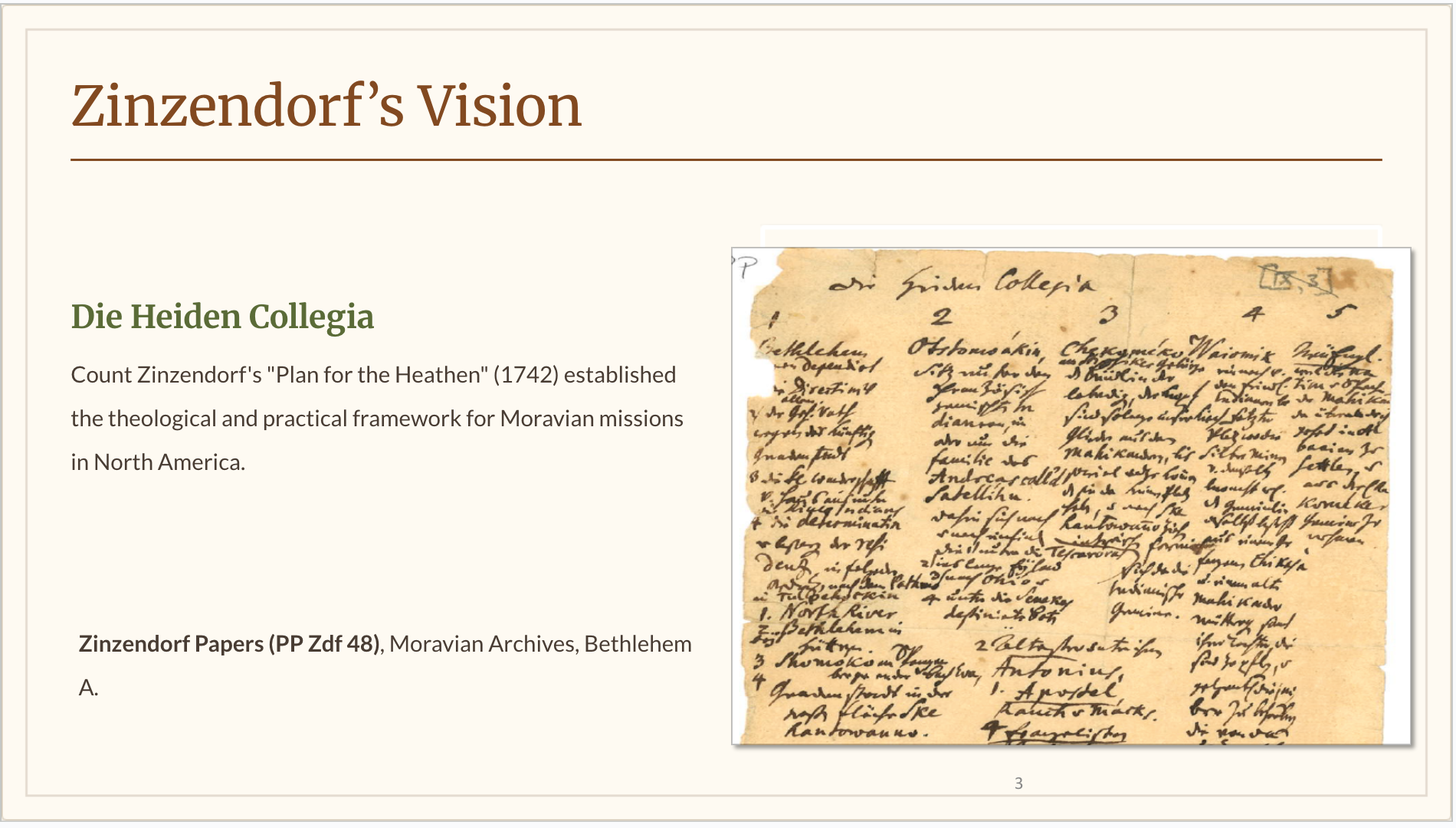
The Moravian presence at Shamokin represented a central part of Zinzendorf’s mission plan for North America, which emphasized strategically practised humility and cultural respect (Atwood, 2004). I will show how this humility and respect was manifested in the mission through the lens of indigenous agency. The physical place directly influenced religious practice, with European hymns sung alongside sweat lodge ceremonies, pastoral visits conducted across the frequently swirling, ice-filled river, and Shikellamy, the Oneida sachem with oversight over Shamokin, finding spiritual and physical refuge in the Moravian loghouse while maintaining Indigenous practices. Through the 1747 formal agreements establishing a blacksmith’s shop, the Moravians created a shared sacred space where work itself became a form of witness.

Building on the work of Jane Merritt, Richard Pointer and Rachel Wheeler that challenge the older historiographical view of Shamokin, where Shamokin was described as a “place of the prince of darkness”, the Moravian mission diarists describe a place of challenge, both physical and spiritual, but also of cultural and spiritual exchange. Similarly, Rachel Wheeler describes Mohican Christianity in New England, which she argues represented an intentional spiritual choice that transformed both Native and non-Native spirituality, claiming that the Moravians succeeded where Congregationalists failed partly because they were “culturally non-aggressive” colonial outsiders who lacked expansionist ambitions. This approach enabled genuine mutual learning and spiritual exchange between missionaries and Native peoples. In his recent study of Moravian theology on the margins, Ben Pietrenka claims that these liminal spaces radically upturned hierarchies of power. Indeed, such ruptures have been described by Katherine Gerbner in her new book “Archival Irruptions” as subversive discourses of power that are documented in the archives and require a radical counterreading of the traditional narratives of mission, race, and colonialization. It is against this backdrop that I investigate today the relations of agency and religion in the marginal place of Shamokin,  Pa. 

The town of Shamokin had long functioned as a crucial hub in a vast network of Indigenous mobility. The Moravian mission diaries of the 1740s and 50s reveal a constant movement of Indigenous peoples up and down the Susquehanna River: Tuscaroras, Cayugas, Oneidas, Mohawks, Nanticokes, and Lenape peoples are constantly arriving, departing, hunting, and passing through. Thus, Shamokin was not a static settlement but a dynamic crossroads where multiple Native nations intersected with European traders, missionaries, and colonial officials.

The Moravians’ attitude towards Shamokin evolved through contradictory emotions that traced the broader tragedy of Indigenous dispossession in the Susquehanna Valley. Initially, Zinzendorf well understood the importance of the forks of the Susquehanna as a strategic touchpoint with the powerful Haudensaunee Confederacy and its spiritual possibility—a place where their message of salvation could be spread, where communion could be celebrated, where the gospel might take root among multiple Native nations gathered together. Yet this hope coexisted with frustration over a place that never quite became what they envisioned, where missionary efforts yielded limited lasting results, and safety couldn’t be guaranteed. 

Shamokin served practical (if ethically challenging) purposes: a place to develop a relationship of trust with the Haudenosaunee, through building a blacksmith’s shop for gun repairs for Indigenous peoples. The diary is replete with references to a working landscape where Indigenous economies intersected with colonial trade networks, though increasingly on terms dictated by land sales and territorial encroachment. Whereas previous European visitors, such as John Bartram on his visit in 1743, described the place of Shamokin as ideal land for settlement, with its “peach trees, plums, excellent grapes,” and also described the Indigenous people of the area as unable to cultivate it for themselves, the Moravians saw the Indigenous population as politically sophisticated, technologically capable, and spiritually discerning, understanding and respecting their reasons for not cultivating the land according to colonial rules as being rooted in resistance to colonization.

Interactive Visualization at this link

The mission diaries reveal the dark reality of such colonial encroachment, evidenced primarily through the chaos of violence and disorder fuelled by alcohol. The diarists record regular drinking & carousing” (9/17/1745), “all night dancing & howling” (11/2/1745) where “Everybody [is] drunk” (6/5/1748, 6/9/1748) with “drunken brawls & fighting” (2/24/1749) causing “Sleepless night for missionaries” (1/11/1749) and culminating in the Penns Creek “Massacre of white neighbors” (10/16/1755) by the Western Delaware who were allied with the French. 

The Moravian missionaries at Shamokin thus lived a paradox of witness and persistence amid overwhelming chaos. Between 1747 and 1755, they engaged in relentless physical labor—constructing two mission houses, laying floors, building chimneys, repairing bridges, and erecting a smithy that became central to their relationship with the Indigenous community. Their documentation of measurements, dates, and improvements suggests both immense commitment to their work and an attempt to create order in an environment beyond their control.

The forge operated as more than a blacksmith shop—it was a tool of engagement and a testament to pragmatic adaptation. The missionaries fixed guns, made charcoal, accepted payment in hides and pelts, and deliberately kept cultivation “at the level of the Indigenous economy” rather than imposing European agricultural models. Yet their economy remained perpetually precarious: starvation diets, crops ruined by frost and hail, with chickens and horses stolen or lost.

Yet amid this distress, the Moravians maintained remarkably disciplined spiritual practice. They held communion services, foot-washing ceremonies, and, in the 1750s, lovefeasts requiring sugar and tea, Easter dawn services at the turnip field where Brother Hagen had been buried, and services that ran until 2 a.m. The stark contrast is captured in Christmas observed with lovefeast while chaos reigned outside. Their principled Sabbath observance—refusing to let Indians demand that they work at the forge on those days—led to “astonishing questions” even as it was criticized for interfering with economic needs. One poignant detail reveals both their vulnerability and their peaceful intervention: a brawl “silenced by missionary’s singing.”

By 1755, the mission’s fragile stability collapsed. Advised to flee (advice “disregarded”), threatened with land claims, facing “bloody action by hostile Indians,” they finally witnessed the “massacre of white neighbors” in October. The mission house and forge were offered for sale with no date given—a poignant detail suggesting the uncertainty of when they could actually leave.

The archival evidence clearly shows that the Moravians at Shamokin operated within Indigenous political and cultural frameworks, adapting themselves to Native authority, while simultaneously navigating colonial politics. When Shikellamy held a Nanticoke Council in 1747 to address the issue of two Nanticokes who had been shot with arrows, the Moravians participated by preparing food “which they placed before the council”—thus serving the Indigenous political process rather than directing it. Significantly, when the Nanticokes showed reluctance to listen to Shikellamy, the Moravians attributed this to “not to some essential notion of their race but rather to them being surrounded by traders,” placing blame on colonial disruption rather than on any inferred Indigenous characteristic.

Cultural exchange flowed in multiple directions. In 1757, Moravian visitors to a Shawnee village on the North Branch were invited to a sweat lodge and accepted, afterwards enjoying an evening concert of European chorales and music for strings played on violins provided by the Indians—a remarkable scene of reciprocal hospitality and shared musicality. Medical practices also bridged cultures: on July 10, 1747, several Indians came to Brother Hagen to be bled, reflecting a shared humoral worldview where both Moravian and Indigenous medicine understood the body as a system of flows requiring balance.

Yet the missionaries also practised strategic isolation, maintaining strict “aloofness from traders” who were “strictly kept out of the house.” This wasn’t cultural superiority but a survival strategy in an environment where traders brought the twin scourges of alcohol and violence. The Moravians navigated a careful path: adapting to Indigenous authority and participating in Native cultural life while protecting their mission space from the destabilizing forces of the colonial economy. Their approach recognized that the greatest threats to peaceful coexistence came not from Indigenous peoples but from European traders whose liquor traffic undermined the very communities the Moravians sought to serve.
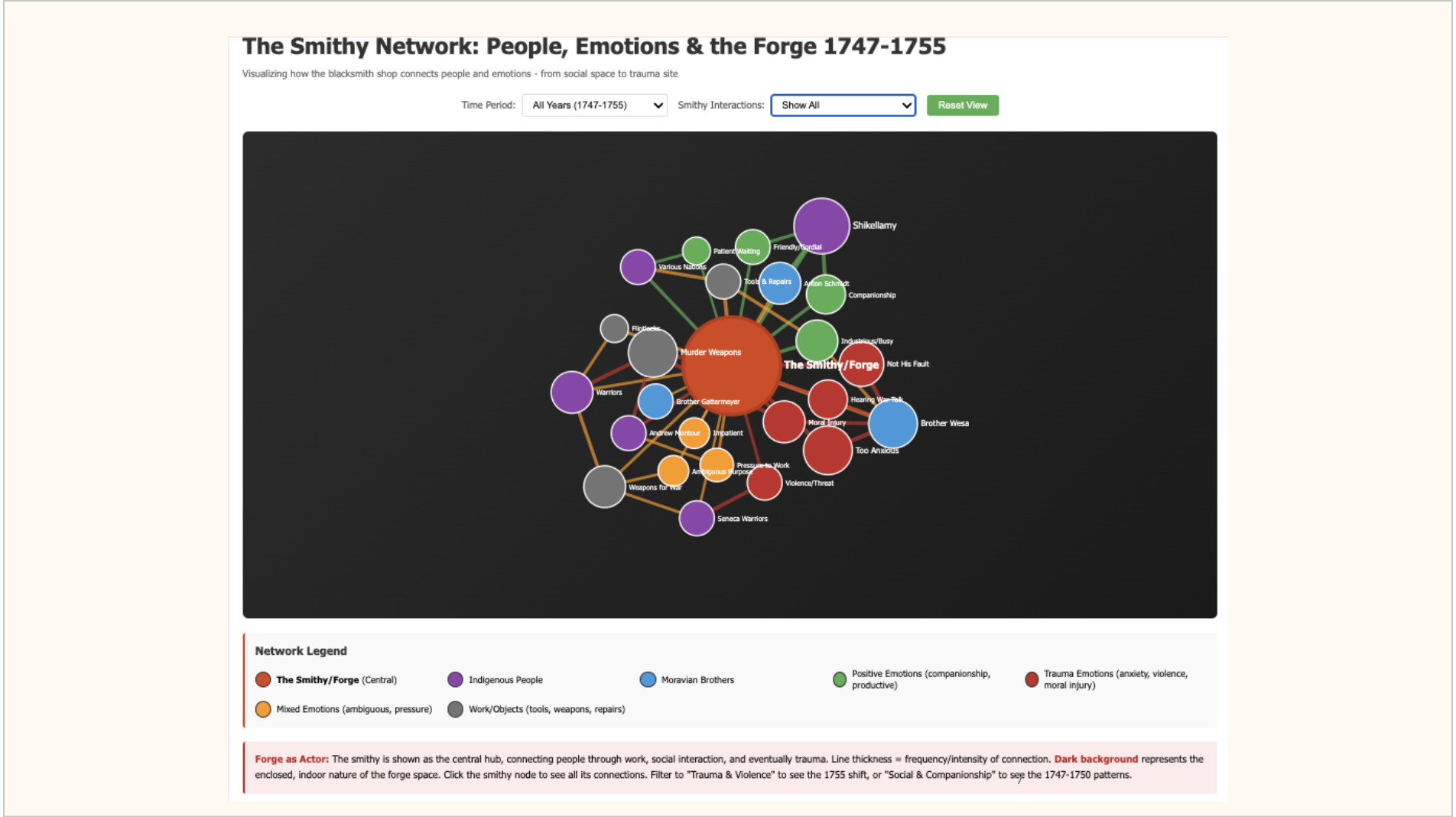
Interactive visualization is at this link

The smithy at Shamokin was clearly the economic and relational heart of the mission. The Moravians structured its operation to align with Indigenous economic patterns rather than imposing European models. Indians were “kept on the preferred list,” receiving priority service, while payment came in hides and pelts through immediate exchange, avoiding the debt relationships that characterised exploitative trader practices. The forge offered practical services: repairing guns, manufacturing charcoal, and meeting community needs on a self-supporting basis. This economic philosophy extended to their agricultural practices: they explicitly kept “farming activities on the level of Indian economy” and maintained “agricultural enterprises at a minimum.” Rather than establishing a European-style plantation that would signal territorial claims and economic dominance, the Moravians adapted to Indigenous economic patterns, using the smithy as a tool of engagement that served the community without attempting to transform it. 

On August 2, 1747, letters from Bethlehem arrived (always a source of joy), but this time with the critical news that agreement had been reached with the Colonial government to build the smithy. Shikellamy calls a council of the Indigenous leaders, which permits Bishop Spangenberg to speak through his letters, composed in Onondaga and signed with his Haudenosaunee name, T’girhitonti. That same evening, the Moravians celebrated their first communion, thus demonstrating that work and sacred life were intertwined. Hagen writes in the diary, “How we felt at this communion with our Lord I cannot describe. It was also important to us because it is the first one here in the wilderness, perhaps as long as the forest has stood.” 

But the smithy was much more than a place of work- it was central to the Moravians’ mission at Shamokin, constructed and operated by them. In this interior space, they controlled who could enter and when, and who could have work done and when. According to the agreement with Shikellamy, it was Indigenous agency that decided whether the warriors needed to pay for the work. The space of the smithy, also, demanded a moral position in which the Moravians could not avoid complicity in the repair of arms. Every decision they made demanded a moral choice and left them no space for passivity in the face of conflict. 

Looking at the smithy as a fulcrum of emotion and agency, we can view this diagram which us designed to show emotions connected to the smithy over time. For example, if one wants to talk of an emotional register, the smithy in 1755 is a place of impossible choices for Brother Wesa. A place that had once been a space of Shikellamy’s companionship (1747-8) had become a site of trauma (1755) where Wesa is forced to repair the bloodstained weapons of war.

Interactive visualization is at this link

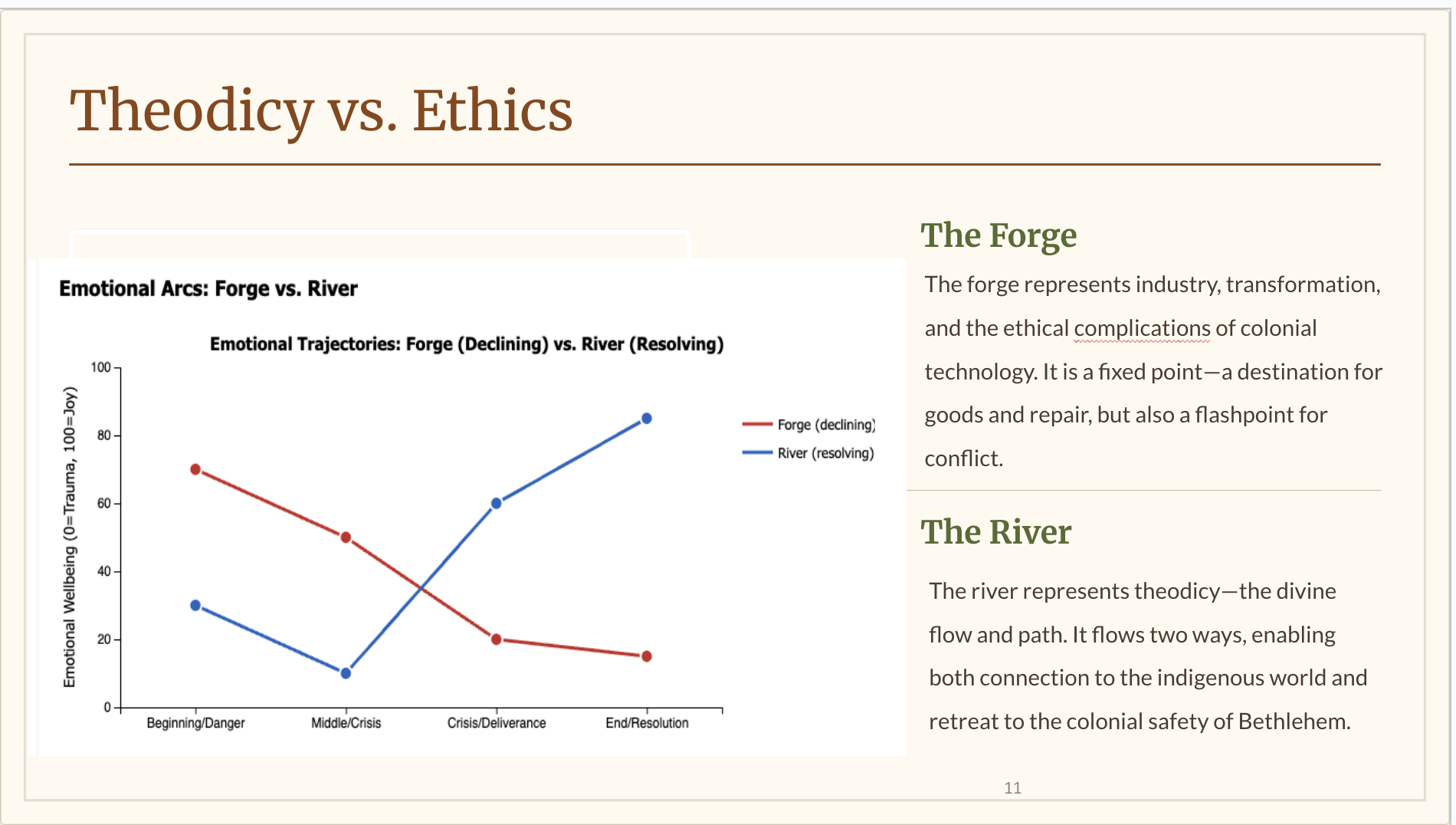
If we perform the same analysis for the Susquehanna River, we can see that the river serves as an antidote to the ethical conflict in the smithy. It belongs to the realm of nature, an open force of nature beyond human control in a pre-existing landscape. It acts independently of human will, flooding, freezing, and flowing. Moravians respond to it but do not control it. It also offers a morally neutral territory, carrying warriors up and downstream. It offers danger through its rocks, riffles, and ice floes. Yet it is also deeply embedded in colonial geography, defining the boundaries of lawful settlement. The river has a social function, too, linking Shamokin with the Wyoming Valley (one of Zinzendorf’s original Heiden Collegia).
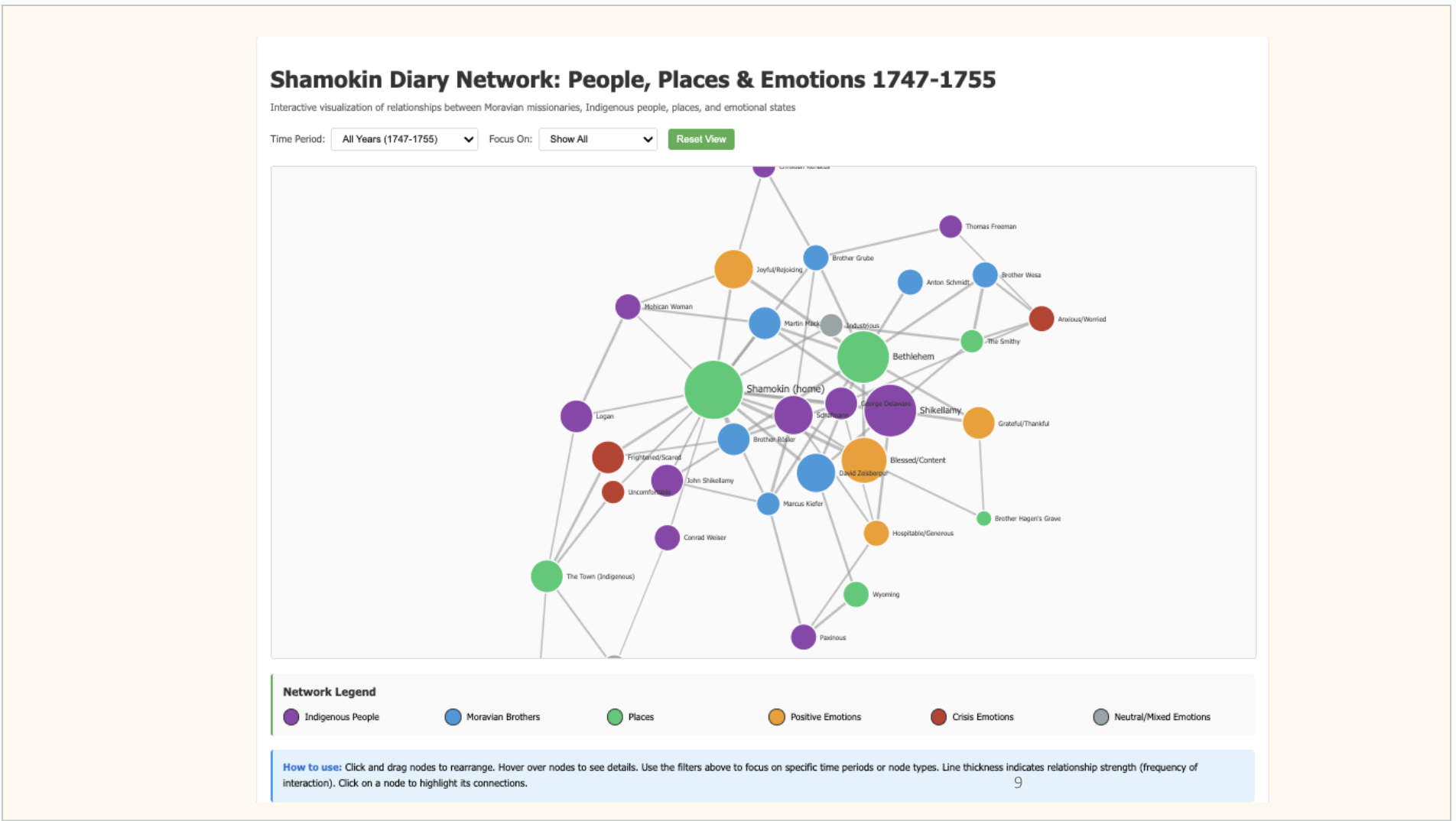
Interactive visualization at this link

But not only are places linked to emotion; so are people. First, references to specific places are accompanied by specific sentiments in the diary narrative (of course, there are multiple diarists, and their reactions to people and places also determine the emotional index).

Interestingly, Bethlehem is always seen as a place of refuge, frequently referred to during this period by those on mission work as “das Kripplein,” the little manger. People are also associated with emotions: Shikellamy is always a friend and protector, and when he dies, his sons, Johan and Logan, inherit his role but are not as intimately involved in the work of the smithy.

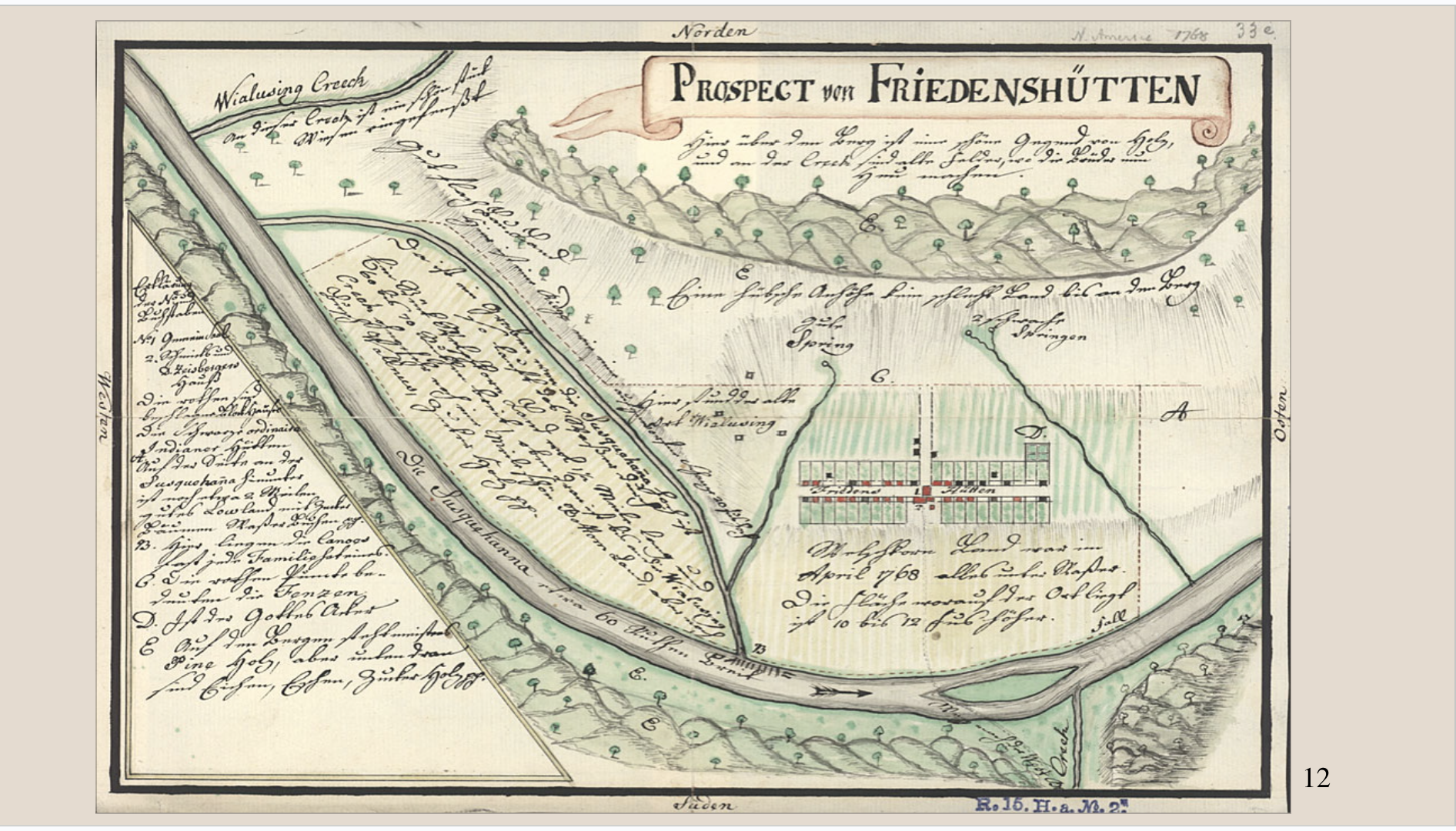
The sense of sacred place at Shamokin contrasts sharply with that of the Moravian North Branch mission sites—particularly Friedenshütten (“Huts of Peace”) (1768-1772) and Scheschquehannunk (1769-1772)—both established between Pontiac’s Rebellion and the American Revolution. These later “Places of Peace” were intentional Christian communities led by converts such as Johannes Papunhank (a Munsee religious leader baptised by David Zeisberger). Friedenshütten embodied the Moravian mission vision that had eluded Shamokin: a thriving mission town with substantial infrastructure, agricultural prosperity, and a vibrant liturgical life that earned admiration from colonial officials and Indigenous leaders alike. The community erected impressive buildings, including a meeting house with glass windows and a belfry, produced abundant harvests that fed both residents and countless visitors, and grew from fourteen to forty-seven communion participants. Their sophisticated governance structures, bilingual education, and extraordinary hospitality—extended even when it strained their own resources—demonstrated Indigenous Christian agency and strategic cultural competence. Yet this success contained its own vulnerability. Built on disputed land, caught between competing political pressures, and ultimately forced to abandon everything on May 3, 1772, Friedenshütten revealed the brutal reality that no amount of prosperity, spiritual commitment, or colonial admiration could protect Indigenous peoples from the violence of expansion and the fundamental insecurity of their land rights. Where Shamokin had struggled against chaos, Friedenshütten achieved everything the Moravians envisioned—and still could not survive.

To return to the questions with which I began this presentation: did landscape play a role in the choice of mission in a way that was not only defined by utility and strategic advantage? Did landscapes themselves hold sacred value? And if so, how did this concept differentiate itself from indigenous concepts of sacred landscapes? I would argue that landscape of Shamokin was selected strategically but became sacred though the 8 years of the mission being active there. Shamokin was selected strategically: Shikellamy’s invitation, Six Nations council site, smithy opportunity. But eight years of dwelling transformed it.  The missionaries noticed the river’s beauty (“like warp and weft”), tended Brother Hagen’s grave with pre-dawn visits, called their new house “this dear little place” and composed a hymn for it. They left “not without little tear.” Thus landscape accumulated sacredness through relationship, not geography.

BETHLEHEM was a permanent sacred, always positive across all periods. Letters from there “like honey and balsam.” The place they couldn’t stop longing for.

THE RIVER: Theodicy sacred. Sacred when God acted through it – the flood became Noah’s ark, dangerous falls became deliverance sites. Natural danger without moral culpability.

SHAMOKIN: Relational sacred. Sacred through Shikellamy’s daily protection, through communion’s “unspeakable proximity.” But this sacredness evaporated when relationships fractured in 1755.

The emotional geography reveals that the sacred for the Moravians wasn’t fixed in land but in relationships and divine action. How did this understanding differ from Indigenous sacred landscapes? The Shamokin diary shows that both groups navigated the tension between place and the need to be mobile. Therefore, the relationship to place was not simply “fixed” or “portable”. For the Moravians, Christ is portable (they can worship anywhere). However, through the text we can see that their emotions showed a strong longing for Bethlehem, and when crisis arose, it forced a flight to their permanent sacred centre.

For the INDIGENOUS PEOPLES, place was vital to rituals of identity. For example, the Nanticoke reburied their departed’s bones, the islands in the river were places for council fires and decision making, the land and forest and water were places for the hunt and trade. At the same time the indigenous people demonstrate strategic mobility (seasonal migration, dispersal under pressure) and also, most importantly, exercised agency over who could stay, who had to leave Shamokin. The critical difference was that Moravians could leave because Bethlehem remained secure. Indigenous people maintained protocols through displacement because colonial violence destroyed their sacred places.

The Moravians sought a “portable sacred” – Christ present anywhere. But the emotional geography of the Shamokin diary reveals they couldn’t escape place through theology, in that they couldn’t worship safely without Indigenous protection (Shikellamy made devotion possible); they couldn’t resolve moral complicity in one place (the forge), so they fled to another (the river) where suffering could be explained theologically. And finally, they couldn’t stop longing for one specific place (Bethlehem).

Meanwhile, Indigenous people maintained sacred obligations to specific places (returning bones, ritual sites) while strategically adapting to colonial violence – demonstrating not attachment vs. mobility, but agency under impossible circumstances. Colonial violence, not theology or culture, determined who kept their sacred places. The Moravians fled to Bethlehem. Indigenous people were displaced from Shamokin. Both groups’ relationship to landscape was relational, adaptive, and vulnerable – but only one group had a secure sacred center to return to.

Therefore, landscape mattered beyond utility, but it became sacred through dwelling, not through inherent geography. Landscapes held sacred value for the Moravians – but through relationships, divine action, and community, not fixed spiritual power. This differed from Indigenous concepts – but both groups navigated place/mobility more than simple binaries suggest. The emotional geography reveals that vulnerability, not belief, shaped the sacred landscape. And, at least for a while, Indigenous agency determined who could stay.

Places of Peace: Moravian Missions on the North Branch of the Susquehanna 1769-1772

Lecture delivered at the Dietrich Theater, Tunkhannock, PA on October 15, 2023

Thank you for the invitation to speak today at the Dietrich Theater in Tunkhannock, standing on the traditional lands of the Munsee, Lenapehoking and Susquehannock Indians. 

I titled this talk “Places of Peace” and intentionally did not add a question mark. As I will try to show, there were certainly tensions on the North Branch of the Susquehanna River, both in the Moravian Indian villages of Friedenshütten and Scheschquehannunk between the Mahican and Delaware (Unami and Munsee) residents, and with their neighbours, both settlers and Native Americans,  and also in outward-facing discussions with the Haudenosaunee to the north, specifically the Cayuga nation’s chief and the Colonial Superintendent of Indian Affairs, Colonel William Johnson. But, since the outbreak of the French and Indian war and the subsequent Pontiac’s Rebellion, the villages were places of relative peace in comparison with the violence and bloodshed that was occurring as a result of increasing racial tensions between the white settlers and ANY Native Americans further down the Susquehanna River.

What I would like to discuss today is how this place – from the mouth of the  Lackawanna up to what is now the New York/Pennsylvania border – was briefly a place of relative stability and environmental wealth for groups of displaced Moravian Indians, Mohican, Unami and Munsee speaking, who were caught up in both the religious awakening that swept up and down the Susquehanna River in the 1740s and the redefinition and renegotiation of tribal identities in Native communities in the Susquehanna Valley.

To help me in this work, I draw on my own long involvement with the records of the Moravian Church in the North American missions, in particular the deep research for my forthcoming book on the Shamokin mission which predated these North Branch missions by 10-15 years but which contains some of the same actors. Common themes for that research project and this one include the historical work of scholars such as Jane Merritt on the contribution of women missionaries to the intercultural exchanges in Pennsylvania, my own work on trade and missions in early Pennsylvania; the recent revisioning of this time and place by scholars such as Richard Pointer, in his remarkable “biography” of Papunhank, the Munsee religious leader that was published in 2020. Also vital to my work is Amy Schutt’s important essay on tribal identities in Moravian missions on the North Branch; and, as we end today,  Rachel Wheeler and Sarah Eyerly’s reconstructions of the soundscapes of Moravian mission landscapes. Much of this work is based on the deciphering of the archival records of the Moravian Church, held in Bethlehem PA and also available through Gale Cengage online (if you can read archaic German script).

There are also certain central figures that pervade this work:

  • The Moravian missionary, David Zeisberger
  • The Munsee “Prophet” (John) Papunhank, baptized into the Moravian Church by Zeisberger
  • Job Chillaway and his brother Billy, residents and later title holders to the lands of Wyalsuing
  • John Woolman, a leading Quaker whose work with Papunhank was central to his religious vision
  • The Moravian missionary couples who worked in Friedenshütten and Scheschquehannunk: Johann and Margeret Jungmann (fluent in Mahican), 
  • Johann and Johanna Schmick (who was fluent in Mahican and wrote a Mahican dictionary)
  • Johannes and Marie Roth (who was learning Munsee dialect of Delaware)

First, who were the Moravians and why were they establishing missions to the Native Americans of the North East in the Colonial period? 

Count Nicholas Ludwig von Zinzendorf was born in Dresden, the capital of Saxony in 1700.  Zinzendorf was a descendent of Protestant Austrian nobility and was raised by his grandmother, Henriette Catharine von Gersdorf after his father’s death and his mother’s remarriage.  His grandmother, an educated and talented woman, exercised great influence on the politics and pietism of the day.  Zinzendorf was educated at Francke’s school in Halle where he first encountered missionaries returning from the Lutheran mission in Tranquebar, India. 

During this period in Halle, he most likely heard about emigration to North America, as in 1702 an entrepreneurial German who had lived in Pennsylvania, Daniel Falckner, had met with the leader of the school and discussed subjects as far-ranging as where the other German settlers lived, to what Native Americans ate, how they hunted, how they raised their children and how one might trade and make money. By 1727 over 20,000 Germans had settled in Pennsylvania in search of financial wealth, and religious and political freedom. 

Zinzendorf developed a quite unique approach to mission work. For example, Zinzendorf claimed that the refusal of some missionaries from other denominations to mix with the non-Christians, or to live at their level of poverty, was contrary to the spirit of Christ and accordingly, baptisms were to be performed individually and not en masse, that the individual’s path to salvation was charted by means of frequent “speakings” with spiritual Helpers from the same cultural and linguistic background as the candidate, and that each person was a member of a small band of people who came together regularly to discuss their spiritual growth, exchange confidences about their personal problems, encourage and forgive each other, and help each other. Such an individualistic approach toward conversion had both its benefits and drawbacks.  The benefits showed themselves in the success of the missions. The drawback was that the number of converted remained small.

In 1742 Zinzendorf travelled to North America and stayed first in Philadelphia and then came up into the Lehigh Valley. From there he made several trips into Indian Country, first to the Mohican village in Shekomeko, Dutchess County NY, then he visited unsuccessfully the Shawnee in the Wyoming Valley, and also he visited Shamokin and met Shikellamy, Madame Montour and Andrew.

The Moravian mission project was just one of many vectors of colonization of Native American religion and lifeways, but arguably, the most well-meaning. Other groups had already proselytized the Native Americans of the North East, such as the Jesuits and the Presbyterians. Some Native Americans (like Madame Montour) were baptized multiple times and some, like the Oneida, Shikellamy had been baptized in his youth but was drawn to the Moraivans, perhaps especially David Zeisberger, and might well have been baptized before his untimely death in December 1748. The Moravian understanding of conversion and baptism required that each individual non-Christian should feel the call to convert within his or her heart because of the model provided by other Moravians (European or Native American) and also the need to repent. This meant that Moravian conversions were small in number, individualized, and yet also more deeply internalized within Native American communities, to the extent that when asked to move within the vicinity of other non-Chrstian Native villages in the aftermath of Pontiac’s War, leaders such as Papunhank refused, citing the difficulty of maintaining their lives of faith when having to live with non-Christians.

The mission at Friedenshütten was the result of years-long negotiation and discussion with both the Colonial authorities and also with Papunhank, the Munsee religious leader who had built up a substantial town at Wyalusing in the 1750s. Born probably in 1705, maybe in upstate New York, Papunhank’s life has been masterfully pieced together by historian Richard Pointer who draws heavily on many different manuscript sources in the Moravian archives. Pointer outlines not only his biography but also the context in which he lived: an incredibly complex world of colonial expansion, Native American negotiation, betrayal, trickery, increasing racial tension, a discovery of faith, renewal, and alliance building. His story is definitely that of the Delaware peoples, as they were displaced and removed, “adopted” and made into rhetorical women and children by the Six Nations. Renouncing alcohol after the death of his father, Papunhank campaigned to ban the trade in rum. He visited the Society of Friends in Philadelphia (especially Anthony Benezet, the abolitionist and author of influential tracts on the shared humanity of both enslaved Africans and colonized Native Americans) and, according to Pointer, possibly met Shikellamy in Shamokin and witnessed how this effective diplomatic and negotiator for the Six Nations managed to effect a delicate balance between his people’s culture and priorities and the rapidly changing landscape of the Colonial period.

Papunhank desired to found his own village, where his rejection of alcohol and his awakened spirituality could determine the rhythm of life. The availability of good hunting and fertile land and access to the waterways that served as the major routes for trade led him in 1752 to settle on land at Wyalusing and build a substantial settlement. But it was not long before the hostilities of the French and Indian War which erupted in 1755 and the Delawares were split in their loyalties between the French and the British.

The fate of the Indian Moravians who had been expelled from New York state in 1744 and had moved to Gnadenhütten on the Mahoning and Nain near Bethlehem has been told many times. The hostilities of Pontiac’s Rebellion and the ensuing attacks on any Native American groups in 1763-4, converted or not, meant that the safest place for them was deemed by the Colonial authorities to be the barracks in Philadelphia. The attacks of the Paxton Boys as they were known on the Conestoga Indians in Lancaster County and then the ensuing march on Philadelphia made it clear that the “Peaceable Kingdom” that William Penn had envisaged was now an impossibility.  The perpetrators of the massacre defended their actions in a remonstrance published in 1764, claiming that the violations of the “distressed and bleeding” frontier were an affront to the brethren and relatives of the murdered whites.  They also accused the Moravian Indians of Nain of sending messages to the Shawnee living on the Great Island to plot further murders of the white settlers along the Susquehanna River.  According to historian Kevin Kenny, the Paxton Boys were not the only ones to suspect that the Moravian Indians of Nain were secretly trading with enemy Indians and supplying them with guns and ammunition.  The Assembly’s commissioners also believed that “there is much reason to suspect the said Moravian Indians have also been principally concerned in the late Murders committed near Bethlehem, in the county of Northampton” (Kenny, p. 133)  In response to these accusations, in October 1763 restrictions were placed on purchases of gunpowder in Nain, and the commissioners recommended that the Nain Indians be removed to Philadelphia so that their “behavior may be more closely observed.” (ibid.)  To this end, on November 8 1763 a party of 127 Indians from the missions of Nain, Wechquetank, Nazareth and Bethlehem set out for Philadelphia.  

As I have discussed in another talk, the non-Indian residents of Bethlehem viewed the departure of the Indians, not only from the mission villages but also from within the very choirhouses of Bethlehem with ambivalence. Kate Carté has argued that the removal of the Nain and Wechquetank Indians was something accepted by the Bethlehem non-Indian residents and that they did not fight this decision because they had never seen them as part of their community (Engel,  For Religion and Profit, p. 184)  And, a few weeks after the Moravian Indians arrived in Philadelphia on November 11, they were greeted by a furious mob ready to murder them. Afraid that the Philadelphia barracks would not protect them from the mob, the Moravian Indians were moved to a former “pestilence house” on Province Island in the Delaware River.  And there they stayed for fifteen months.  Conditions were terrible in the prison. Disease was rampant.  By the end of 1764, 56 of the Indians had died, nearly half of them children.  

The fate of the Nain Indians in the Philadelphia barracks was a constant source of concern for the Bethlehem Moravians.  Given the political unrest and racial hatred now rampant in the Pennsylvania backcountry, that was spilling into the crowds of the cities of Philadelphia and Lancaster, it was clear that Nain could no longer be the home of Christian Indians.  In September of 1764, before even a clear decision had been made as to the fate of the Indians, plans were drawn up to dismantle the buildings.  After the leaders of the Indians in the barracks petitioned for their own release, they were permitted to leave the city and arrived on March 22 1765 back in Bethlehem in deep snow.  They were allowed to briefly stop for a week at what remained of their old homes. Six of the fourteen houses were sold to individuals in Bethlehem on March 30, (according to Levering, one was the chapel) and then the following day a farewell lovefeast was held and on April 3 the Moravian Indians left Bethlehem for the apparent safety of Papunhank’s village of Wyalusing on the North Branch.

How come these baptized Indians, Delaware and Mohican, were invited to come to the North Branch? According to Pointer, the Muncee prophet’s village was losing its inhabitants in the early 1760s; some no longer wanted to hear his message, some were worried at the violence on the frontier and as close as the Wyoming Valley where Teedyuscung’s village had been attacked. At this point of crisis, the Moravian missionary David Zeisberger turned up in Papunhank’s village and accepted his invitation to preach. This fortuitous appearance in 1763 led to Papunhank inviting the Moravians to send a missionary to the upper North Branch; also Papunhank requested that Zeisberger baptize him into the Moravian Church. Upon baptism, he received the name, Johannes. Now a Moravian and also still the leader of his village he also recognized the threat that his people were under and for this reason joined the Nain Indians in the Philadelphia Barracks. Negotiating with the Six Nations and also the Colonial authorities, Johannes Papunhank should also be credited with arranging the removal of the remainder of the Nain Indians to Wyalusing. According to Pointer, Papunhank assumed the leadership of this new Moravian community in June 1765, preaching in the Muncee dialect of the Lenape language and also, it is thought, able to communicate with the Mohican Moravians due to his time at the Philadelphia Barracks. 

The village that became known as Friedenshütten was built in 1766 in a position closer to the river than Papanhunk’s Wyalusing. The mission diary reveals the day-to-day activities that sustained the community both physically and spiritually. From its beginnings in the spring of 1765, when food was scarce, to its dissolution in the summer of 1772, the town supported itself with its gardens of produce, and seasonal hunting and shad fishing.  It hosted numerous parties of visiting Indian nations, some very large and very hungry, many coming for political parley, some coming to visit their family members who had converted. Reading the mission diaries that still exist only in manuscript form, a picture emerges of a vibrant community with a multi-lingual school, a Gemeinhaus (church) complete with oil paintings and a bell, log houses with glass windows, bark houses for those who preferred them, fertile kitchen gardens, and canoes tied up along the river bank.

The numbers in this community kept growing. By the end of 1765 the number was 146, by the end of 1766, 172, and by the end of 1767, 185. The population was made up of almost a third of non-baptized Native Americans, Delaware, Mohican, and also visitors from the Nanticoke, Tuscaroras, and the Cayuga, under whose oversight the lands in Wyalusing fell. Disputes did occasionally arise about the language of worship in Friedenshütten, with the Lenape speakers feeling as though they were at a disadvantage with the preponderance of services being held in Mohican. 

And perhaps for that reason in 1769 a delegation of Delaware Moravians discussed the transfer of their members to the already existing village of Schih-shi-quan-nink (a Delaware name meaning a rattle made of a tortoise shell)  about 13 miles upriver (or 3.5 hours on a good day). As Amy Schutt has discussed in her work on tribal identities on the Upper Susquehanna, the possible separation of the two congregations into their linguistic groupings in fact went against the Moravian mission philosophy of converted Indians seeing themselves as “one people.” However, the separation into two congregations helped relations between the two groups. 

Schechschequanunk was a smaller mission village, numbering only 53 individuals, most of whom were not communicant members, and up to half of whom were not baptized. The geographical location of the village, over 20 miles closer to the Munsee settlements on the Chemung River, meant that it attracted frequent visitors from there, many of whom were relatives of those living in the Moravian village. Some visits were also from the extended family of the Montours, especially the granddaughter of Madame Montour, Esther. The picture of “Queen” Esther that emerges from the mission diaries is not of the bloody avenger of the Wyoming Valley but rather of a leader of the Munsee at a time of political turmoil, colonial negotiation and eventually, with the 1768 Treaty of Fort Stanwix, the prospect of imminent displacement of Native Americans, Christian or not, to lands either under the oversight of the Cayuga (today’s Ithaca, NY) or further west. 

Regardless of the threat of imminent removal (surveying of the lands began in June 1769) in both communities, the inhabitants sustained themselves according to the hunting and agricultural traditions of their cultures. There are frequent mentions of the hunting parties coming back with deer, bear and elk meat; but also of the interdiction of hunting on Sundays and the abolition of the celebration of the “bison” or magic hunting medicine ritual in October 1769. The communities are both plagued by wolves who attack livestock repeatedly and thus necessitate the building of a fence around the Friedenshütten village. In March, the inhabitants (women) would leave for the sugar camps where maple sap was tapped and boiled day and night. Corn was planted in late May, when shad were also fished for. Schoolbooks for English spelling were distributed, and the children were reported to be eager learners, and a new schoolhouse was erected to hold the growing population in Freidenshütten. Johannes Roth would bring communicant members of Scheschquinunk down to Friedenshütten for Communion and Easter celebrations. 

But in amongst all this activity directed towards building a secure and sustainable settlement, the Moravian Indians were frequently reminded of the insecurity of their right to be on this land. Job Chillaway had filed a legal claim to the lands with the Colonial authorities; Chief Gagohunt of the Cayuga was encouraging the Delaware to move north out of Pennsylvania; David Zeisberger was heeding the invitation of other Delaware chiefs to move west into Ohio country, where the precarity of the property rights in Wyalusing would be unimportant. Johannes Papunhank was however committed to staying put. 

Then in September 1771 out of seemingly nowhere, Job Chilloway and others brought accusations of witchcraft against Johannes Panpunhank. This was the final straw in the fight over the land and rights, and although in October chiefs from the Conoy, Nanticoke, Minisink, and Cayuga all refuted the lies told about Papunhank’s sorcery, the distrust stuck. Three weeks later the moving plan to Ohio country was announced which was to be completed by the end of May 1772.  Chief Netawatwees of the Delaware council at Gekelemukpechünk had received reports that the way in which the Indians at Wyalusing could live as both Christians and Indians was good and therefore invited them to come west. The message was delivered through Delaware leader Wangomen and then through another leader, Killbuck.

As the 19th-century historian of the Moravian Church William Reichel writes, “The order for the survey at Wyalusing in favour of Job Cilloway is dated the 20th of May, 1772.” The survey was made by John Lukens, Surveyor General. 16th Sept 1773. As we can see from this beautiful digitally restored image of the original survey, completed by Bob Lissa here in Tunkhannock and donated by David Buck, the land covered 623 acres and began on the eastern side of the North Branch at the mouth of the Wyalusing Creek, extended up the side of the creek 139 perches and then over and back to the river. It was part of the Proprietories “Manor of Pomfret” but was called Dundee Manor. The price was 784 pounds.

Why should we be concerned about this history today? 

First, this history of complexity and multi-layered identities compounded by place is still with us today; in the place names, the landscapes, the environment that survives from nearly three hundred years ago. As you know, progress towards restoring the environmental health of the river is being made with the help of DCNR and other non-governmental bodies: dams are being removed and fish ladders are being built to allow for the shad to return. New state parks along the river are being created (Vosburg Neck and PA Highlands – last site of Susquehannock village down in York County).

Also scholars are using the internet to open up new public-facing research. Indigenous artists, filmmakers, musicians, are writing this history from their perspective for the audience of today. An example is this powerful retelling of the Conestoga Indian massacre.

Other recent public-facing work that focuses on the links between contemporary Native American populations and this history of peaceful coexistence can be found in the work of Rachel Wheeler and Sarah Eyerly (https://oireader.wm.edu/open_wmq/singing-box-331/).

They write of this project: “Reading more deeply in the mission records made clear that these hymns were a significant element of congregational life in Mohican-Moravian communities such as Shekomeko, New York, and Gnadenhütten, Pennsylvania, in the mid-eighteenth century. They were sung to and by the sick and the dying. They were sung at gravesides. They were sung by men while hunting. They were sung at communal feasts. They were sung for visitors and when traveling to other communities, both Native and European American. They were sung to bring comfort, to call spiritual power, and to create and fortify community.1 And as written documents, the hymnbooks have become important cultural and linguistic records, silently preserving this tradition of Mohican-Moravian hymnody for more than 250 years. As material objects, the hymnbooks in Box 331 are an important, but limited, representation of what was once a living, aural tradition of hymn singing.”

Careful historical research allows us to reconnect and rework the past into the present. Again, Eyerly and Wheeler have worked with the Stockbridge Mohican Munsee population to “resound the compositions of Josua” so we may listen to the past. And in fact today in Nazareth, Dr Eyerly is giving the Zug lecture at the Moravian Historical Society on her book Singing in the Wilderness which includes a collective singing of Moravian hymns in multiple languages. Don’t worry, I won’t ask you to do that!

Conclusion

I conclude my talk today on places of peace in amongst daily reports of war from Ukraine and most recently from Israel and Palestine. One could say that both of these conflicts have at their core claims to land, whose claims predate whose, and who has a right to live on which lands. As one political scientist has recently said in relation to the issue of economic development in the Global South, without clear title to land, no one will or can invest in building industries and infrastructure. This problem is at the root of economic underdevelopment in countries like Haiti. And indeed one can say the same for the desire for economic development here in Colonial Pennsylvania.

The survey map I show here, also digitally restored thanks to Bob Lissa here in Tunkhannock, is from a collection published by the State of Pennsylvania in 1895 that brought together as many of the land surveys from the Colonial period that had survived a fire in the state printing shop. The volume is entitled Draughts of the Proprietaries Manors. About ten years ago I was handed a copy of this volume with its cover tattered, some pages missing, others covered in river silt from the 1972 flood after Hurricane Agnes inundated the Susquehanna Valley. The donor told me to take it and make good use of it as he knew that I worked on the history of the Susquehanna River.  For a long time, the maps lay on the kitchen table of a colleague of mine, waiting for him to help to locate the places on these beautiful drafts on a map of Pennsylvania today. Well, he never quite got around to it. So I showed the volume to another friend, Dave Buck, and, once, thanks to Dave, Bob’s daughter Alianna had done her digital magic, we could work with digitized printouts of the maps. So together we poured over the maps, trying to work out where each Manor might lie. Dave had been trained as a surveyor so he pulled out a pencil and started making calculations about rods, and perches, and chains (which was all quite foreign to me) and turned the maps this way and that to try to make them fit. But they just wouldn’t. So I did some digging around in some databases and found a very helpful article about surveying in early Pennsylvania that confirmed our fears. Some of these terrains were just so hard to traverse, let alone lay down chains to measure, that the surveyor just made it up. Ugh! 

The reason I bring this up is that the non-Native or non-indigenous notion of land ownership is predicated on surveys and measurements and limits and boundaries that give us “rights” over that area. But if those boundaries are fictions then what happens? Wyalusing and Friedenshütten were abandoned because the land on which they stood had been “sold” or signed over by multiple agents; the Proprietaries, the Six Nations, the Chilloways and Johann Papunhank. The places of peace that were for a short time here on the North Branch became sites of contention. When the Moravian Indians left Friedenhütten for Ohio country, they tolled the chapel bell as they floated the canoes down the river until they turned the bend in the river below Sugar Run and lost sight of their homes at the Huts of Peace.

Thank you!

Race, Gender and Feelings: Moravian Religious Sentiments in 18th century North American Memoirs

Paper given in November 2021 to mark Professor Wolfgang Breul’s Birthday. A small portion of the results discussed here are published in the Fall 2022 issue of the Journal of Moravian History.

Thank you for invitation to present a paper on the subject of “Fromme Gefühle” to celebrate Professor Wolfgang Breul’s significant birthday (albeit a year late!) As we share a birth year, I am well aware of the passing of this milestone myself, but am fortunate enough to be about six months older and therefore marked its passing in the company of friends with good food and wine before Covid forced us all into lockdown!

We are here to show our indebtedness to Professor Wolfgang Breul for his lifelong research into aspects of Pietism that were not the norm when he began his academic career. Like him, I am intrigued by the questions of how Pietism, as a religion of the heart both challenged Enlightenment concepts of what it means to be human, whether in terms of reason, writing, and scientific enquiry, and also extended the possibilities of human fulfilment to those denied by the philosophers of reason. Those considered not to be fully human because of their sex and race by thinkers such as Kant and Hume, and who were excluded from arenas of political, educational, cultural and economic agency through the hue of skin, hair type, breadth of forehead, or the possession of a uterus, enjoyed perhaps the liberatory potential of Pietism’s promise of universal salvation through a personal relationship with Christ.

I have devoted much of my professional life to the study of autobiography, gender and race and in particular the genre of the Moravian memoir (Lebenslauf) with its promise to deliver an authentic record of an individual’s life. The custom, introduced by Zinzendorf in the 1750s as a means to bid farewell to the Gemeine, was widely practised throughout the Moravian world and also in the North  American congregations of the 18th century. 

What I would like to briefly discuss today is whether an examination of specific corpora of memoirs undermines or confirms the notion of “emotional communities” in the ethnic and cultural groups that made up Colonial and early American congregations. Drawing on a North American corpus, written in German and English by Moravians of European, African, and Native American descent can we detect common emotional responses to recorded life experiences?  In what ways do these North American documents reveal fundamental differences in the execution of the promise of the Moravian memoir when we include historically disenfranchised and minoritised populations? In this preliminary examination, I will be using both analogue and computational methods of reading and analysis of archival documents from the digitized and manuscript collections of the Moravian Archives in both Europe and North America (moravian.bucknell.edu).

Although an enormous corpus (over 65,000) of memoirs exists and is housed primarily in archives in Herrnhut, Germany and Bethlehem, Pennsylvania in the US, but also in smaller less researched collections of documents in many of the Moravian settlements across the world, less than 10% of the material composed between 1750-1850 has been published.  

Over the last 25 years, scholarly interest in the genre of the Moravian “Lebenslauf” has been fueled by first the recognition of autobiography as a genre worthy of scrutiny and second by easier physical access to the main repository of the manuscript sources in the Unity Archives in Herrnhut, Germany. Concurrent with this have been changes in conceptual models in social and religious history, and gender/race theory that see such “ego-documents” as valuable primary sources to gain a perspective from the social classes that do not usually have a voice in the writing of history, such as women and men of the artisan classes and marginalized peoples who were enslaved or driven from their lands by settler colonists. One constant focus of the critical gaze has been the question of the degree of expressive and emotional freedom allowed each individual to record authentic and unique reflections on lived experience within the memoir.  Whereas some critics have argued that the very institutional edict to write a self-narration necessarily limits that act in terms of form, formulation, and individuality, others have argued that the Pietistic environment in which these self-relations were created, encouraged, at least in the 18th century, a balance between the demands of the community and the self.  As Peter Vogt has so aptly stated, the Moravian memoir constitutes “a dynamic of reciprocity between individual witness and community identity.” Paul Eakin also discusses such reciprocity in the narration of the self and argues that without a story there is no self, and, in the age of the digital, this self is “not only reported but performed, certainly by any of us as we tell or write stories of our lives, and perhaps to a surprising degree by the rest of us as we listen to them or read them.” (Eakin 2014, 24)

So how does this dialectic between the demands of the individual and the community play itself out in the North American memoir in light of promises of liberty in both the US Declaration of Independence and formalized in the motto adopted by the US Moravian Church, ‘In essentials, unity; in non-essentials, liberty; and in all things, love’? The origin of the motto is thought to have come from the 16th-century thinker, Peter Meiderlin, who apparently adopted it from an earlier Catholic bishop, Marc Antonio de Dominis (1560-1624) himself embroiled in the vibrant disputes of the Reformation and Counter-Reformation. It is thus a motto that is not exclusive to the Moravian Church but is rather entwined in the confessional and denominational conflicts of the 16th and 17th centuries, and, according to Craig Atwood, it is a motto also used by other religious groups, such as the Quakers and Evangelical Presbyterians. It is clearly then not a motto that the 18th-century Moravians would have known, either in North America or in Europe. Considered an attempt to transcend sectarian differences, this dictum was first cited in a Moravian context by Augustus Schulze, a professor at Moravian Theological Seminary in 1902 and was then quickly adopted by the American Moravians, with its obvious echoes of the language and intent of foundational documents of the United States. Despite this external origin, the motto serves as a useful summary of the ethics of the Moravian Church in America: e pluribus unum.

Mottos serve as an externally and internally directed signifier. To outsiders of a group, they signal important beliefs held by the insiders, To the insiders, they act as a reminder of the way in which they live, acting as a kind of shorthand to identity, a glue. Scholars of Moravian history, when analyzing the identity and modes of cohesion of the Moravian Church, draw heavily on Benedict Anderson’s crucial work, “Imagined Communities” (1983). For example, in her foundational study of the “Herrnhuter Brüdergemeine” as a global community, Gisela Mettele (2009) employs Anderson’s concept of the necessity of “simultaneity” and “communication” (highly appropriate for today’s Zoom environment) coupled with the importance of language (German) to construct an intellectually satisfying picture of the Moravian Church as an entity that could thrive in the realization of its motto “In essentials unity, in non-essentials, liberty and in all things love”. Similarly, Peter Vogt, in his essay, “Everywhere at home” (2006) outlines the pillars on which the transatlantic Moravian Church founded its work.  For Vogt, these consist in 1) strong leadership, 2) an effective network of communication, and 3) a uniform system of belief and worship. Vogt’s essay outlines clearly those aspects that he considers most important for such unity in belief and worship.

If we think of a unifying force within the Moravian Church, let us take as an example, the terminology of Moravian identity. How many of us Moravian scholars have had to include a glossary of terms in any monograph on or edition of Moravian materials? What to Moravians and non-Moravians who have immersed themselves in this history may not need explanation is quite baffling to outsiders. What is a Lovefeast? A Choir? A Singstunde? A Pedilavium? A Sickwaiter? This specialized terminology which exists in German, English, and many of the other languages of the people of the Church, provides, as Vogt argues, “the connectedness between the members of the community in terms of fraternal kinship ties” (Vogt 2006, 18): a kinship based not on blood ties but on a shared vocabulary of faith. Vogt argues that the very concept of the “Gemeine” “implies the awareness and the concrete experience of being connected to fellow believers” (19).

The organization of the Moravian Church was first held together (argues Vogt) by the charismatic personality of its founder, Count Zinzendorf and after his death the Unity Elders Conference saw the organization of the Gemeine as providing a strong and universally recognizable structure within which members could continue to feel connected globally. This “homogeneity”, Vogt continues, was also present in the unity of worship and faith. The Singstunde in Salem is the same as the Singstunde in Herrnhut, or Neu Herrnhut in Greenland or Australia, or the Singing Hour in Fulneck, Yorkshire. Coupled with this uniformity of ritual structure is the fact of its communication to all other places in the Moravian world through the Gemeinnachrichten or its successor publications. Extracts from mission reports, memoirs deemed of universal interest, diaries, letters were sent out to the Moravian congregations around the globe. These same reports were read out loud to the congregations, if not completely simultaneously to the hour, but on the same Sunday at the monthly Gemeintag (Vogt 24: Mettele, 145-7). In this way, Onondago and Lenape peoples in Central Pennsylvania could hear about the mission to the Inuit in Greenland; a young Friedrich Schleiermacher in Barby could learn about Heckewelder’s travels through Ohio and up to Detroit; and Anna Anders in Bethlehem could hear about the life of the child, Peter West, born in London in 1751 and who was buried in Fulneck in 1760, in the Gottesacker where Anna herself would be buried in 1803. This unifying ritualistic action of writing, reading, and listening to the lives and actions of others provides, according to Vogt and Mettele, the stability and unifying strength of the expanding Moravian Church across the globe.

But what about that other tenet of the North American Moravian motto, “in non-essentials, liberty”? What are such non-essentials, and how did liberty manifest itself in the lives of the Moravians? To return to the 18th century: in the light of the origins of this motto, it is clear that the notions of “essentials” as outlined by Peter Vogt and Gisela Mettele can be agreed upon. But, in an era prior to the political revolutions of the late 18th century, we must remember that “liberty” or “libertas”/Freiheit occurred in more of a confessional realm than political. So how might this motto apply to the memoirs from this early period? Critics, such as Gisela Mettele, Stepahnie Böß, Christine Lost (and myself) have argued for the importance of the Moravian memoir as a social and theological practice within the church. Mettle’s examination of the memoirs that were circulated in the Gemeinnachrichten and later published in the Nachrichten aus der Brüdergemeine argues for the importance of the uniformity of the published lives to show “simultus iustus et peccator”, the publicly communicated salvific history of the individual as sinner and redeemed. Thus, the individual differences in terms of details of where s/he was born, into which social class s/he was born, which language s/he spoke could all be considered insignificant in comparison with the essential consciousness of one’s need for salvation. This last point is especially bewildering to those of us in the 21st century when we read autobiographical documents by enslaved peoples or those whose lands were occupied by settler colonists. The commonality with white Moravians consists in the “slavery to sin” and not in the question of being enslaved or dispossessed and colonized. Within the language and symbology of the Moravian church, there might be a place where some form of liberty has been exercised. I would agree with Peter Vogt about the role of ritual in cementing the far-flung communities together. However, as we have seen from recent work by Rachel Wheeler and Sarah Eylerly, Moravian hymns still are expressions of faith whether they are sung in Mohican, Delaware, German or English.  But when it comes to the composition of a memoir, there is inherent within that very act the tension between the individual life and the universal pattern of salvation.

The worldwide reach of the Moravian church means that Moravian archives preserve some of the earliest ‘ego documents’ produced by eighteenth-century Africans and Native Americans. And archiving these documents has fulfilled a twofold purpose; that is storing and ordering them in the institutional archival memory of the Church and also, for those who access this archival memory, as a locus of presence and interactivity in the lived memory of the Church. (Haskin 2007, 401) As noted above, the relation of the lives of exemplary believers, as Peter Vogt argues, helped to create “a tangible impression of the invisible church community.” (Vogt 2017, 39) In an examination of several centuries’ worth of Lebensläufe from the Herrnhut archives, Christine Lost describes the communicative structure of Moravian experience. (Lost 2007; Mettele 2009) as both inwardly and outwardly directed; that is, it serves as a means of self-examination for the writing “I”, as well as participating in the construction of a communal identity. This dialectic of individual/community (that so influenced Friedrich Schleiermacher’s concept of religious consciousness and ethical action) reflects very much Zinzendorf’s own understanding of the function of the Lebenslauf. The relation of one’s life within this community serves as an act of witness and testimony to the invisible host of those who had gone before and who were still to come.  Additionally, the intersection of religion, cultural and personal memory, (Jan Assmann 2008) introduces a narrative tension into the writing one’s memoir, as the author balances demands of a personal desire to belong to a social group with the lived realities of one life. 

And maybe we also need to ask, to what extent can there be liberty, what might it look like, and what role does this balancing act play in creating the “universal history’ of the church, as Zinzendorf envisioned it. What happens when the authors of those self-relations belong to otherwise disenfranchised groups within the 18th century; groups such as the enslaved peoples of Africa, the freed and formerly enslaved, the Christianized indigenous peoples from the Moravian mission movement, and women? In what way can the Moravian memoir act as an “authentic relation of the self” and not instead represent the acquisition of a new argot that signals membership in a new group?

The development of tools in the field of digital humanities affords researchers a way of not only approaching these questions but also of thinking in new ways about how to conceptualize notions of self, narrative, and language. Corpora of memoirs have already been constructed by researchers interested in demographics, religious community, missions, and memoirs in Moravian history (see, for example, Smaby 1988, Mettele 2009, Böß 2016, Lost 2007, van Gent 2012, and Faull 1997 and 2017). The development of digital tools in text analysis, such as Voyant and Antconc, permits the investigation of large corpora in search of topic models, keywords, lexical “keyness” in comparison to non-Moravian corpora.  Looking for meaningful patterns in the exercise of distant reading transforms digital tools into integral parts of the process of understanding the study of Christianity.  Furthermore, extracting tagged entities from marked-up texts leads to the possibility of both network visualization and geospatial analysis, allowing such work to expand and ask new questions and find new answers. In many ways, re-enacting the archival drive of the Moravians in the 18th century, the methods of DH permit analyses of both the metadata and the text of large amounts of information that allows the other function of memoir to be fulfilled, the function of lived memory in which the archived materials of the past may become present and interact with others. (Haskin 401) 

The Moravian Lives project is aimed at realizing the potential of DH approaches to opening up the memoir corpus, namely through the construction of a searchable database of the memoir metadata of all the holdings in the main archives of the Moravian Church in Bethlehem, PA and Herrnhut, Germany, and also linking the metadata visualizations with the facsimile and transcribed memoirs and their extracted named entities. 

The Moravian Lives platform provides a means of accessing and analysing corpora with specific parameters of time period, geographical location, gender. As digitized memoirs in the Bethlehem archives have been linked to the search interface, we can access the memoirs of Native American and African American members of the Congregation, members such as Peter and Mary Titus. 

For example, if we search for Mary Titus in the map interface we find the record exists and is linked to the digitized original. The transcription has also been completed, and thus we have access to a digital text

Slide 15

Similarly, if we search for her husband, Peter Titus, we find his memoir on the transcription desk, and it has already been transcribed and also Andrew’s memoir which I have published and discussed previously. 

Much work is to be done on the topic of what I have termed “Black Bethlehem” but we have been able to digitize the memoirs I have been able to locate so far in a collection on the Moravian Lives transcription desk. Being able to make collections of memoirs allows us to create “corpora” or bodies of text on which we can perform computational or algorithmic readings in an attempt to describe and analyse possible patterns of normative expressions. 

 As Jacqueline van Gent has argued in the context of Moravian ego-documents, the expression of emotion in textual sources (letters, memoirs etc) does not necessarily allow us to know what emotion a subject was feeling at the time of composition.  Rather, salient emotions reported in these sources adhere to the language rules and expectations of a linguistic (and emotional) community.  In the context of the memoirs of enslaved peoples (Andrew and Magdalene), converted non-European peoples can adopt the emotional vocabulary of the Moravians in order to display their membership in the group.  The question as to the authenticity of those emotions is a much harder one to answer. However,  as mentioned above, as one part of the unity of the Moravian motto, the “norms” of Moravian language adhere to expectations for norms that are set through specific practices (praxes within the Moravian congregations).

Results for key terms from Bethlehem’s English language memoirs
Results from African-descended men’s memoirs in Bethlehem

Furthermore, if there are limits to the authenticity of expression, especially within marginalized groups, then can linguistic expression reveal something about our subconscious states? Given the limitations expressed above as to the use of conscious selection of vocabulary, psychologist James Pennebaker’s methodology provides a multidimensional lens to analyse language that relies not on the “content words” of what we say but on the “function words” or stop words, often stripped out of a text when using distant reading techniques, such as Voyant or Antconc.  These function words–the articles, prepositions, pronouns, negations, auxiliary verbs, conjunctions, quantifiers, common adverbs–are those parts of speech that we use unconsciously; they are used at very high rates, they are short and hard to detect, they are processed in a different part of the brain than content words, and they are very social. So can this method overcome the problems I outlined above with other computational (and non-computational) methods in the analysis of Moravian memoirs?  Can we access subconscious psychological states through the application of Pennebaker’s methods? Running the corpus through the LIWC software we find: (results here)

Looking at this corpus, Women in Bethlehem Archive (German): there is a significant difference between memoirs by White American women and Native American in terms of positive emotions (including terms such as love, sweet, nice). However, the NegEmo measure (anxiety, sadness, hostility) shows not much variance. Maybe the absence of positive emotion does not necessarily mean that there is a presence of negative emotion. Of the women’s memoirs from Bethlehem that are in English, we find much more variation in the Authenticity measure — Burger, Baker, Powell, Quitt all show distinctly higher values.  Of the men from the Bethlehem Archive who are writing in German, the lowest PosEmo scores in the corpus include Andrew’s memoir.  However, one of the highest PosEmo scores belongs to Peter Titus.  Andrew’s memoir scores among the highest for NegEmo. Of the men in Bethlehem who write in English there is hardly any variation in PosEmo or NegEmo scores. 

 Moving now to a small corpus of 12 memoirs by Native Americans, how do these subconscious “scores” look? As we know, such texts are very hard to find in the archives. Often the biographical information is hidden behind Europeanized names or racialized monikers, and of this corpus 20 are written in the third person and two in the first person. However, even within the third-person memoirs, we find direct quotations from the speaking or interviewed subject. Running the texts through LIWC we find among the Native American authors that the highest score for “anger” and “negative emotion” is found in “Michael’s memoir (it can be found on the BDHP website). 

Michael (we do not have a record of his Native name) came from the Minnisink people and was baptized in Shekomeko by Brother Büttner. Described as a “great warrior” in his memoir, his bravery was depicted on his face in a series of tattoos: a snake, scalps on a pole, two crossed spears and a boar. The Choir Helper of the Single Brethren who records the memoir says “all of it was done very neatly.” Michael, according to the text, refuses to consider the proposed relocation of Christianized Native Americans to the Wyoming Valley. During the French and Indian war, he bolsters up the spirits of the Single Brethren (who were posted on the fences around the Bethlehem settlement) and urges them not to be afraid but rather says, “If you are in good stead with the Savior, you would not be so nervous.  Your bad hearts are responsible for your anxiety.” Michael is considered the “crown of all our baptized in this part of the world, because his holiness progressed after his baptism without many changes and transformations.” So we need to ask ourselves where does the negative emotion and anger come from that reveals itself in the use of function words in Michael’s memoir? His resistance to being moved out of Bethlehem? His bravery? His choice to become Christianized? 

Or we might look at why the memoir of “Isaac,” a young Mahican/Wampanoag man who died at the age of 18 having been baptized at the age of 11 scores so low for “authenticity?”. His mother and father had both been baptized by the Moravians. By 14 he had lost both his mother and father to smallpox and fever and was taken in by friends who moved with him first to the Wyoming Valley and then to the Moravian mission of Gnadenhütten. He escaped to Bethlehem after the attack on the mission in November 1755 and was taken into the Single Brethren’s house where he died the following year of consumption. On his deathbed, the choir helper notes, “At his request a number of little hymn verses in Indian were sung to him by the Indians present.  Shortly before his departure Br. Schmick asked him if he felt Jesus’ Blood in his heart and would gladly go home. To which he responded; “Quame,” that is, “Yes.”  After that he stretched himself out, laid his hands on his breast and went to sleep for a while.”  What I find so interesting in this description is the language in which the verses are sung and that his last words are recorded in Wampanoag.

Conclusion

If we return to the nature of the practice of unity and liberty within the Moravian Church of the 18th century, can we perhaps test those claims by examining the recorded lives of those who belong to non-European groups, especially women? I have tried to show in this brief talk first, the main ways in which scholars have tried to understand the creation of unity within the Moravian Church of the 18th century, through neologisms, specific linguistic tropes, ritual, and simultaneous communication. Then, I examined one of the main means to create unity, that is the writing of a memoir, that definitely follows a specific narrative and emotional pattern which is composed to be read to others. Beyond reading individual memoirs out of primarily genealogical interest or for the subject’s perceived exemplary significance to the movement, studying the large corpus of Moravian memoirs is only possible if they are published. The Moravian Lives digital project aims to make available through the publishing of the original archival document and its transcription thousands of memoirs. By creating a digital text we make these sources available to scholars to test the claims of universality, of liberty, of unity and love. We make available the lives of those whose very chances at liberty or life at the birth of the United States was not guaranteed and who are indeed still fighting to “become American”.

Selling History in Browntown, PA: LNG Plant Plans to Cut Through the “Jewel of the Susquehanna”

Back in 2013, I wrote a short piece about the site of the Moravian Indian mission town of Friedenshütten which is in what is today known as Browntown just off Route 6 outside Wyalusing, PA. In that blog, I tried to explore the problems of making invisible history visible to local people in the face of the growing fracking industry in North Eastern Pennsylvania. At that point, the major concern was the rail traffic trundling past the site of the Moravian Indian town that had been dubbed “The Jewel of the Susquehanna” by contemporary luminaries and had inspired the world-famous German writer, Johann Wolfgang von Goethe to write a poem about these banks of the Susquehanna River, even though he had never been to America.

Today the threat to this jewel is far more immediate. The land on which the site lies has been sold to New Fortress Energy as part of a proposed LNG plant in Browntown, a plant that will bring huge amounts of truck traffic to the site, both while the plant is being constructed, and beyond, as the liquefied natural gas is transported out of town for export. Currently under public comment, partial plans have been posted to the PA Bulletin by the DEP, and show the extent to which just one of the natural resources (water) in this area will be impacted (see PA Bulletin for May 4, 2019 here). The summary statistics in the report state that the project “will result in 203 linear feet of permanent stream impacts, 18,449 ft2 (0.42ac) of permanent floodway impact, 2,427 ft2 (0.06ac) of temporary wetland impacts, and 28,615 ft2 (0.66ac) of permanent wetland impact.” The original (December 2018) planning application that also lists projected air pollution amounts can also be found on the DEP website.

Anyone who has kayaked this part of the river knows its beauty. Hills rise up on either side of the Susquehanna, eagles circle overhead, and in late summer the current carries you over the riffles of the river bend, downstream towards Laceyville. However, soon this glorious landscape will be overshadowed by the steam (and other less pleasant) gas emissions, truck traffic, and profile of a huge LNG plant (for an interactive overlay map of the site, click here). Since December, when the plan was put before the public, some local citizens have expressed their deep concern about the environmental effects of the plant, the direct destruction of Native American and Colonial American historical sites, and the lack of transparency in the permitting process. This concern has been met with an unwillingness on the part of Fortress Energy to discuss openly these issues.

Golkowsky’s 1768 map of Friedenshütten, near Wyalusing. From the Unity Archives, Herrnhut TS 213.13. All rights reserved. An interactive version can be found by clicking here.

Part of the land on which this plant will stand was once the Moravian Indian town of Friedenshütten, a thriving, busy, and strategically important village from 1765-1772. But like any site where material traces of human culture have been erased, it is difficult to imagine the life that was lived in this place, an enterprise that brought together European settlers and Native Americans (Mahicans, Lenape, and members of the Six Nations of the Haudenosaunee) in the confusing and tumultuous period around American independence. Manuscript diaries kept by the Moravian missionaries reveal many details that help paint a rich picture of life on that field. From its beginnings in the spring of 1765, when food was scarce and the bears were not, to its dissolution in the summer of 1772, the town supported itself with its gardens of produce, and seasonal hunting and shad fishing.  It hosted numerous parties of visiting Indian nations, some very large and very hungry, many coming for a political parley, some coming to visit their family members who had converted to Christianity. Reading the mission diaries that still exist only in manuscript form, a picture emerges of a vibrant community with a multi-lingual school, a Gemeinhaus (church) complete with oil paintings and a bell, log houses with glass windows, bark houses for those who preferred them, fertile kitchen gardens, and canoes tied up along the river bank.

As we look at the empty field today, it is hard to envisage the multilingual and multicultural celebrations that took place here. The Moravian Indians who came here had already endured terrible hardships, as we can read in the detailed account by the missionaries Johannes Schmick and David Zeisberger, now published in the Journal of Moravian History. In the very first year of the mission, 1765, in this soon to be destroyed field, as many as 120 people attended a midnight Christmas Eve service at which the gospels were read in the Lenape language to an attentive congregation.  For the next seven years, Christian feast days were celebrated with liturgies in the Lenape language, beeswax candles, and musical accompaniments.

Staking out the drainage ditch at Friedenshütten, May 13, 2019. Photo courtesy of David Buck.

The building in which these remarkable occurrences took place stood at the point at which today we see the historical monument, dedicated to the memory of the Moravian Indian village. As we look westwards, we might have seen a street lined with those log houses and Indian bark dwellings, in which men and women and children lived, and worked, and prayed, and slept. Yesterday, as I walked through the misty rain, I saw the stakes already planted in the ground to mark off the edges of a 50′ wide trench to drain stormwater from the site. This ditch will cut straight through the site of the historical village (for a detailed map, click here).

So why should we care about what looks like just a point on the map, an empty field with a simple obelisk in the middle, marking the site of this Moravian Indian village from the last half of the 18th century? First, history matters. An important part of what makes us human is our ability to learn from the stories of the past, to read and listen to the memories of others, to think about the lives that they led, perhaps to better understand our own. And when those people are no longer here to tell us these stories themselves, our communities need to curate and incorporate them into an understanding of where we are from. If we erase those places and their narratives, we are in danger of not only flattening the land around us, but also diminishing our understanding of ourselves.

Moravian Historical Society monument in Browntown, PA. Photo courtesy of David Buck.

Second, the Native Americans who lived here both before the Moravians came and while they were here have descendants among the current-day Lenape nations in Canada and Oklahoma. Tracing one’s roots back several generations is notoriously difficult for displaced peoples, as anyone who has explored their ancestry knows. Destroying this site will further erase the past of Native peoples who were pushed out of Pennsylvania by Sullivan’s march, the final military act of forced removal of Indians from this state. Mach’wihilusing (the Indian village’s name) and Friedenshütten mark the place of people’s pasts, of their lives and in some cases their deaths. Recognized by the state’s historical commission, this is a place we must work to preserve, this Jewel of the Susquehanna. If we care about the past, a past that brings together settlers from Europe and Native American nations, in order to build a better future, then we need to make our voices heard and write to the newspapers, write to our political representatives, write to the DEP, and demand that a full historical site survey be carried out on this important place in American history.

“We went over the Water A Visiting…”[1]

Repeatedly in the Moravian mission diaries we find entries that read, “We went visiting …” or, “We spent the morning visiting….”  What might on the surface appear to be a casual reference to an extreme sociability of the Moravian missionaries is however a reference to the pastoral practice of the “Besuch” or visit.  An important part of Moravian pastoral care in the towns and in the mission field was to visit both those who were already members of the Gemeine, and also those who were not.  And, as Moravian pastoral care in the colonial period also required that men speak to men and women speak to women, as much as was possible, then both members of couples such as Martin and Anna Mack, missionaries at Shamokin, or Anna Margarethe and Johann Jungmann, missionaries at Shekomeko, NY were active in this practice.   The Moravian sisters were also not just present to speak to the Native American women in German or English.  They were present because they were frequently the ones who possessed the linguistic skills to interpret and translate from German or English into Mohican, Delaware, Oneida, Seneca.   For example, both Anna Mack and Anna  Jungmann spoke the languages of the Native Americans living around the mission settlements.  Anna Mack had learned to speak Mohican from the neighbors to her father’s farm in upstate New York.  Anna Margarethe Jungmann had learned to speak Mohican (and later Delaware/Lenni Lenape) when she had first been sent out into the mission field.

The practice of the “visit” could be seen as laying a foundation for the discursive practice of the “Speaking” that was the subject my my last post (and the lectures at Moravian seminary).  The repeated “bringing into words” of the personal experiences of loss and redemption, despair and hope were linked to the physical or somatic manifestations of spiritual states; and this self-expression (a hallmark of both Pietist and many Native American world-views) was encouraged and practiced in all senses of the word in the Moravian world of the eighteenth century, whether the subject was English, German, Mohican, Delaware, Igbo, or Inuit.

One could ask the question, if this “Speaking” was so practiced, then could it also be authentic?  In what ways can a formulaic genre also be a personal expression of selfhood?  This is kind of question we will be tackling next semester.[2]


[1] From “Brother Martin Mack’s Journal from the 13th September 1745 N.S. of his Journey and Visit to Shamoko.” Papers of Martin Mack, Moravian Archives, Bethlehem, PA.

[2] It is also one that I have grappled with in my essay on the use of “parrhesia” in the Moravian discursive world, “Speaking and Truth-Telling: Parrhesia in the eighteenth century Moravian Church” in Self, Community, World:  Moravian Education in the Transatlantic World, eds. Heikki Lempa and Paul Peucker (Bethlehem: Lehigh University Press, 2010), 147-167.

Visualizing Connections…

Over the last five years, my work in the archives of the Moravian Church in the USA and also Germany, has focused on the Moravian mission to the Native Americans in Pennsylvania during the 18th century.  The primary focus has been on the Moravian mission at Shamokin, Pa (now Sunbury), which sits at the confluence of the North and West branches of the river and which, in the contact period, was known as the “capital of the Woodland Indians”.  Continue reading “Visualizing Connections…”