Places of Peace: Moravian Missions on the North Branch of the Susquehanna 1769-1772

Lecture delivered at the Dietrich Theater, Tunkhannock, PA on October 15, 2023

Thank you for the invitation to speak today at the Dietrich Theater in Tunkhannock, standing on the traditional lands of the Munsee, Lenapehoking and Susquehannock Indians. 

I titled this talk “Places of Peace” and intentionally did not add a question mark. As I will try to show, there were certainly tensions on the North Branch of the Susquehanna River, both in the Moravian Indian villages of Friedenshütten and Scheschquehannunk between the Mahican and Delaware (Unami and Munsee) residents, and with their neighbours, both settlers and Native Americans,  and also in outward-facing discussions with the Haudenosaunee to the north, specifically the Cayuga nation’s chief and the Colonial Superintendent of Indian Affairs, Colonel William Johnson. But, since the outbreak of the French and Indian war and the subsequent Pontiac’s Rebellion, the villages were places of relative peace in comparison with the violence and bloodshed that was occurring as a result of increasing racial tensions between the white settlers and ANY Native Americans further down the Susquehanna River.

What I would like to discuss today is how this place – from the mouth of the  Lackawanna up to what is now the New York/Pennsylvania border – was briefly a place of relative stability and environmental wealth for groups of displaced Moravian Indians, Mohican, Unami and Munsee speaking, who were caught up in both the religious awakening that swept up and down the Susquehanna River in the 1740s and the redefinition and renegotiation of tribal identities in Native communities in the Susquehanna Valley.

To help me in this work, I draw on my own long involvement with the records of the Moravian Church in the North American missions, in particular the deep research for my forthcoming book on the Shamokin mission which predated these North Branch missions by 10-15 years but which contains some of the same actors. Common themes for that research project and this one include the historical work of scholars such as Jane Merritt on the contribution of women missionaries to the intercultural exchanges in Pennsylvania, my own work on trade and missions in early Pennsylvania; the recent revisioning of this time and place by scholars such as Richard Pointer, in his remarkable “biography” of Papunhank, the Munsee religious leader that was published in 2020. Also vital to my work is Amy Schutt’s important essay on tribal identities in Moravian missions on the North Branch; and, as we end today,  Rachel Wheeler and Sarah Eyerly’s reconstructions of the soundscapes of Moravian mission landscapes. Much of this work is based on the deciphering of the archival records of the Moravian Church, held in Bethlehem PA and also available through Gale Cengage online (if you can read archaic German script).

There are also certain central figures that pervade this work:

  • The Moravian missionary, David Zeisberger
  • The Munsee “Prophet” (John) Papunhank, baptized into the Moravian Church by Zeisberger
  • Job Chillaway and his brother Billy, residents and later title holders to the lands of Wyalsuing
  • John Woolman, a leading Quaker whose work with Papunhank was central to his religious vision
  • The Moravian missionary couples who worked in Friedenshütten and Scheschquehannunk: Johann and Margeret Jungmann (fluent in Mahican), 
  • Johann and Johanna Schmick (who was fluent in Mahican and wrote a Mahican dictionary)
  • Johannes and Marie Roth (who was learning Munsee dialect of Delaware)

First, who were the Moravians and why were they establishing missions to the Native Americans of the North East in the Colonial period? 

Count Nicholas Ludwig von Zinzendorf was born in Dresden, the capital of Saxony in 1700.  Zinzendorf was a descendent of Protestant Austrian nobility and was raised by his grandmother, Henriette Catharine von Gersdorf after his father’s death and his mother’s remarriage.  His grandmother, an educated and talented woman, exercised great influence on the politics and pietism of the day.  Zinzendorf was educated at Francke’s school in Halle where he first encountered missionaries returning from the Lutheran mission in Tranquebar, India. 

During this period in Halle, he most likely heard about emigration to North America, as in 1702 an entrepreneurial German who had lived in Pennsylvania, Daniel Falckner, had met with the leader of the school and discussed subjects as far-ranging as where the other German settlers lived, to what Native Americans ate, how they hunted, how they raised their children and how one might trade and make money. By 1727 over 20,000 Germans had settled in Pennsylvania in search of financial wealth, and religious and political freedom. 

Zinzendorf developed a quite unique approach to mission work. For example, Zinzendorf claimed that the refusal of some missionaries from other denominations to mix with the non-Christians, or to live at their level of poverty, was contrary to the spirit of Christ and accordingly, baptisms were to be performed individually and not en masse, that the individual’s path to salvation was charted by means of frequent “speakings” with spiritual Helpers from the same cultural and linguistic background as the candidate, and that each person was a member of a small band of people who came together regularly to discuss their spiritual growth, exchange confidences about their personal problems, encourage and forgive each other, and help each other. Such an individualistic approach toward conversion had both its benefits and drawbacks.  The benefits showed themselves in the success of the missions. The drawback was that the number of converted remained small.

In 1742 Zinzendorf travelled to North America and stayed first in Philadelphia and then came up into the Lehigh Valley. From there he made several trips into Indian Country, first to the Mohican village in Shekomeko, Dutchess County NY, then he visited unsuccessfully the Shawnee in the Wyoming Valley, and also he visited Shamokin and met Shikellamy, Madame Montour and Andrew.

The Moravian mission project was just one of many vectors of colonization of Native American religion and lifeways, but arguably, the most well-meaning. Other groups had already proselytized the Native Americans of the North East, such as the Jesuits and the Presbyterians. Some Native Americans (like Madame Montour) were baptized multiple times and some, like the Oneida, Shikellamy had been baptized in his youth but was drawn to the Moraivans, perhaps especially David Zeisberger, and might well have been baptized before his untimely death in December 1748. The Moravian understanding of conversion and baptism required that each individual non-Christian should feel the call to convert within his or her heart because of the model provided by other Moravians (European or Native American) and also the need to repent. This meant that Moravian conversions were small in number, individualized, and yet also more deeply internalized within Native American communities, to the extent that when asked to move within the vicinity of other non-Chrstian Native villages in the aftermath of Pontiac’s War, leaders such as Papunhank refused, citing the difficulty of maintaining their lives of faith when having to live with non-Christians.

The mission at Friedenshütten was the result of years-long negotiation and discussion with both the Colonial authorities and also with Papunhank, the Munsee religious leader who had built up a substantial town at Wyalusing in the 1750s. Born probably in 1705, maybe in upstate New York, Papunhank’s life has been masterfully pieced together by historian Richard Pointer who draws heavily on many different manuscript sources in the Moravian archives. Pointer outlines not only his biography but also the context in which he lived: an incredibly complex world of colonial expansion, Native American negotiation, betrayal, trickery, increasing racial tension, a discovery of faith, renewal, and alliance building. His story is definitely that of the Delaware peoples, as they were displaced and removed, “adopted” and made into rhetorical women and children by the Six Nations. Renouncing alcohol after the death of his father, Papunhank campaigned to ban the trade in rum. He visited the Society of Friends in Philadelphia (especially Anthony Benezet, the abolitionist and author of influential tracts on the shared humanity of both enslaved Africans and colonized Native Americans) and, according to Pointer, possibly met Shikellamy in Shamokin and witnessed how this effective diplomatic and negotiator for the Six Nations managed to effect a delicate balance between his people’s culture and priorities and the rapidly changing landscape of the Colonial period.

Papunhank desired to found his own village, where his rejection of alcohol and his awakened spirituality could determine the rhythm of life. The availability of good hunting and fertile land and access to the waterways that served as the major routes for trade led him in 1752 to settle on land at Wyalusing and build a substantial settlement. But it was not long before the hostilities of the French and Indian War which erupted in 1755 and the Delawares were split in their loyalties between the French and the British.

The fate of the Indian Moravians who had been expelled from New York state in 1744 and had moved to Gnadenhütten on the Mahoning and Nain near Bethlehem has been told many times. The hostilities of Pontiac’s Rebellion and the ensuing attacks on any Native American groups in 1763-4, converted or not, meant that the safest place for them was deemed by the Colonial authorities to be the barracks in Philadelphia. The attacks of the Paxton Boys as they were known on the Conestoga Indians in Lancaster County and then the ensuing march on Philadelphia made it clear that the “Peaceable Kingdom” that William Penn had envisaged was now an impossibility.  The perpetrators of the massacre defended their actions in a remonstrance published in 1764, claiming that the violations of the “distressed and bleeding” frontier were an affront to the brethren and relatives of the murdered whites.  They also accused the Moravian Indians of Nain of sending messages to the Shawnee living on the Great Island to plot further murders of the white settlers along the Susquehanna River.  According to historian Kevin Kenny, the Paxton Boys were not the only ones to suspect that the Moravian Indians of Nain were secretly trading with enemy Indians and supplying them with guns and ammunition.  The Assembly’s commissioners also believed that “there is much reason to suspect the said Moravian Indians have also been principally concerned in the late Murders committed near Bethlehem, in the county of Northampton” (Kenny, p. 133)  In response to these accusations, in October 1763 restrictions were placed on purchases of gunpowder in Nain, and the commissioners recommended that the Nain Indians be removed to Philadelphia so that their “behavior may be more closely observed.” (ibid.)  To this end, on November 8 1763 a party of 127 Indians from the missions of Nain, Wechquetank, Nazareth and Bethlehem set out for Philadelphia.  

As I have discussed in another talk, the non-Indian residents of Bethlehem viewed the departure of the Indians, not only from the mission villages but also from within the very choirhouses of Bethlehem with ambivalence. Kate Carté has argued that the removal of the Nain and Wechquetank Indians was something accepted by the Bethlehem non-Indian residents and that they did not fight this decision because they had never seen them as part of their community (Engel,  For Religion and Profit, p. 184)  And, a few weeks after the Moravian Indians arrived in Philadelphia on November 11, they were greeted by a furious mob ready to murder them. Afraid that the Philadelphia barracks would not protect them from the mob, the Moravian Indians were moved to a former “pestilence house” on Province Island in the Delaware River.  And there they stayed for fifteen months.  Conditions were terrible in the prison. Disease was rampant.  By the end of 1764, 56 of the Indians had died, nearly half of them children.  

The fate of the Nain Indians in the Philadelphia barracks was a constant source of concern for the Bethlehem Moravians.  Given the political unrest and racial hatred now rampant in the Pennsylvania backcountry, that was spilling into the crowds of the cities of Philadelphia and Lancaster, it was clear that Nain could no longer be the home of Christian Indians.  In September of 1764, before even a clear decision had been made as to the fate of the Indians, plans were drawn up to dismantle the buildings.  After the leaders of the Indians in the barracks petitioned for their own release, they were permitted to leave the city and arrived on March 22 1765 back in Bethlehem in deep snow.  They were allowed to briefly stop for a week at what remained of their old homes. Six of the fourteen houses were sold to individuals in Bethlehem on March 30, (according to Levering, one was the chapel) and then the following day a farewell lovefeast was held and on April 3 the Moravian Indians left Bethlehem for the apparent safety of Papunhank’s village of Wyalusing on the North Branch.

How come these baptized Indians, Delaware and Mohican, were invited to come to the North Branch? According to Pointer, the Muncee prophet’s village was losing its inhabitants in the early 1760s; some no longer wanted to hear his message, some were worried at the violence on the frontier and as close as the Wyoming Valley where Teedyuscung’s village had been attacked. At this point of crisis, the Moravian missionary David Zeisberger turned up in Papunhank’s village and accepted his invitation to preach. This fortuitous appearance in 1763 led to Papunhank inviting the Moravians to send a missionary to the upper North Branch; also Papunhank requested that Zeisberger baptize him into the Moravian Church. Upon baptism, he received the name, Johannes. Now a Moravian and also still the leader of his village he also recognized the threat that his people were under and for this reason joined the Nain Indians in the Philadelphia Barracks. Negotiating with the Six Nations and also the Colonial authorities, Johannes Papunhank should also be credited with arranging the removal of the remainder of the Nain Indians to Wyalusing. According to Pointer, Papunhank assumed the leadership of this new Moravian community in June 1765, preaching in the Muncee dialect of the Lenape language and also, it is thought, able to communicate with the Mohican Moravians due to his time at the Philadelphia Barracks. 

The village that became known as Friedenshütten was built in 1766 in a position closer to the river than Papanhunk’s Wyalusing. The mission diary reveals the day-to-day activities that sustained the community both physically and spiritually. From its beginnings in the spring of 1765, when food was scarce, to its dissolution in the summer of 1772, the town supported itself with its gardens of produce, and seasonal hunting and shad fishing.  It hosted numerous parties of visiting Indian nations, some very large and very hungry, many coming for political parley, some coming to visit their family members who had converted. Reading the mission diaries that still exist only in manuscript form, a picture emerges of a vibrant community with a multi-lingual school, a Gemeinhaus (church) complete with oil paintings and a bell, log houses with glass windows, bark houses for those who preferred them, fertile kitchen gardens, and canoes tied up along the river bank.

The numbers in this community kept growing. By the end of 1765 the number was 146, by the end of 1766, 172, and by the end of 1767, 185. The population was made up of almost a third of non-baptized Native Americans, Delaware, Mohican, and also visitors from the Nanticoke, Tuscaroras, and the Cayuga, under whose oversight the lands in Wyalusing fell. Disputes did occasionally arise about the language of worship in Friedenshütten, with the Lenape speakers feeling as though they were at a disadvantage with the preponderance of services being held in Mohican. 

And perhaps for that reason in 1769 a delegation of Delaware Moravians discussed the transfer of their members to the already existing village of Schih-shi-quan-nink (a Delaware name meaning a rattle made of a tortoise shell)  about 13 miles upriver (or 3.5 hours on a good day). As Amy Schutt has discussed in her work on tribal identities on the Upper Susquehanna, the possible separation of the two congregations into their linguistic groupings in fact went against the Moravian mission philosophy of converted Indians seeing themselves as “one people.” However, the separation into two congregations helped relations between the two groups. 

Schechschequanunk was a smaller mission village, numbering only 53 individuals, most of whom were not communicant members, and up to half of whom were not baptized. The geographical location of the village, over 20 miles closer to the Munsee settlements on the Chemung River, meant that it attracted frequent visitors from there, many of whom were relatives of those living in the Moravian village. Some visits were also from the extended family of the Montours, especially the granddaughter of Madame Montour, Esther. The picture of “Queen” Esther that emerges from the mission diaries is not of the bloody avenger of the Wyoming Valley but rather of a leader of the Munsee at a time of political turmoil, colonial negotiation and eventually, with the 1768 Treaty of Fort Stanwix, the prospect of imminent displacement of Native Americans, Christian or not, to lands either under the oversight of the Cayuga (today’s Ithaca, NY) or further west. 

Regardless of the threat of imminent removal (surveying of the lands began in June 1769) in both communities, the inhabitants sustained themselves according to the hunting and agricultural traditions of their cultures. There are frequent mentions of the hunting parties coming back with deer, bear and elk meat; but also of the interdiction of hunting on Sundays and the abolition of the celebration of the “bison” or magic hunting medicine ritual in October 1769. The communities are both plagued by wolves who attack livestock repeatedly and thus necessitate the building of a fence around the Friedenshütten village. In March, the inhabitants (women) would leave for the sugar camps where maple sap was tapped and boiled day and night. Corn was planted in late May, when shad were also fished for. Schoolbooks for English spelling were distributed, and the children were reported to be eager learners, and a new schoolhouse was erected to hold the growing population in Freidenshütten. Johannes Roth would bring communicant members of Scheschquinunk down to Friedenshütten for Communion and Easter celebrations. 

But in amongst all this activity directed towards building a secure and sustainable settlement, the Moravian Indians were frequently reminded of the insecurity of their right to be on this land. Job Chillaway had filed a legal claim to the lands with the Colonial authorities; Chief Gagohunt of the Cayuga was encouraging the Delaware to move north out of Pennsylvania; David Zeisberger was heeding the invitation of other Delaware chiefs to move west into Ohio country, where the precarity of the property rights in Wyalusing would be unimportant. Johannes Papunhank was however committed to staying put. 

Then in September 1771 out of seemingly nowhere, Job Chilloway and others brought accusations of witchcraft against Johannes Panpunhank. This was the final straw in the fight over the land and rights, and although in October chiefs from the Conoy, Nanticoke, Minisink, and Cayuga all refuted the lies told about Papunhank’s sorcery, the distrust stuck. Three weeks later the moving plan to Ohio country was announced which was to be completed by the end of May 1772.  Chief Netawatwees of the Delaware council at Gekelemukpechünk had received reports that the way in which the Indians at Wyalusing could live as both Christians and Indians was good and therefore invited them to come west. The message was delivered through Delaware leader Wangomen and then through another leader, Killbuck.

As the 19th-century historian of the Moravian Church William Reichel writes, “The order for the survey at Wyalusing in favour of Job Cilloway is dated the 20th of May, 1772.” The survey was made by John Lukens, Surveyor General. 16th Sept 1773. As we can see from this beautiful digitally restored image of the original survey, completed by Bob Lissa here in Tunkhannock and donated by David Buck, the land covered 623 acres and began on the eastern side of the North Branch at the mouth of the Wyalusing Creek, extended up the side of the creek 139 perches and then over and back to the river. It was part of the Proprietories “Manor of Pomfret” but was called Dundee Manor. The price was 784 pounds.

Why should we be concerned about this history today? 

First, this history of complexity and multi-layered identities compounded by place is still with us today; in the place names, the landscapes, the environment that survives from nearly three hundred years ago. As you know, progress towards restoring the environmental health of the river is being made with the help of DCNR and other non-governmental bodies: dams are being removed and fish ladders are being built to allow for the shad to return. New state parks along the river are being created (Vosburg Neck and PA Highlands – last site of Susquehannock village down in York County).

Also scholars are using the internet to open up new public-facing research. Indigenous artists, filmmakers, musicians, are writing this history from their perspective for the audience of today. An example is this powerful retelling of the Conestoga Indian massacre.

Other recent public-facing work that focuses on the links between contemporary Native American populations and this history of peaceful coexistence can be found in the work of Rachel Wheeler and Sarah Eyerly (https://oireader.wm.edu/open_wmq/singing-box-331/).

They write of this project: “Reading more deeply in the mission records made clear that these hymns were a significant element of congregational life in Mohican-Moravian communities such as Shekomeko, New York, and Gnadenhütten, Pennsylvania, in the mid-eighteenth century. They were sung to and by the sick and the dying. They were sung at gravesides. They were sung by men while hunting. They were sung at communal feasts. They were sung for visitors and when traveling to other communities, both Native and European American. They were sung to bring comfort, to call spiritual power, and to create and fortify community.1 And as written documents, the hymnbooks have become important cultural and linguistic records, silently preserving this tradition of Mohican-Moravian hymnody for more than 250 years. As material objects, the hymnbooks in Box 331 are an important, but limited, representation of what was once a living, aural tradition of hymn singing.”

Careful historical research allows us to reconnect and rework the past into the present. Again, Eyerly and Wheeler have worked with the Stockbridge Mohican Munsee population to “resound the compositions of Josua” so we may listen to the past. And in fact today in Nazareth, Dr Eyerly is giving the Zug lecture at the Moravian Historical Society on her book Singing in the Wilderness which includes a collective singing of Moravian hymns in multiple languages. Don’t worry, I won’t ask you to do that!

Conclusion

I conclude my talk today on places of peace in amongst daily reports of war from Ukraine and most recently from Israel and Palestine. One could say that both of these conflicts have at their core claims to land, whose claims predate whose, and who has a right to live on which lands. As one political scientist has recently said in relation to the issue of economic development in the Global South, without clear title to land, no one will or can invest in building industries and infrastructure. This problem is at the root of economic underdevelopment in countries like Haiti. And indeed one can say the same for the desire for economic development here in Colonial Pennsylvania.

The survey map I show here, also digitally restored thanks to Bob Lissa here in Tunkhannock, is from a collection published by the State of Pennsylvania in 1895 that brought together as many of the land surveys from the Colonial period that had survived a fire in the state printing shop. The volume is entitled Draughts of the Proprietaries Manors. About ten years ago I was handed a copy of this volume with its cover tattered, some pages missing, others covered in river silt from the 1972 flood after Hurricane Agnes inundated the Susquehanna Valley. The donor told me to take it and make good use of it as he knew that I worked on the history of the Susquehanna River.  For a long time, the maps lay on the kitchen table of a colleague of mine, waiting for him to help to locate the places on these beautiful drafts on a map of Pennsylvania today. Well, he never quite got around to it. So I showed the volume to another friend, Dave Buck, and, once, thanks to Dave, Bob’s daughter Alianna had done her digital magic, we could work with digitized printouts of the maps. So together we poured over the maps, trying to work out where each Manor might lie. Dave had been trained as a surveyor so he pulled out a pencil and started making calculations about rods, and perches, and chains (which was all quite foreign to me) and turned the maps this way and that to try to make them fit. But they just wouldn’t. So I did some digging around in some databases and found a very helpful article about surveying in early Pennsylvania that confirmed our fears. Some of these terrains were just so hard to traverse, let alone lay down chains to measure, that the surveyor just made it up. Ugh! 

The reason I bring this up is that the non-Native or non-indigenous notion of land ownership is predicated on surveys and measurements and limits and boundaries that give us “rights” over that area. But if those boundaries are fictions then what happens? Wyalusing and Friedenshütten were abandoned because the land on which they stood had been “sold” or signed over by multiple agents; the Proprietaries, the Six Nations, the Chilloways and Johann Papunhank. The places of peace that were for a short time here on the North Branch became sites of contention. When the Moravian Indians left Friedenhütten for Ohio country, they tolled the chapel bell as they floated the canoes down the river until they turned the bend in the river below Sugar Run and lost sight of their homes at the Huts of Peace.

Thank you!

The Nain-Schober House: Another Bethlehem Chapter

Address given at the dedication of the restored Nain House, 2014

Katherine Faull, Bucknell University

Thank you for the invitation to speak at this significant event that marks the culmination of decades’ worth of work to restore the Nain house. The perseverance and vision of those who have worked to achieve this vision should be noted and rewarded!  I would like to speak today about how the physical restoration of the Nain Indian house is not only an achievement for Historic Bethlehem, but also represents a significant moment in the interpretation and representation of the history of Moravian Bethlehem.  I will argue that this modest house offers the world of scholars, historians, archivists, and interpreters of Moravian heritage an opportunity to present a different picture of Bethlehem that moves beyond sugar cake and Moravian stars to an interpretive history that reveals the best of Moravian intentions and one of the darkest moments in the era of the founding of the American Republic.

This house, as many of you may know, was sold to “Bethlehem individuals” in March 1765, after the decision had been made to move the Moravian Indians from Nain and nearby Wechquetank to the Upper North Branch of the Susquehanna River, a place that had been traditionally settled by Delaware and Mohican Indians, Machwihilusing.  The abandonment of the Nain village, as discussed by Kate Carté Engle, stems from the decision made at the 1765 Bethlehem conference that focused on the future of the Nain Indians. It was at this conference, Engel argues, that the growing rift between decisions made in Herrnhut and the political realities of Bethlehem during the turmoil of the French-Indian war became clear.  The end of Nain, argues Engel, signifies the end of the original mission of Bethlehem that was set out by Zinzendorf in 1742.

So, what was Zinzendorf’s original plan?  In a document entitled “Heiden Collegia” housed at the Moravian Archives in Bethlehem, we can see the leader of the Renewed Church’s vision for the mission to the “heathen”. Zinzendorf drew this up after he had made his famous journey through Pennsylvania in 1742 and had already met with the major actors in the Colonial and Woodlands Indian world in this period of early contact.  He was one of the first Europeans to traverse Susquehanna Country. Zinzendorf focuses on five places where he knows both the Native leaders, Moravians and Europeans sympathetic to the plan who are already in the area, and the potential for these to belong to a structured world of Moravian missions. Bethlehem was considered to be the center of all mission activities, the place on which depends the direction of all the work in the areas around Bethlehem, the North River (or North Branch of the Susquehanna River), Shamokin at the confluence of the West and North branches of the Susquehanna and at Gnadenstadt, which was envisioned to be settled in the Wyoming Valley.  Other places he outlines in this sketch for the mission structure are Ostonwakin, on the West Branch of the Susquehanna River, which consisted of three main villages of mixed Iroquois nations, led by the Montour family. This center of mission activity would allow the Moravians access to the Ohio River watershed and also a pathway, both literally and figuratively, to the council fire at Onondaga of the Iroquois Confederacy.  Shekomeko, in upstate New York, was already a Christian village and was to act as the base from which Mahican Christian Indians could be sent to form new mission villages; the Wyoming Valley on the North Branch of the Susquehanna River, which was inhabited by peaceful members of several Iroquois Nations, the Mohawks, Oneida, Onondaga, and Cayuga was considered to be a fertile ground for cooperation between the Native peoples and the Moravian missionaries.  Finally, the Mahican converts in Shekomeko were to proselytize in New England.

Whereas some of these ambitious plans to organize the mission effort among the Native populations of the mid-Atlantic were realized, most notably the mission at Shamokin and that at Gnadenhütten, both subjects for another talk, the outbreak of the French-­‐Indian war had an immediate effect upon the possibility of Native converts living close to or even among any white congregation. The mission at Shamokin was abandoned in 1755 and soon after, Gnadenhütten was razed to the ground.  But even as the increase in racial tension between Europeans and Native Americans reached new levels around Bethlehem and Nazareth in the two years that followed these attacks, the decision was approved by Lot in Herrnhut to begin the enterprise of establishing an Indian village in the vicinity of Bethlehem, as this was in accordance with Zinzendorf’s plan, outlined above in the “Heiden Collegia”. 

However, 1757 was not 1742 in the Middle Colonies.  What might have been perceived as a possibility in the still relatively peaceful earlier era of white settlement, where the Native population was regularly included in the conferences and treaties of the Colonial government on almost an equal footing, in accordance with the utopian vision of the pacifist Quaker William Penn, now flowed almost perversely against the tide of racial separation, suspicion and fear that marked the rivers and valleys of Pennsylvania. In addition, as Brother Martin Mack argues, Zinzendorf’s plan showed no awareness of the cultural needs of Native people to have good hunting grounds close to their settlements.  The Indian villages of the converted Moravians were planned out following a European model with kitchen gardens, domestic animals, and separate family houses.  Where would the inhabitants of an Indian village on the Monocacy be able to hunt in an area of quite dense Euro-­‐American settlement, traversed by the turnpikes that carried wagons of goods to and from Philadelphia, Lancaster, and Reading? 


Despite all these obstacles, the Native Americans who were living in Bethlehem, some of whom were residents of the destroyed or abandoned Indian towns listed in Zinzendorf’s original plan, agreed that the building of a town for them outside Bethlehem was desirable and so, with the permission of the Governor of Pennsylvania, the plan was approved. As Levering has discussed in his compendious history of Bethlehem, the construction of Nain had to be done also with the permission of the Iroquois Confederacy and also Teedyuscung, an erstwhile Moravian convert who now agitated against the Moravians and even accused them of holding the Moravian Indians hostage. Only with the permission of these two groups, the Governor argued, could the building of Nain proceed.

And proceed it did!  Embracing several hundred acres of the best land in the region, on property owned by the wealthy Quaker Benezet family, the place that had already been given the name of Nain by Zinzendorf was cleared. Providing Bethlehem with firewood for the winter of 1757-8, the land that was being cleared was perilously close to the Reading-­‐Easton turnpike and there were fears that this proximity could lead to an escalation in the racially motivated attacks by whites on the Moravian Indians.  Mutual suspicion was running high and the Moravian Indians were assured of protection by the Governor and the Bethlehem inhabitants.  Teedyuscung decided to spend the winter on the south side of Bethlehem, to keep an eye on the Moravian Indians and the building of Nain.

Beginning in the cold winter of 1758 the lumber and fence rails of the new settlement were prepared, the site for new buildings was selected.  The Native Americans living in neighboring Gnadenthal offered to help with the construction work, the town was staked out, and the work progressed nicely into the spring months.  As the village was being built, land was also being prepared for growing crops. By the end of May, the fence around the village was finished, the first house was blocked up in June, and the building of houses, some from the lumber of the former Bethlehem chapel, continued on throughout the summer. The new chapel was built, and services of dedication conducted on October 18.  Services were conducted bilingually, sometimes tri-­‐lingually in Mahican, Delaware and German. Children’s services were held, the Gemeinhaus was built and a house erected for the unmarried missionary.  There were 90 Indians present at the dedication service for the chapel and by 1762 there were 14 houses and four huts in the village. The village flourished, crops grew and were harvested, there was an abundance of venison around the end of the first year.  All seemed to be going as planned!  The missionaries working in Nain, Brothers Schmick, Martin Mack (1758-­‐59) and Grube, were all experienced missionaries who had lived with and labored among many of the Indians who lived in the village.  The Sprecher of Nain was the Mohican, Josua, Sr. a member of the Wolf clan.  The diaries of the mission village reveal a life that centered around the services and liturgical life of many other Gemeinen .  Visitors from Bethlehem would come regularly to speak with the choir members of the single brethren, single women, married men and women and widowers and widows.  Sister Lawatsch speaks with deep affection of the village on her deathbed in 1760 where she remembers her visits to Nain during the harvest love feast the previous year and asks that she be remembered to them and remind them of her love for the Savior.  In the second year of its existence, a house for the Single Brethren was dedicated, as was the Gottesacker. The village slowly expanded, necessitating the building of a new chapel by 1763. Liturgical life was little different from that of the non-­‐Indian Gemeine across the Monocacy Creek.  Devotional paintings depicting Christ’s life were displayed in the chapel, festival days were marked by trombone choirs, scriptures were read, hymns were sung, lovefeasts celebrated, in Mahican, some in Delaware and some in German.

But this protected existence could not last. Nain village was under the constant surveillance of its white neighbors for signs of drunkenness, unlicensed gunpowder sales, and any other expected infractions of order.  This suspicion and hostility increased for the next three years until in December 1763 the infamous Scots-­‐Irish Paxton Boys attacked and brutally murdered the peaceable Susquehannock Indians who were still living in Conestoga manor, land granted to the few remaining Susquehannock Indians by the Penn family.  The perpetrators of the massacre defended their actions in a remonstrance published in 1764, claiming that the violations of the “distressed and bleeding” frontier were an affront to the brethren and relatives of the murdered whites.  It is thought that the Paxton boys actually fell on the Conestoga Indians only after repeated attempts to massacre the Moravian Indians had been thwarted.  They accused the Moravian Indians in Nain of sending messages to the Shawnee living on the Great Island to plot further murders of the white settlers along the Susquehanna River. According to Kevin Kenny, the Paxton Boys were not the only ones to suspect that the Indians of Nain were secretly trading with enemy Indians and supplying them with guns and ammunition.  The Assembly’s commissioners also believed that “there is much reason to suspect the said Moravian Indians have also been principally concerned in the late Murders committed near Bethlehem, in the county of Northampton” (Kenny, p. 133)

In response to these accusations, in October 1763 restrictions were placed on purchases of gunpowder in Nain, and the commissioners recommended that the Nain Indians be removed to Philadelphia so that their “behavior may be more closely observed.” (ibid.)  To this end, on November 8  1763 a party of 127 Indians from the missions of Nain, Wechquetank, Nazareth and Bethlehem set out for Philadelphia. How did the non-­‐Indian residents of Bethlehem view the departure of the Indians, not only from the mission villages but also from within the very choir houses of Bethlehem itself?  Kate Carte Engel has argued that the removal of the Nain and Wechquetank Indians was something accepted by the Bethlehem non-­‐Indian residents and that they did not fight this decision because they had never seen them as part of their community (Engel, For Religion and Profit, p. 184)  In some ways this might be true, but the removal of the Indians from Nain and Wechquetank and Bethlehem probably did save their lives.  For merely a few weeks after the Moravian Indians arrived in Philadelphia on November 11, greeted by a furious mob ready to murder them, the Paxton Boys murdered the Conestoga Indians.  Afraid that the Philadelphia barracks would not protect them from the mob, the Moravian Indians were moved to a former “pestilence house” on Province Island in the Delaware River.  And there they stayed for fifteen months. Conditions were terrible in the prison. Disease was rampant.  By the end of 1764, 56 of the Indians had died, nearly half of them children. The fate of the Nain Indians in the Philadelphia barracks was a constant source of concern for the Bethlehem Moravians.  Given the political unrest and racial hatred now rampant in the Pennsylvania backcountry, that was spilling into the crowds of the cities of Philadelphia and Lancaster, it was clear that Nain could no longer be the home of Christian Indians.  In September of 1764, before even a clear decision had been made as to the fate of the Nain Indians, plans were drawn up to dismantle the buildings in the village across the Monocacy.  After the leaders of the Indians in the barracks petitioned for their own release, they were permitted to leave the city and arrived on March 22 1765 back in Bethlehem in deep snow.

They were allowed to briefly stop for a week at what remained of their old homes. Six of the fourteen houses were sold to individuals in Bethlehem on March 30, (according to Levering, one was the chapel) and then the following day a farewell lovefeast was held and on April 3 the Indians left Bethlehem for Friedenshütten.

Kate Carte Engel has argued that the end of Nain marks the end of the original mission of Bethlehem. (Engel, p. 195) That might be true in a limited sense, in that Zinzendorf’s original plan which was drawn up in the early days of Moravian presence in the colonies was now clearly no longer operative.  However, it is not true that Moravians were no longer working closely with Native peoples. As we know, David Zeisberger and Johannes Ettwein led the families of Nain, after their seven year sojourn in Friedenshütten on the North Branch of the Susquehanna to Ohio, to found another Gnadenhütten, and then up into the territories around the Huron River. The mission of the Moravians to the Native peoples of North America continued well into the 20th century.  What had changed however significantly was the possibility that this vision for “a collegium of the converted” would be in any way congruent with the politics of the New Republic.  The massacre at Gnadenhütten.,Ohio in March 1782 of around 100 Moravian Indians, many of whom were either related to the Nain Indians or had actually lived there, was in many  ways an inevitable and logical escalation of the racially motivated frontier violence that had been witnessed in 1763 in Conestoga and which prompted the interning of the Nain Indians in Philadelphia.  The Moravian work among the Native peoples, motivated by a belief that all men and women regardless of race and culture possess a soul that can be ignited for Jesus, became an anomaly in an increasingly binary world of white versus other.  In most Native eyes, especially those of the Delaware, Mohicans, and Iroquois, Moravians were considered to be figures of trust, people who took the time to learn their languages, to understand their culture, who respected their worldviews and cosmologies, even if it was with the goal of translating those notions of orenda or Manitou into Moravian Christian concepts of the Holy Spirit as Mother and Christ as the sacrificial Lamb.  As scholars such as Jane Merritt have pointed out, the painted scenes of the Passion, the bloody language of the Litanies and hymns were not necessarily that foreign to the Native peoples. in fact the infamous Litany of the Wounds was the most popular litany among the Moravian Indians and records show that as late as 1758  services in Nain were strongly emphasizing sifting period language. But this desire for conversion to Christian faith through the achievement of an individual understanding of salvation became a “third way” in the history of the settling of the United States.  As historian Daniel Richter has described it, the Moravian “experiment” did not fit within the binary structures of racial politics and expansionist thrusts that were the hallmarks of American history of the 19th century.

At the beginning of my talk, I suggested that the dedication of the Nain house offers the interpreters of Bethlehem history an opportunity to enter into a new phase of public education.  I would like to urge the wonderful societies represented here and the organizations that worked so hard to see this project come to fruition to put behind us the era of Moravian historiography that in 1956 painted a picture  of the Nain Indians as passive, powerless and victimized peoples, whom the Moravians taught “thrift and self-­‐dependence” and who signed for their wages with “drawings of their totems, .. quaint momentos preserved in the Moravian Archives.” (Elma Gray, Wilderness Christians, 1956, p. ?)  In my work on the Moravian Indian village of Friedenshütten to which the Nain Indains moved in 1765 after leaving Bethlehem, I have come into contact with many Native American groups among the Haudensosaunee; Seneca, Tuscarora, Mohawk, Onondaga, who want to know more about this vital part of their own history.  The Moravian records reveal details of their forebears’ lives that are preserved nowhere else, they record the words and deeds of those who otherwise have passed into the anonymity of the defeated in history.  And I would urge us to work to rebuild those bonds of friendship that were forged by the first Moravian missionaries who set out from Bethlehem over 250 years ago. Thank you!

Selling History in Browntown, PA: LNG Plant Plans to Cut Through the “Jewel of the Susquehanna”

Back in 2013, I wrote a short piece about the site of the Moravian Indian mission town of Friedenshütten which is in what is today known as Browntown just off Route 6 outside Wyalusing, PA. In that blog, I tried to explore the problems of making invisible history visible to local people in the face of the growing fracking industry in North Eastern Pennsylvania. At that point, the major concern was the rail traffic trundling past the site of the Moravian Indian town that had been dubbed “The Jewel of the Susquehanna” by contemporary luminaries and had inspired the world-famous German writer, Johann Wolfgang von Goethe to write a poem about these banks of the Susquehanna River, even though he had never been to America.

Today the threat to this jewel is far more immediate. The land on which the site lies has been sold to New Fortress Energy as part of a proposed LNG plant in Browntown, a plant that will bring huge amounts of truck traffic to the site, both while the plant is being constructed, and beyond, as the liquefied natural gas is transported out of town for export. Currently under public comment, partial plans have been posted to the PA Bulletin by the DEP, and show the extent to which just one of the natural resources (water) in this area will be impacted (see PA Bulletin for May 4, 2019 here). The summary statistics in the report state that the project “will result in 203 linear feet of permanent stream impacts, 18,449 ft2 (0.42ac) of permanent floodway impact, 2,427 ft2 (0.06ac) of temporary wetland impacts, and 28,615 ft2 (0.66ac) of permanent wetland impact.” The original (December 2018) planning application that also lists projected air pollution amounts can also be found on the DEP website.

Anyone who has kayaked this part of the river knows its beauty. Hills rise up on either side of the Susquehanna, eagles circle overhead, and in late summer the current carries you over the riffles of the river bend, downstream towards Laceyville. However, soon this glorious landscape will be overshadowed by the steam (and other less pleasant) gas emissions, truck traffic, and profile of a huge LNG plant (for an interactive overlay map of the site, click here). Since December, when the plan was put before the public, some local citizens have expressed their deep concern about the environmental effects of the plant, the direct destruction of Native American and Colonial American historical sites, and the lack of transparency in the permitting process. This concern has been met with an unwillingness on the part of Fortress Energy to discuss openly these issues.

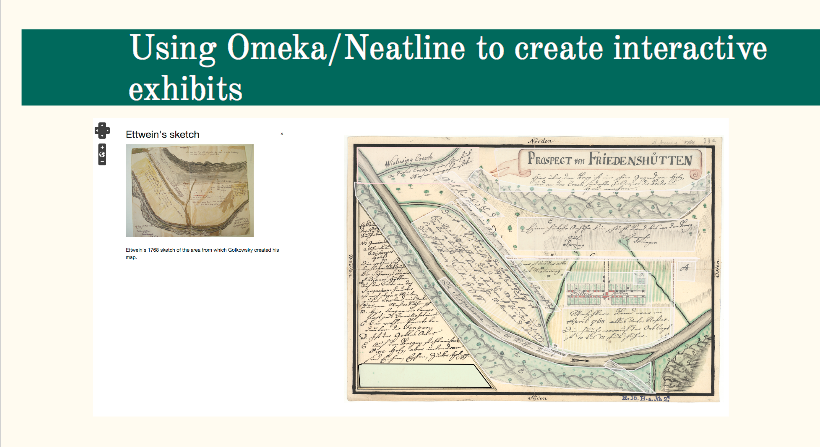
Golkowsky’s 1768 map of Friedenshütten, near Wyalusing. From the Unity Archives, Herrnhut TS 213.13. All rights reserved. An interactive version can be found by clicking here.

Part of the land on which this plant will stand was once the Moravian Indian town of Friedenshütten, a thriving, busy, and strategically important village from 1765-1772. But like any site where material traces of human culture have been erased, it is difficult to imagine the life that was lived in this place, an enterprise that brought together European settlers and Native Americans (Mahicans, Lenape, and members of the Six Nations of the Haudenosaunee) in the confusing and tumultuous period around American independence. Manuscript diaries kept by the Moravian missionaries reveal many details that help paint a rich picture of life on that field. From its beginnings in the spring of 1765, when food was scarce and the bears were not, to its dissolution in the summer of 1772, the town supported itself with its gardens of produce, and seasonal hunting and shad fishing.  It hosted numerous parties of visiting Indian nations, some very large and very hungry, many coming for a political parley, some coming to visit their family members who had converted to Christianity. Reading the mission diaries that still exist only in manuscript form, a picture emerges of a vibrant community with a multi-lingual school, a Gemeinhaus (church) complete with oil paintings and a bell, log houses with glass windows, bark houses for those who preferred them, fertile kitchen gardens, and canoes tied up along the river bank.

As we look at the empty field today, it is hard to envisage the multilingual and multicultural celebrations that took place here. The Moravian Indians who came here had already endured terrible hardships, as we can read in the detailed account by the missionaries Johannes Schmick and David Zeisberger, now published in the Journal of Moravian History. In the very first year of the mission, 1765, in this soon to be destroyed field, as many as 120 people attended a midnight Christmas Eve service at which the gospels were read in the Lenape language to an attentive congregation.  For the next seven years, Christian feast days were celebrated with liturgies in the Lenape language, beeswax candles, and musical accompaniments.

Staking out the drainage ditch at Friedenshütten, May 13, 2019. Photo courtesy of David Buck.

The building in which these remarkable occurrences took place stood at the point at which today we see the historical monument, dedicated to the memory of the Moravian Indian village. As we look westwards, we might have seen a street lined with those log houses and Indian bark dwellings, in which men and women and children lived, and worked, and prayed, and slept. Yesterday, as I walked through the misty rain, I saw the stakes already planted in the ground to mark off the edges of a 50′ wide trench to drain stormwater from the site. This ditch will cut straight through the site of the historical village (for a detailed map, click here).

So why should we care about what looks like just a point on the map, an empty field with a simple obelisk in the middle, marking the site of this Moravian Indian village from the last half of the 18th century? First, history matters. An important part of what makes us human is our ability to learn from the stories of the past, to read and listen to the memories of others, to think about the lives that they led, perhaps to better understand our own. And when those people are no longer here to tell us these stories themselves, our communities need to curate and incorporate them into an understanding of where we are from. If we erase those places and their narratives, we are in danger of not only flattening the land around us, but also diminishing our understanding of ourselves.

Moravian Historical Society monument in Browntown, PA. Photo courtesy of David Buck.

Second, the Native Americans who lived here both before the Moravians came and while they were here have descendants among the current-day Lenape nations in Canada and Oklahoma. Tracing one’s roots back several generations is notoriously difficult for displaced peoples, as anyone who has explored their ancestry knows. Destroying this site will further erase the past of Native peoples who were pushed out of Pennsylvania by Sullivan’s march, the final military act of forced removal of Indians from this state. Mach’wihilusing (the Indian village’s name) and Friedenshütten mark the place of people’s pasts, of their lives and in some cases their deaths. Recognized by the state’s historical commission, this is a place we must work to preserve, this Jewel of the Susquehanna. If we care about the past, a past that brings together settlers from Europe and Native American nations, in order to build a better future, then we need to make our voices heard and write to the newspapers, write to our political representatives, write to the DEP, and demand that a full historical site survey be carried out on this important place in American history.

Exciting progress on the Moravian Lives project!

Progress report

The project development team at Bucknell University has been very busy in the last few months.

As was reported on the Bucknell University DPS blog at the beginning of the summer, work is continuing on a couple of fronts. Our Bucknell student “super transcriber”, Carly Masonheimer ’21 has been doing a fantastic job of transcribing the English language materials and now, thanks to generous support from both the Bucknell Unversity Center for the Humanities and the Moravian Archives, Bethlehem this June Carly was able to attend the German Script seminar at the Moravian Archives and is transcribing the German script materials! Further transcription work has been done by Marita Gruner, doctoral candidate at the University of Greifswald, Germany.

This fall, Sarah Kannemann, a doctoral student in the field of Church History at the University of Mainz in Germany, will be coming to Bucknell as a visiting scholar to learn “the Bucknell DH method,” and work closely with project leaders, Faull and Jakacki. She will also carry out archival research at the Moravian Archives in Bethlehem, PA. Thanks go to Prof. Craig Atwood at the Center for Moravian Studies at Moravian Seminary for supporting Sarah’s stay in Bethlehem.  Further cutting-edge platform development is planned this fall at the Academy of Sciences and Literature in Mainz where as part of this exchange, our project developer, Michael McGuire ‘07, will also be teaching a module of the Mainz DH summer school, focusing on the Bucknell “Moravian Lives” project.

New UK Materials

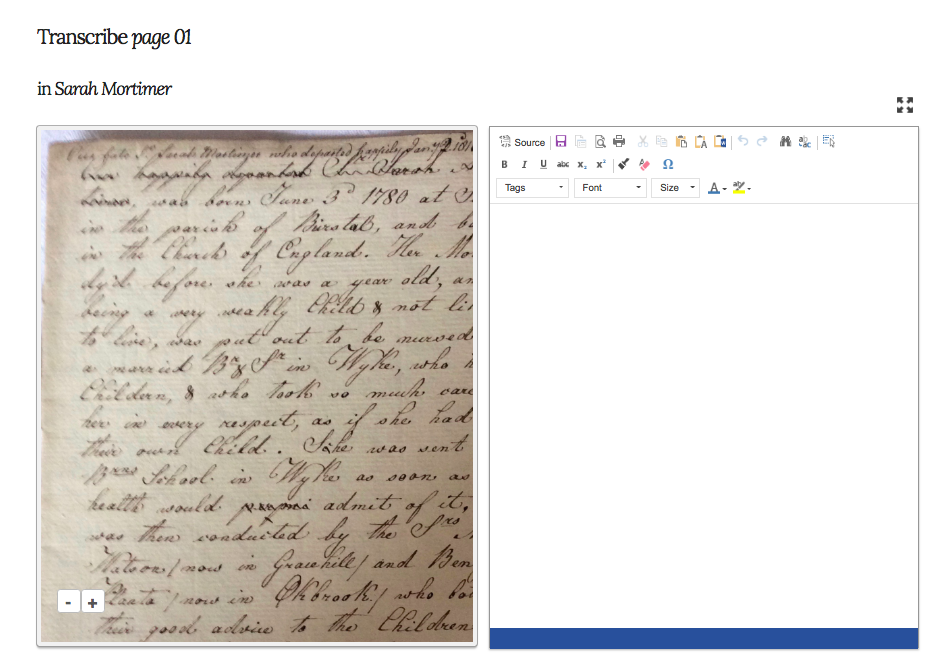
In March 2018, Katie Faull travelled to the Fulneck archives in Yorkshire, UK.  Fulneck was one of the most important Moravian communities in the UK in the 18th century, visited at its founding by Zinzendorf, Anna Nitschmann, Spangenberg and other leading figures in the early church.  The archives there are well-organized, thanks to the work of Rev. Hilary Smith.  While at Fulneck, with the help of her volunteer research assistant, Jane Faull, she was able to digitize the whole as yet uncatalogued collection of Single Sister’s memoirs, as well as a part of the other Choirs’ memoirs.  We are very excited to announce that this collection of Single Sisters memoirs is now available for transcription on the transcription desk!

Screen Shot 2018-08-08 at 9.55.26 AM

This new Fulneck collection joins the other UK materials on the site. In January 2017, Faull digitized a sizeable proportion of the memoirs in the Fetter Lane collection at Church House, Muswell Hill, London. These have already been partially transcribed and form part of the primary materials corpus for Faull’s HUMN 100 The Humanities Now! course at Bucknell in fall 2018.

Latest Scholarly Output

Faull and McGuire will be using the transcribed materials from the Moravian Lives website as their research corpus for a jointly presented paper “Analyzing Moravian Feelings: Using Computational Methods to ask Questions about Norms and Sentiments in Moravian Lebensläufe” at the 5th International Pietism Congress in Halle, Saxony later in August 2018.  We will also be using the opportunity of the Congress to hold our first International Steering Committee meeting for the Moravian Lives project, on which scholars from Germany, the US, Australia, Sweden, and Labrador sit.

Financial support for the Moravian Lives project has come (on the US side) from Bucknell Univesity’s L&IT, the President’s Office, the Bucknell Humanities Center and funds from Faull’s Presidential Professorship. In Sweden, the project has been funded by the Center for Critical Heritage Studies at the University of Gothenburg and also its Center for Digital Humanities; and in Germany funds have come from the federal state of the Rheinland-Palatinate awarded to the University of Mainz’ Professor Wolfgang Breul.

Moravian Lives research collaborators include the Moravian Archives in Bethlehem, PA, the Unity Archives in Herrnhut, Germany, the Moravian Archives in London and Fulneck, U.K., the Johannes Gutenberg University in Mainz, Germany, the Academy of Sciences and Literature in Mainz, the University of Gothenburg in Sweden. Students who are involved on the project include Carly Masonheimer ‘21, Marleina Cohen ‘21, and Bucknell graduates Khoi Le ‘18 and Michael McGuire ‘07.


Resolving the Polynymy of Place: or, how to create a gazetteer of colonized landscapes

Katherine Faull, Bucknell University, Diane Jakacki, Bucknell University

Paper delivered at DH 2018 Mexico City June 27-30, 2018

ABSTRACT

This paper will explore the problem of creating a gazetteer of colonized landscapes, specifically those of the mid-Atlantic in the 18th century, in which the name of a place (toponym) changes depending on the person or political entity who is describing that place. In colonized landscapes, there can be multiple names for one place. Maps of this period are veritable palimpsests of conquests and defeats; and travel diaries, mission records and letters contain accounts of human experience of places that are multiply identified. The task is made more complicated still when one factors time into the equation: when competing spatial identities persist across generations.

The paper proposes a two-phased approach to developing the Moravian Lives gazetteer, which will expand geographically to places beyond North America and will need to resolve polynymic complexities in Central Europe, the Arctic areas of Greenland and Newfoundland, the Caribbean, South Africa and Australia.

This paper is published at http://dx.doi.org/10.17613/M6BG2H91J.    All rights reserved.

Resolving the Polynymy of Place: or, How to create a gazetteer of colonized landscapes

Katherine Faull, Bucknell University, Diane Jakacki, Bucknell University
Slide 2. Introduction 

This paper explores the problem of creating a gazetteer of colonized landscapes, specifically those of the North American mid-Atlantic in the 18th century, where the name of a place (toponym) changes depending on the person or political entity who is describing that place. Maps of this period are veritable palimpsests of conquests and defeats.

Slide 3 Mattheus Hehl’s Itinerant Preachers Map

They also are the result of travel diaries, mission records and letters that contain accounts of human experience of places. The task of compiling a historical gazetteer is made more complicated still when one factors time into the equation: that is when competing spatial identities persist across generations.

Slide 4 Naming Mountains

Here a detail of the previous map where the mountains are renamed as they are crossed by German Moravian missionaries.

Slide 5 Moravian Lives Gazetteer 

Using the case study of the research project “Moravian Lives” we ask how we can create a gazetteer of places using authority IDs, when that very authority is itself the product of a political-historical struggle. Facing the problem of polynymy (multiple placenames for one location) how can we satisfactorily reflect the multiple perspectives and presence or absence of agency of those who name place? If one of our objectives is to make our gazetteer ready for linking with other projects, can we use this approach to create a system of “triples” that will align our place names more effectively.

We argue that the addition of a variable that allows for the designation of agency helps to resolve that problem.

The construction of an historical gazetteer for Moravian Lives involves complexities that arise from not only the naming of places but also how their spatial identities reflect respective, concurrent relationships to those places by Native American peoples, Moravian missionaries, and colonial representatives. There are multiple names for a single place as well as multiple understandings of place names, and these differences depend on who it was who did the naming.

  • How can we recognize spatial multivalence (or “polynymy”) in the Moravian Lives gazetteer?
  • How does the scholar act responsibly while acknowledging their own potential complicity in political-historical renegotiations and multiple cultural understandings of place?
  • Must we not push back at the idea of *an* authority, and work toward a system that recognizes and synchronizes multiple authorities?

Slide 6) Moravian Lives Database 

This is the current state of the personography and gazetteer–the metadata of the 60,000 records are in an intraoperable database but not interoperable LOD system, either with the person and place entities in the transcribed memoirs or with a digital cultural heritage infrastructure.

Slide 7 Setting scoped by Period and Place 

In examining models for the creation of digital historical gazetteers we have found the one proposed by Grossner, Janowicz and Kessler to be particularly helpful. In order to prepare a gazetteer for broad data linkage, they adapted Peter Bols’ list of requirements for digital gazetteers to consider the complexities of place over time. They employ the term “Place” in a contextual sense, where geographic space provides the location for events as well as artefacts and Earth features. They then use the term “Period” as related to time spans – “containers”, as they explain, for discrete “events or an interval of time.” Grossner and his co-authors then apply the concept of “geosetting” proffered by Michael Worboys and Kathleen Hornsby to account for the complexities of the spatial-temporal.

As shown in their diagram we can, therefore, see the subject/predicate/object structure in which Setting is scoped by both Period and Place where each has a specific type and name. Setting, therefore, provides Temporal and Spatial Scope, supporting a framework for W3C OWL Time and Geospatial ontologies.

While this historical expansion is incredibly useful for distinguishing place names that change over time, it also reifies placename authority in a linear geographical narrative predicated on socio-political understandings of possession. For example, 17th-century Eurocentric names for the areas that would ultimately comprise Pennsylvania were connected to land claims and treaties among Dutch and English powers, all of which had beginning and end dates, and were defined by particular geometries. The “Setting” model as set forward here does not take into account the complexities of socio-cultural understandings and namings of place – often in concurrent and sometimes competing timespans.

Slide 8 Case Studies 

Slide 9 Shippen’s Shamokin 

An example of this challenge is the town of Shamokin in 18th-century Pennsylvania. From the end of the 17th century to the mid-18th century, Shamokin was known as the capital of the Woodland Indians.  Lying at the confluence of the two branches of the Susquehanna River, intersected by over 11 major paths used by American Indians, it marked the southern limit of Iroquoia and was considered by both the Iroquois and the colonial powers to be a location of great strategic significance.

Slide 10 John Smith’s Quadroque

Before the Iroquois Shamokin, this place was the probable site of “Quadroque,” one of the Susquehannock forts marked on Captain John Smith’s 1612 map of his journeys around the Chesapeake.

Slide 11 Shippen detail

Shamokin encompassed the shores of both branches and an island at the river’s fork for Shikellamy, the Oneida emissary of the Six Nations of the Iroquois or Haudenosaunee, who oversaw the Algonquin-speaking nations of the Lenni Lenape, Shawnee, and Mahican in Iroquoia (present-day Pennsylvania and New York), and who lived in the town in the 1740s.

Slide 12 Heiden Collegia

To Nikolaus von Zinzendorf, the founder of the Moravian Church who visited Shikellamy in 1742, “Shamokin” represented an opportunity to proselytize Christianity to the Iroquois. Shamokin had already loomed large in Zinzendorf’s mind as he planned his  “Heiden-Collegia” in Pennsylvania and New York.

Slide 13 Plan of the Western Front

To Conrad Weiser, Palatinate German settler and negotiator between the colonial government in Philadelphia and the Indian nations, “Shamokin” represented a strategic and ultimately military outpost that would become the site of Fort Augusta during the French and Indian War. These “Shamokins” co-existed, with Native American, Moravian, and Colonial inhabitants and visitors relating to it in discrete yet overlapping ways.

A further complication is the existence of present-day Shamokin, founded in the late 18th century, which lies 18 miles to the east of the historic town.

Slide 14 Modification of Grossner’s model 

This is a simplified diagram of “setting” defined by Period and Place

Slide 15 Adding Agent 

Drawing on the recent work of scholars of new gazetteers (Berman et al 2016), we propose a modification of Grossner et al’s model through the inclusion of consideration of the “agent” of an event that occurs within a particular setting (defined by temporal and spatial scope). By including an agent within this model we thus can deepen the “geosemantic” approach to place that recognizes that a place may be the setting for many events of significance, that significance being dependent on the view of the naming agent. Following Doreen Massey’s dictum that “place is the meeting up of histories in space” (Massey 2005) the inclusion of agent, whether a person or an organization, foregrounds the historical aspect of geo-spatial mapping without imposing a hierarchy on the naming authority of that place. Thus, the colonial practice of renaming “unfamiliar” places with familiar names (Paul Carter, “The Road to Botany Bay” and Faull, “Smooth Rocks in a River Archipelago”) can be recorded and presented as a polynymic practice without granting that colonial name primacy.  Pulling on a more metonymic naming practice, the addition of “agent” facilitates the mediation between historical discourse and the spatial world. We reject the suggestion that a historical gazetteer should create a hierarchy of definitions of place, from the mainstream to the marginal (Shaw, 2016) but rather we propose that addition of agent as an entity will allow for the aggregation of naming practices in a metonymic string.

Slide 16 Shamokin Determined as Authority Name 

Shamokin offers us an excellent example of how we can benefit from the modification of “agent” in the Setting model. As demonstrated above, there is no one “Shamokin” in the contact period; however, there are multiple names for the place(s) that constituted the geographical area during that timespan – all connected to people or groups of people who lived in or associated with the space, often at the same or in overlapping periods of time. As we develop the gazetteer we are trying to resist the temptation of claiming a naming authority for ourselves that is, resolving to one authority name that we have determined for digital expediency’s sake. Just as we are conscious of the need to recognize different cultural heritage claims to place names, we are concerned about reifying “variants” or in some way deprecating or subordinating others to one name.

In this case, the names we are working with are Shamokin, Fort Augusta, Otzinachson, Sunbury, and Chenastry. Those names are associated with multiple Native American nations, administrative powers and settlers/colonists, and there is no discrete linear temporal distinction between place names (as Grossner’s model asks).  

Slide 17: Adding Metonym

The concept of creating “metonyms” works well within our project. While we create unique identifiers for each place name within the Moravian Lives taxonomy we can extend our TEI schema to include an attribute of @metonym under the @naming class. Therefore, we can connect these place names so that:

Shamokin is a metonym of Fort Augusta is a metonym of Otzinachson is a metonym of Sunbury, etc.

Slide 18: Considering Existing Unique IDs 

As we create the Moravian Lives entities, we negotiate the difference between place names that need to be “minted” and those that have already been assigned a VIAF, Wikidata, or Geonames ID. So far we have not found such IDs for Otzinachson or Chenastry, so we can establish a Moravian Lives ID and make them unique identifiers on the web (via Wikidata, etc.) Because Fort Augusta already has a Wikidata ID of Q5470761 we can associate our Moravian Lives Fort Augusta with that Fort Augusta via “sameAs”. If we do the same with Sunbury, it has a Geonames ID of 5214814. However, in the Geonames entry Sunbury has an alternative name of “Shamokin” – but without citation or date-range indicator. For the historical and cultural studies scholar, it is inaccurate, misleading, and in some ways, irresponsible then to equate Sunbury with or consider Shamokin to be its variant.  As digital humanities projects move into a phase where historical place data is linked, we want to find ways to resist the givenness of authority names; we believe that the metonymic chain of place names need not be fully recognized but is available to all people.

Slide 19: Polynymous Shamokin 

Once we have established the idea of metonymy, we can return to the idea of “agent” and how it is through these eighteenth-century agents that we can effectively integrate the gazetteer within the larger Moravian Lives project and then more broadly to other DH projects. As outlined above, our agents are individuals and groups of people.

Mme Montour and Colonial/metis traders ~ Chenastry

Shikellamy and Iroquois nation, Count Zinzendorf and the Moravians ~ Shamokin

Conrad Weiser ~ Otzinachson

British Colonial powers ~ Fort Augusta

Northumberland County administrators ~ Sunbury

As we create our Moravian Lives entities and relationships, therefore, we need to be explicit about establishing links between the Moravian Lives gazetteer places and persons and organizations. So we create a bi-directional link between ML Shamokin and Shikellamy, Zinzendorf, Moravians, and Iroquois; Fort Augusta and John Sullivan, etc.

Slide 20 Conclusion

We recognize that this is just a beginning and we eagerly look forward to further conversation.

Slide 21 Bibliography

Original slide show viewable at http://bit.ly/2yUIEzc

—————–


Translating the Holocaust: The Ethics of Memoir

Paper delivered at the conference, “Holocaust Writing and Translation” Institute of Advanced Study, University of London, Feb. 2011.

In his provocative 1998 study of the theory and practice of translation, critic Lawrence Venuti makes the following claim for the power of translated texts to disrupt the target culture’s literary and ideological hegemony.  Although “foreign literatures tend to be dehistoricized by the selection of texts for translation, removed from their foreign literary traditions where they draw their significance”(Venuti 1998, 67), translation, he asserts, “simultaneously constructs a domestic subject” (Venuti 1998, 68) who can be transgressive or conservative.  Translation possesses for him “an identity-forming power” that can change canons and concepts of self-identity by forming new domestic subjects through “a process of “mirroring” or self-recognition: the foreign becomes intelligible when the reader recognizes himself or herself in the translation by identifying the domestic values that motivated the selection of that particular foreign text and that are inscribed in it through a particular discursive strategy.” (Venuti 1998, p. 77)  In other words, translated texts, although removed from their historical context in the source culture, retain a transformative power in the target culture because that which was seen to be relevant to the target culture is identified by the new audience.

Venuti takes as case studies two canon-changing translation trends in Classical and Japanese literature.  However, I would like to test this claim on perhaps the far thornier literary and historical phenomenon of Holocaust memoir.  To what extent could Venuti’s insight help us to understand the complexities of reception of the translated text of personal testimony in Holocaust literature.  To what extent does a target culture recognize itself in the translation of the text of witness?  To aid me in this inquiry, I will draw on the work of Italian philosopher Giorgio Agamben, in a brief examination of Primo Levi’s Survival in Auschwitz, and the publication history of Ruth Klüger’s weiter leben (1992) and its English version Still Alive (2001).

Recent critical studies of Holocaust memoir have made, what is euphemistically known, as the “linguistic turn”, using either speech act theory, or recent trends in linguistic pragmatics to examine the implicit and explicit assumptions about the truth-value of the utterance of witness and testimony in Holocaust memoirs.  Such an approach can be found in Ruth Franklin’s A Thousand Darknesses: Lies and Truth in Holocaust Fiction, newly issued from Oxford University Press, in which she bravely points out that even “the canonical work of Holocaust literature, involves some greying of the line between fiction and reality.” (p. 11)  Alan Rosen in his Sounds of Defiance: The Holocaust, Multilingualism and the Problem of English (Nebraska UP, 2005) problematizes the use of English, both within the camps and in immediate post-war texts of testimony as well as in the proliferation of Holocaust memoirs now written with English as their first language.   Piotr Kuhiwczak’s “The Grammar of Survival.  How do we Read Holocaust Testimonies” (in Translating and Interpreting Conflict, (2007) pp. 61-73 examines the fascinating phenomenon of using how English, with its status of non-Native language, can access memories of trauma that remain inexpressible in native tongues. (P. 67)  All these studies problematize the use of English in critical literature on the Holocaust as well as, for Rosen, examine the potential liberatory value of English in the camps.  However, as Franklin’s title would suggest, what is also at stake here is the question of authenticity; the authenticity of the speaking and writing “I” in testimony, the authenticity of the memoir (most famously disproven in the scandalous case of Wolfgang Koeppen’s “ghost-writing” of Jakob Littner’s first-person account “Journey through the Night”) and the examination of the power of, what critic Philippe Lejeune has famously termed the “autobiographical pact.”  This pact, he has theorized, is the necessary agreement between reader and author that the grammatical, speaking “I” of the autobiographical text is the same as the experiencing “I” who is the principal character of the memoir.  This equation constitutes the classical autobiography.  There are variations: where the speaking “I” is not the experiencing “I” and the text, therefore, becomes a “biography in the 1st person;” in other words, a homodiegetic narrative of witness, approaching what Italian philosopher Giorgio Agamben  posits in his examination of the impossibility of writing the testimony of the “Muselmann” in his brilliant study of the ethics of witness and the Holocaust Remnants of Auschwitz: The Witness and the Archive (Zone, 1999).  Or, the writing grammatical subject can be referred in the second person but still be identical with the writing subject, in which case we have an autobiography in the second person, such as we find in Christa Wolf’s Kindheitsmuster.  The choice of grammatical speaking and witnessing subject is crucial to the testimonial nature of Holocaust memoir.  Given that many critics, from Adorno to George Steiner, consider Holocaust testimony to reside outside the realm of aestheticization or fictionalization, we arrive at a demand for a kind of “radical authenticity” in Holocaust memoir that, as Agamben argues, carries the impossible and tautological burden of bearing witness to the gas chambers, an experience that one cannot survive.  For Agamben, “ the value of testimony lies essentially in what it lacks; at its center, it contains something that cannot be borne witness to and that discharges the survivors of authority.” (Agamben, 1999, p. 33)  If then, one cannot bear witness to an event, such as being inside a gas chamber and survive it to write of it, the meaning of testimony has to be sought elsewhere. For Agamben, that meaning is to be found in the ethical decision to write of the (untranslatable) Muselmann, the state of simultaneous being human and non-human.

Let us return momentarily to Venuti’s claim with which I began this paper, namely that the potential for cultural disruption that the translated text possesses lies in its ability to “enable a process of self-recognition”.  Now, Venuti here is arguing for a model of [re]cognition that stems from the German Romantics and has been most thoroughly examined in terms of translation studies by Antoine Berman in his work, L’épreuve de l’étranger: Culture et traduction dans l’Allemagne romantique. [Paris: Gallimard, 1984] .  Berman identifies in his work the twelve deforming tendencies of translation

  • Rationalisation,
  • Clarification,
  • Expansion,
  • Ennoblement,
  • Qualitative impoverishment,
  • Quantitative impoverishment,
  • the destruction of rhythms,
  • the destruction of underlying networks of signification,
  • the destruction of linguistic patternings,
  • the destruction of vernacular network or their exoticisation,
  • the destruction of expressions and idioms,
  • the effacement of the superimposition of languages

Of these tendencies, the ones that might prove to be of most conceptual use to the study of Holocaust memoir and translation are the “destruction of underlying networks of signification” and those deforming tendencies that deal directly with the inter-lingual translation as also an inter-semiotic one.  For example, what would be the linguistic patternings of the source text, the vernacular network, expressions, idioms, the multi-layering of language in Holocaust memoir?  In Primo Levi’s Survival in Auschwitz, the author makes frequent reference to the “Babel” of the carbide tower of the Buna works, built with its “Ziegel, briques, tegula, cegli, kamenny, mattoni, téglak”, (p. 73) the ziggurat of linguistic brickwork preserved in Stuart Wolf’s translation.  German in the camps is a language of survival, English the language of potential liberation, signified by the grinning English POWs in their fur-lined jackets, clandestinely giving the extra-linguistic Victory sign as they pass the lines of slave workers.

But what must also evade deformation in translation is the untranslatable, the sign that cannot be deciphered, to which no equivalent may be found in any target language:  the Muselmann.  Again, avoiding the deformation of the loss of vernacular networks, Stuart Woolf lists the labels one could assume within the camp system, the “Organisator, Kombinator, Prominent” and if one cannot become one of these, one soon “becomes a musselman” (p. 89)  Strangely, Woolf decides to attempt a translation of Muselmann and produces a deformed term—“musselman”, what is this, a collector of mussels? Not even using the lexical equivalent of the German term “Muselmann”=muslim, Woolf produces a neologism, perhaps to exoticize, to alienate, to make the reader stumble over the term.  But, I would argue this is not satisfactory, which also seems to be Woolf’s judgment as he switches on the following page between his newly coined and deformed term and the German original.

The “Muselmann” provokes much discussion in both Holocaust literature and criticism.  For Agamben, Levi’s account embodies the paradox of witnessing the “Muselmann” in that the ethical moment of Holocaust memoir comes in self-recognition of the witness in the human/non-human whose gaze has now become milky, whose skin has developed sores and whose body displays the edema of severe malnutrition: that gaze of self-recognition that produces the guilt of the survivor and the exhortation to witness.  The subversive tendency of translation in this perversely Lacanian mirror-moment would then consist of a disruption of the radical anti-semitism of the Nazis that pro- and re-duces the human to the non-human, that translates the Jew into the “Muslim”, the “Muselmann.”[1]  What is left, as an act of permanent restitution, in the sense of Steiner’s fourth hermeneutic motion, would then be to give the “drowned their story” to quote Primo Levi.  The untranslatable “Muselmänner” of Auschwitz, etymology better left unknown, present themselves as “the anonymous mass, continually renewed and always identical, of non-men who march and labour in silence, the divine spark dead within them, already too empty to really suffer.  One hesitates to call them living: one hesitates to call their death death, in the face of which they have no fear, as they are too tired to understand.” (Primo Levy, Survival in Auschwitz, p. 90)

The ethical question that Agamben poses, and on a much wider cultural plateau that Venuti echoes, is how to bear testimony to “this inhuman impossibility of seeing.”  (Agamben, p. 54) Is then what is recognized as the “tohu-bohu” of preconscious existence?  The chaos of the existent world before God moved upon the waters?  That state of non-being of which each of us is capable, that is beyond the ethical, the moral, the conscious? And what does that then make of the witness? Not only one who recognizes that this state is present in the other and the self, but also that the presence of this state radically disrupts the moral fabric of those who survive, of the world that continues on after the “non-death” of the Muselmann.

How, then, does the survivor “weiter leben”?

In 1992, Ruth Klüger published her Holocaust memoir, weiter leben.  Wildly successful in Germany, selling over 250,000 copies and on the bestseller lists, the book actively engaged the German reader in an interrogation of the Nazi past.  Immediately translated into Dutch, French, Italian, Spanish and Japanese, the book did not appear in English until 2001, after the death of Klüger’s mother.  However, as Caroline Schaumann has pointed out, Klüger’s English Holocaust memoir was an act less of textual self-translation than a substantive cultural translation.[2] Schaumann has already painstakingly traced many of the linguistic and stylistic changes from the German version to the English and has linked the changes to specific events in the ensuing years after the appearance of the German volume.  For example, Klüger’s mother dies, new facts arise as to the actual end of Klüger’s father (in fact from a reader of the German version), Klüger writes the English version in America and not in Germany.  There are multiple places within the work where Klüger performs deformations à la Berman of either expansion or clarification, whether dealing with German terms, Jewish, or allusions to American parallels.   Schaumann examines the comments made by the author that are specifically targeting her audience, either in Germany or in the US and comes to the conclusion that Klüger’s text is “the first Holocaust testimony devised as a specific dialogue with a culturally specific readership.” (p. 336)  Putting the question of primacy aside, I would like to focus on one culturally specific change to the Holocaust memoir that caused Klüger to rewrite the whole work as an English memoir and not as a translation of a German memoir, bearing in mind Venuti’s claims for translation’s potential to form cultural identities.

Klüger was also in Auschwitz.  The argot of the camp produced, from nowhere, the term “Muselmann” as referenced above in Levy’s work.  In the German text of her memoir, Klüger writes of the importance of not giving up hope in order that one did not become like the Muselmann:

Es gibt eben außer der Hoffnungslosigkeit, die Mut macht und die Borowski über die  Hoffnung stellte, noch die apathische Hoffnungslosigkeit, verkörpert in dem Phänomen “Muselmänner”, Menschen, denen der Selbsterhaltungswille im KZ abhanden gekommen war, und die nun wie Automaten reagierten, fast autistisch.  Sie galten als verloren, kein Muselmann könne lang überleben, versichterte man mir.  (weiter leben, p. 106)

Echoing Primo Levy, Klüger defines the Muselmann as the non-living, the autistic, non-communicative existent, soon to be memorialized in her “aalglatte[r] Kindervers” Der Kamin, which follows, transcribed from memory as the poet had in Auschwitz, of course, neither paper nor pencil.

In the English version, as though suddenly faced with the ontological paradox of translating the phenomenon of the Muselmann, Klüger omits the remembered children’s verse, and writes the following:

Maybe there are two types of despair, the kind that enables you to take risks, as Borowski thought, and which he held in higher esteem than hope, and then the kind of despair that makes you listless, sluggish, impassive.  There was a type of prisoner who had given up, whose will to live had been destroyed, who acted and reacted as if sleepwalking.  I don’t know the source of the moniker Muselmänner, Muslims, which was used to describe them, but no racial slur was implied, since Islam wasn’t an issue either for the Nazis or for the inmates of the camp.  The Muselmänner were walking deadmen who wouldn’t live long, I was told. (Still Alive, p. 90)

Bearing in mind her politically sensitive American audience, Klüger removes the reference to autism, and performs a quantitive and qualitative deformation by substituting “listless, sluggish, impassive”  (hardly a PC way out for the readers who knew the German as well as the English!).  Faced with the “épreuve” of translation, of the foreign, Klüger (like other prisoners in Auschwitz) denies knowledge of the source of the term “Muselmann,” at the same time as she assures us of its non-racist intentions, removing from its conceptual grid the very irony commented on by others (Mansoor et al).  Klüger’s  American version has been deformed, with the destruction of the underlying networks of signification, of the vernacular network of the KZ and its idioms.  Schumann has identified the places in the American text where Klüger has drawn sometimes uncomfortable parallels between the experience of anti-Semitism and American racism, places that she, Schaumann elevates to the status of a direct interrogation of the target audience.  I would disagree.  To return to Venuti: the phenomenon of racial discrimination may well be that which the target audience (of which Klüger herself has become one, as an American not German author) sees reflected in the translated text and recognizes as the reason the text speaks to them.  But, the ethical moment of translation, is to endure the “épreuve” of the foreign, the gaze of the slave worker, the non-death of the Muselmann.

[1] See Parvez Manzoor “Turning Jews into Muslims: The Untold Saga of the Muselmänner” Islam21 (April 2001) pp. 8-12.  Accessed on 2/5/11 at http://www.algonet.se/~pmanzoor/Muselmann.htm

[2] Caroline Schaumann, “From weiter leben (1992) to Still Alive (2001):  Ruth Klüger’s Cultural Translation of her “German Book” for an American Audience” in German Quarterly 77 (Summer 2004), pp. 324-339.

“Teaching, Learning, Doing DH in a Comparative Context: Promoting Critical Thinking in the Liberal Arts”

Delivered at the 2016 ACLA Harvard University March 18, 2016

What does it mean to do Digital Humanities in an undergraduate context?  How do we promote critical and comparative thinking at the same time as cultivating “digital habits of mind?”

In  Bucknell University’s interdisciplinary Comparative Humanities Program, Digital Humanities has become the fulcrum of a new critical hermeneutic that invites students in Computer Science to think as Humanists and students in the humanities to learn the processive discipline of Computer Science. Starting with seminars on the concept of DH itself, and the challenges that it might pose to critical theory and the canon, this program has developed a set of undergraduate courses that takes students from the discovery and representation of an archival artifact to the creation of sophisticated data visualizations of multi-variant datasets.

Intrinsic to these pedagogical inquiries are the “multiple lenses” of DH, as Tanya Clement has described them. Moving between the positivism of data curation and the critique of interpretation, students learn that representation is also a knowledge generator; that epistemological systems beget representational systems in the digital world as well as the analog (Drucker 2014). As such, student DH-ers become critical learners, questioners and creators.

Within the field of Digital Humanities (and for this paper I am going to posit that there is a field–itself a significant question) there still rages the vibrant debate whether one must code to be a true DH practitioner. Within the undergraduate environment, this is especially complex, as curricula within colleges (such as across Engineering and Arts Sciences) are not normally constructed to allow for coding humanists or humanistic coders.  However, I would argue, following Alan Liu, that a Liberal Arts environment provides exactly the location where we can investigate “The Meaning of DH” (Liu 2014).  In thinking about DH as a hermeneutic act, teachers and students alike become both “builders and interpreters” where the goal of undergraduate DH is guided by a pedagogic hermeneutic of “practice, discovery, community.”  Indeed, within the Liberal Arts context we are encouraged to practice what I and others call “research-based learning” in which we faculty scholars invite student-scholars to collaborate in a classroom setting on our own research.

Founded in 2001, the Comparative Humanities Program at Bucknell seeks to engage the undergraduate student in a sophisticated and complex examination of the breadth of the humanistic disciplines.  Not limiting itself to the study of literature, the program incorporates the study of philosophy, history, religion, political science, echoing Giles Gunn’s 20-year old critique of the limits of comparative literature. As he says,

“Literature and  . . . ” does not capture the emergence of new subjects and topics such as history of the book, materialism of the body, psychoanalysis of the reader, sociology of conventions, ideologies of gender, race, and class as well as intertextuality, power, and the status of “others.” (Gunn 1992, 248-9)

With its own dedicated core courses that follow what might seem to be a “Great Books” trajectory, the program also incorporates theoretical and methodological seminars in concepts of comparativity across media, genres, and national literatures.   It also regularly cross lists courses from departments across the humanities at the 200 and 300-level. Upper level seminars in, for example, The History of Sexuality, are cross listed three or even four ways, causing the Registrar many headaches.

Criteria for cross-listing are based in the adoption of 2 or more of our learning goals that foreground concepts of comparativity, linguistic competency, and written and oral communication.  In order to distinguish ourselves from courses in English literary studies, for example, or Philosophy, comparativity is crucial.  Assessing student outcomes is also key to the evaluation of educational achievement and can prove a difficult task.

In her long engagement with the theory and practice of interdisciplinarity, Julie Thompson Klein has provided the academy with a useful vocabulary with which such assessment can work.  Distinguishing between multidisciplinarity, interdisciplinarity, and transdisciplinarity, in her recent volume Interdisciplining DH: Boundary Work in an Emerging Field (2015) Klein firmly situates DH (and I would argue CH) within what she terms the baseline vocabulary of interdisciplinarity.  Privileging integration over juxtaposition or (a kind of Hegelian) synthesis (although the latter are not excluded) the ground of interdisciplinary comparison becomes for Klein method, data, tools, and concepts.

Within this curricular environment, the Program in Comparative Humanities in collaboration with colleagues in other humanities departments has designed a minor in Digital Humanities that includes the following curricular components:

  • course offerings that explicitly involve Digital Humanities (and/or Digital Media) modes and methods as applied to critical humanistic inquiry
  • interdisciplinary/cross-disciplinary courses that bring the “digital” to and from other disciplines
  • Independent study and/or faculty-student research project electives that involve digital literacies and the development of applicable skill sets
  • a portfolio that demonstrates mastery of digital approaches to humanities subjects through a set of artifacts

This minor is interdisciplinary in nature, spanning humanities departments and programs and including faculty from non-humanities programs and departments and Engineering as appropriate.  As my colleague and co-author Diane Jakacki and I have written elsewhere, one of the distinguishing features of a Digital Humanities course is the foregrounding of critique.  Unlike other more CS-based classes, students in DH classes are required to reflect on the process they have undertaken in developing their projects to be able to place their praxis within the broader scholarly discourse of DH.  Therefore, we argue, carefully selected readings are directly linked to development of each of the student’s competencies and embedded within the class schedule. Teaching students to use these digital platforms requires the conscious placement of the course within a curricular context; in our case, within the context  of the program in Comparative Humanities.

The learning goals of the minor (a requirement to be included in the minor is the adoption of at least two of these) foreground the concepts of interdisciplinarity and critique.  Requiring students to learn, practice and critically evaluate the methodologies, conventions, and social contexts of DH, the minor attracts students from STEM and other humanities fields.  And, in order to integrate and not merely juxtapose, in these courses, DH cannot be viewed as “just a tool, just a repository, just a pedagogy (Klein, 2015).  But rather, as Willard McCarty (2005) has argued in his work, we seek to avoid the relegation of DH and its practitioners (especially colleagues in so-called alt/ac positions) to the rank of “mere assistants or delivery boys to scholarship”.  Rather, as learning goal #3 clearly states, the collaborative nature of work in DH must be understood as a part of the heuristic.  DH is a “habit of mind”, a hermeneutic, in which new knowledge, both instrumental and foundational, is created.

A useful way to think about and do DH with undergraduate students is as a new language.  As Jason Rhody, of the National Endowment for Humanities Office of Digital Humanities, has stated, for him DH is a kind of “Boolean operator,” creating a lexicon and syntax for work in multiple disciplines.

This is a helpful concept in the execution and evaluation of student and faculty work in Comparative and Digital Humanities, not least because we also offer a minor in Translation Studies, that has as its basis a firm grasp of linguistics and also translation theory, history and praxis as well as high competency in a second language.  Dynamic intersectionality between Translation Studies, Digital Humanities and Comparative Humanities produces an innovative and exciting curricular and intellectual environment for faculty and students.

Students in the Translation Studies minor engage in an examination of translation from multiple perspectives that provide them with an educational pathway toward the acquisition of general and specific knowledge about the field of Translation Studies, its history, evolution and theories. Further, they are be trained in the practice of critical thinking about language use and translation; and broaden and deepen their understanding of translation as it relates to power relations, politics, ethics, cultural issues, gender, post-colonialism, etc. Additionally, the minor in Translation Studies provides students with an opportunity to acquire important skills in their respective target language(s); skills such as conducting research in preparation for translation, sound writing skills in one’s source language, learning proper analytical processes and appropriate use of current technological resources in the field. As such, the intellectual glue of Comparative Humanities, DH and Translation Studies could well be understood as Roman Jakobson’s notion of intermedial/intersemiotic translation.

Screenshot 2016-03-19 19.08.11Bringing together DH and Translation Studies has produced some groundbreaking work, such as this on-going project in the history of translation.  Tong Tong ‘17 has created a database of all the translations in the Chinese language journal “World Literature” for the 1980s.  From this meticulously scraped data, Tong is able to pursue her research into the transmission of non-Chinese literature into Chinese in the 1980s.

So, how do these programs provide a curricular environment in which the process of practice and discovery is the norm (to quote Alan Liu)?  How do we produce meaning in DH? As Liu has argued

“In both their promise and their threat, the digital humanities serve as a shadow play for a future form of the humanities that wishes to include what contemporary society values about the digital without losing its soul to other domains of knowledge work that have gone digital to stake their claim to that society.” (Liu 2013)

But how is this possible? How do we get from numbers to meaning? The objects being tracked, the evidence collected, the ways they’re analyzed—all of these are quantitative. And, as Willard McCarty has argued, models give meaning (Willard McCarty and Lima).

In an attempt to answer this question, in my course in Data Visualization, I integrate the principles of design into the practice of data visualization. Using Edward Tufte’s work as a basis, and Manuel Lima’s recent research in the field, students are required to produce visualizations that exemplify the insight that they can be either representations or knowledge generators in which the spatialization or arrangement of elements is meaningful.

In her recent work, Graphesis, Drucker encourages us when reading a visualization to use language carefully, employing terms such as “juxtapose”, “hierarchy”, “proximity”. From their work in the core courses in CH, students can verify Drucker’s claim that visualization exploded onto the intellectual scene at the edge of the late Renaissance and beginning of the early Enlightenment, when engraving technologies were able to produce epistemologically stunning diagrams that both described and also produced knowledge. The advent of digital modes to manipulate and produce data means that we can, for example, all produce timelines without giving a thought to the revolution in the conceptualization of time and history that Joseph Priestley occasioned. So, as students work with Timeline JS, Drucker cautions us to become aware of the visual force of such digital generations. “The challenge is to break the literalism of representational strategies and engage with innovations in interpretive and inferential modes that augment human cognition.” (p. 71)

How do we do this? Drucker argues for us to recognize three basic principles of visualization, both as producers and as interpreters: a) the rationalization of a surface; b) the distinction of figure and ground; c) the delimitation of the domain of visual elements so that they function as a relational system. A graphical scheme through which we relate to the phenomenal world structures our experience of it (p. 74).

Screenshot 2016-03-19 19.06.07

In visualizations of the Bucknell curriculum, Comparative Humanities major, Erin Frey and a Computer Science Engineering major, Nadeem Nasimi take as their starting point a student’s experience of the Bucknell curriculum. The student designers drew data from our Banner system, that connected courses in departments and programs with the General Curriculum requirements.  This database was then visualised as a complex network (on the right using a force directed graph).  In an effort to represent the data on a macro, meso, and micro scale, Erin not satisfied with computer generated GUI’s drew the model on the left inspired by Boris Muller’s visualization “Poetry on the Road.” In so doing Erin followed closely Tufte’s principles of display architecture and describes how this visualization  “(1) documents the sources and characteristics of the data,” through its shape; how it “(2) insistently enforces appropriate comparisons,” made possible through the variable node sizing; “(3) demonstrates mechanisms of cause and effect,” by the simple organization of data into the democratic, circular structure; “(4) expresses those mechanisms quantitatively,”  by sizing and connecting each node based on quantitative data from the course catalog; “(5) recognizes the inherently multivariate nature of analytic problems,” shown through the combination of variables such as node color, size, and location, and different CCC requirements; “and (6) celebrates ambiguity (Tufte 53).” http://datavizfordh.blogs.bucknell.edu/author/emf012/

While the Bucknell Registrar might not make the resulting interactive visualization part of his website, for Erin and Nadeem it created a complex and accurate representation of paths taken and not taken through the Bucknell curriculum.

Meredyk Paxton Map
Steffany Meredyk ’14, Bethany Dunn ’14/Prof. Katherine Faull

Drucker argues that the shape of temporality is a reflection of beliefs and not standard metrics, and asks how we find a graphical means to inscribe the subjective experience of temporality or the spatial.

The mapping of the earth, sky, sea or the measurement of time, that are in themselves complex reifications of schematic knowledge, actually become the way in which we experience that thing. The week is seven days long and the month is 28-31 days long (because of lunar cycles) and thus astronomical tables become the way we structure time. But time isn’t like that; it isn’t linear, especially in the humanities! It contains flashbacks, memories, foreshadowings, relativities (it speeds up when we are nervous, and slows down when we are scared). We impose structures from social and natural sciences onto human experience.

This summer research project by, Steffany Meredyk (History and Geography) and Bethany Dunn intentionally draws on the critical cartography of Margaret Pearce (and Ann Knowles) Steffany and Bethany produced a series of museum quality interpretative panels on the history of the Susquehanna River in the mid-18th century.  Drawing primary evidence from historical accounts, some in archives, some published, the two students wove together a representation of the experience of fear and landscape that invites the viewer in.

Having worked in GIS for almost ten years now, I know that as a software, GIS gives us enormous power to produce knowledge as a generator; through the combinatory power of layers, and base maps, and points, and embedded data tables, GIS is seductive with its “deceptive naturalism of maps and bar charts” generated from spreadsheets that I and my students have spent months creating. It strengthens the fiction of observer-independence; the objectivity of the “bird’s eye view”, and, as Drucker so aptly states, “we rush to suspend critical judgment in visualization.” For me, however, and for the students I have worked with, the question of how to represent ambiguity has consumed us; as has also how to make ambiguity the ground of representation.

Screenshot 2016-03-19 19.12.42
Metadata from “Moravian Women’s Memoirs” Faull 1997

In the extraction of data from humanities sources, we are perhaps seduced into thinking this is a isomorphic representation of experience.  For example, digital mapping may give us the ability to georectify a manuscript map onto a coordinate system, but what does this show us? Maybe how accurate a mapmaker was, or not; it might help us to locate a birthplace with accuracy, but it is ignoring the fact that the manuscript map, drawn perhaps on buckskin, or stone, or vellum is a representation (and a thin one at that) of a traveler’s or observer’s experience that we are translating into a system of coordinates.

Screenshot 2016-03-19 19.16.46

Platforms such as Omeka and Neatline can help to make that quantification more complex, more experiential for the viewer, more of a narrative.  Students learn that way-finding depends upon narratives, travel accounts, diaries; and digital maps produce the illusion of isomorphism, but this illusion is based on an elaborate system of abstract schema and concrete reality.

Screenshot 2016-03-19 19.25.34

This work can take place both inside and outside the classroom.  Principles learned in the classroom can be applied outside.  For example, students are working with me on an international DH project that involves some (pretty) big data and they can contribute to the discussions about data storage, retrieval, and visualization.

Importantly they also understand the necessarily iterative process of the work.  This is the first version of the memoir visualization project with the University of Gothenburg and students  are helping to clean data.

Screenshot 2016-03-19 19.28.40

In conclusion, although students in the humanities and computer science might initially view each other with disciplinary suspicion, through collaborative and integrative work that is modeled through the professor’s research, undergraduates in the liberal arts learn that the subversion of the core logic of digital tools can open up new forms of knowledge.


Anna Piesch Seidel

Ich bin gebohren anno 1726 den 12ten January in Berthelsdorff
allwo meine lieben Eltern sich <(>interims Weise<)> aufhielten, bis ihr
neu erbautes Haus in Herrnhuth fertig wurde, denn sie waren
den Herbst vorher erst aus Mähren angekommen.
Wie ich 6 Jahr alt war, verlohr ich meine liebe Mutter, die an
einer hitzigen Kranckheit gar sehr selig u. geschwinde heimging.
Ich hatte 2 Brüder die jünger waren als ich, u. wir wurden eben
alle 3 in das damalige Wäysen-Haus in Hhuth gethan. Unser
lieber Vater war selten zu Hause, weil er beständig mit dem
seligen Papa auf Reisen war. Die Behandlung in dem lieben
Wäysen-Hause war dazumal hart u. schwer. <(>Meine armen
kleinen Brüder grämten sich daß sie beyde die auszehrung krieg-
ten, u. ihrer lieben Mutter bald nach folgten. Ich blieb also
allein übrig, u. habe meine Zeit ab u. zu daselbst zugebracht
bis ich 12 Jahr alt war. Der liebe Heiland war mein Einiger
Trost, an Ihn hielt ich mich, u. Er half mir <gnädig.> durch. Wie ich 11
Jahr alt war 1737 kam ich nebst noch mehreren von meinen Gespie-
linnen ins Stunden-Gebeth, u. war in diesem mir aufgetragenen
Geschäffte so threu, daß ich noch iezt mit Vergnügen dran denke.
den 13ten Septr. dieses Jahres wurde ich in die Kinder-Gemeine auf-
genommen. 1738 im Jan: reiste ich nebst noch unterschiedenen Kin-
dern nach Berlin, allwo der sel. Papa mit seinem Hause schon
verschiedene Wochen vorher war. Wir wurden in Seinem Hause
einlogirt, u. wenn Er seine Reden an die Weibs-Leute hielt, saßen
wir um die Bühne herum worauf er stand, u. sangen gemein-
nigl. die Lieder, die er zum Anfang singen lies.
Im Monat May dieses Jahres, reisten wir Kinder mit Geschw.
Leohards nach Marienborn, u. formirten auch da eine Anstalt, zu
welcher immer Kinder herzu kamen, bis wir endl. zieml. starck wurden. ///Da ich noch nicht 14 Jahr alt war, wurde mir eine zieml. große
Stube voll Kinder anvertraut, deren Vorgesezte ich war, welches
eine eigene Schule vor mich war, u. mich gar sehr zum Heiland trieb
in allen Angelegenheiten.
anno 39 im Oct: ging ich zum erstenmal zum heil: Abendmahl,
zum unvergeßl. Eindruck u. Seegen vor mein armes Herz;
(<)14 Tage darauf wurde ich nebst noch unterschiedenen von meinen Ge- spielinen Confirmirt, oder zur Accoluthie angenommen.(>)
anno 40 zogen wir nach Herrnhaag in das vor die Anstalt er-
baute Haus. anno 41 im Jan: wurde ich Kinder Aeltestin u.
mit Aeltestin der grossen Mädgen, <(>welche Aemter ich in wahrer
Armuth des Geistes etl. Jahre bedient habe.<)> den 13ten Nov: da
das erste Aeltesten-fest in Hhaag gefeyert wurde, war ein ganz
extraordinairer Gnaden- u. Seegens tag, den ich so lang ich lebe
nie vergeßen werde, denn der Hld. that auch aparte Gnade u.
Barmherzigkeit an mir Seinem armen Kinde.
(<)anno 42 da Papa in America waren, hatten die Arbeiter alle Monat ein Pilger Abendmahl in Marienborn, wozu ich auch die Gnade hatte zu kommen, welches mir gar erstaunl. wichtig war, u. mir viel Seegen vor mein Herz austrug.(>)
(<)anno 43 im Apr. kamen Papa, meine liebe Tante u. die liebe Benignel von America zurück, da ging wieder eine ganz neue Gnaden Zeit an, die vor iedes Herz in der Gemeine viel ausgetragen hat.(>) im Juny gings zu einem Gen: Synodum
nach Hirschberg, ich reiste auch dahin, u. wurde bey demselben
am 5ten July zu meiner Gen: Mit Aeltestin ernennt.
<(>Diese hohe Würde in der Gemeine zu bekleiden, kostete
mich unzehl. Thränen,(>) und ich ging klein und Sünderhafft dran.(>)
Die Liebe und wirckl. Zuneigung aller meiner Geschwistern zu
mir armen <(>Ding<)>, beschämte u. beugte mich (<)noch mehr(>).///Nach dem der Synodus vorbey war, reisten wir über Ebersdorff
nach Hhuth u. Schlesien, hatten im Herbst desßelben Jahrs ein
Pilger-Haus in Burau. im Winter war ich im Hhuthschen
Schw. Hause. Da Papa von Liefland zurück kamen 1744
waren in Hhuth selige Mensch-Sohns-Tage, doch war der Auffent-
halt kurz. wir reisten von Hhuth wieder nach Mborn, u. blieben
daselbst bis im Febr. 45 da reisten wir nach Holland, u. hatten
in Amsterdam in Schellingers Haus, ein Pilger-Haus von ein
paar Monaten, alsdann reisten wir wieder zurück nach Mborn
u. ich zog bald drauf ganz nach Hhaag das led. Schw.-Pfleger-
amt zu übernehmen, welches ich bis zu ende Sept: dieses
Jahr besorgte, u. alsdann nach England reiste, nebst meinem
lieben Vater und dem Br: Leonhard<(>, letzterer u. ich hatten den
Auftrag das ganze Werk des Heilands dasselbst zu besorgen,
u. die Arbeiter zusammen zu halten.<)> Dabey hatte ich besonders
den Auftrag ein led. Schw. Chor in London zu sammlen u.
deren Specielle Arbeiterin zu seyn, es sah im Anfang schwierig
aus, aber der Hld lies mirs gelingen, daß ich in kurzer Zeit
ein recht schönes led. Schw. Chor kriegte. Die Sprache lernte ich
auch sehr geschwind, u. war in kurzer Zeit ganz zu Hause.
Im July 46 kamen Papa, Mama u. viele Geschw: nach London
u. wir formirten in Red Lions quare ein schönes Pilger-Haus.
Noch vor Ende des Jahrs gingen Papa pp. wieder zurück nach
Teuschland. anno 47. im Apr: reiste ich zurück nach Hhaag,
wurde am 4ten May vom Papa u. Mamagen zur gen: Aeltisten
aller led. Schw. Chöre eingesegnet. dieselben etl. Monate in
Hhaag werde ich meine lebe tage nicht vergeßen, denn es war
eine ganz aparte selige Zeit. Von da reisten wir nach
Hhuth, u. das Jünger-Haus hielt sich im Berthelsdorfer Schloß///auf. im Nov: reiste ich mit Johannes u. Benignel nach Hhaag
im Herbst 48 reiste ich nach Holland, u. nach einem 2 monatlichen
Auffenthalt in Zeyst mit der sel. Mama über Barby nach
Hhaag zurück, allwo ich den ganzen Winter blieb, u. eine
ernstere schwere Zeit in dem Sichtungs Periodo hatte.
Zu Ende May 1749 reiste ich nach England ins Jünger haus, welches
sich dazu mal im Bloomsburry Square befand. Bald nach meiner An-
kunfft reisten Christel und ich mit Papa und Mamagen nach Yorkshire
u. hielten uns bey nah 2 Monat in dem neuen Gemein Ort in Pudsy
auf, welches bey unserem Da seyn den Namen Grace Hall bekam.
(<)wir legten die Grund-Steine zu den led. Brr- u. Schw. Häusern u. hatten sehr selige u. vergnügte Zeit mit der Gemeine daselbst.(>)
im Aug: kamen wir zurück nach Bloomsburrysquare; u. blieben
da bis anno 50, da wir über Zeyst, Neuwied Mborn u. Hhaag reisten
Hhuth reisten. Von Hhaag emigrirten im Herbst dieses Jahres die
Kinder, (neml. die Mäd:anstalt:) Sie wurden im Hennersdorffschen Schloß
einlogirt, ich kriegte meinen mehresten Auffenthalt bei ihnen, weil
mir die Aufsicht über die ganze Anstalt übertragen worden war
u. es war eine selige Zeit die wir mit den Kindern in diesem
lieben Örtgen hatten. im Merz 51. zog ich mit er Anstalt nach
Hhuth. im Aprill besuchte ich in Schlesien, u. kam zum 4ten May
wieder in Hhuth an, allwo ich verblieb bis im Mitte im Juny, dann
machte ich einen Besuch in Ebersdorff, u. ging von da nach Hhaag
u. Mborn, vertheilte meinen lieben ledgen Schwestern vollends
u. fertigte welche nach Ebersdorff, welche nach Neuwied, und
eine zieml. Anzahl nach Zeyst ab, von da reiste ich über Holland
nach England, allwo ich den 23ten Aug: in Bloomsburry eintraff
u. den Tag drauf kamen auch Papa u. übrige Geschwister des
Jünger-Hauses an. (<)Gegen Winter zogen wir nach West Minster
wir hatten zieml. schwere Zeit. Christel wurde kranck, kriegte im
Febr: 52 das Blut-Speyen, u. darauf eine geschwinde Auszehrung ///u. ging am 28ten May zu unser aller großen Schmerz u. Betrübniß
zum Heiland. ich vor meine Person fühlte aufs empfindlichste was
ich an Ihm verlohr, u. wäre der Hld. nicht mein Trost gewesen
so wäre ich untröstl. über den Verlust geblieben.<)>
Zu anfang Oct: dieses Jahr, reiste ich mit einer Collonne ledger
Schw: nach America; wir gingen mit der Irene, u. kamen am
24ten Novr glückl. u. wohl behalten in Bethlehem an, u. wurden
mit vieler Freude aufgenommen, hatten auch die Gnade noch am
selbigen Abend mit der Gemeine das heilige Abendmahl
zu genießen. im Jan: 53 machte ich eine Besuch in den Stadt
u. Land-Gemeinen. die Indianer Gemeine in Gnaden-Hütten
charmirte mich sehr, u. überhaupt gefiel mir alles sehr wohl
in America. in der Mitte des Febr: reiste ich wieder von Bethle-
hem ab, über Philadelphia nach New York, hatte am 25ten
die Freude mit dasiger Gemeine das heil: Abdm. zu genießen.
ging am 26ten an Bord der Irene, u. am 25ten Merz hatte
ich die Gnade u. Freude das heilige Abendmahl im Jünger
Hause in Westminster mit zu genießen. etliche Tage da-
rauf zogen wir in Linseyhouse ein. im herbst deßelben
Jahrs machte ich einen Besuch in Yorkshire meinen lieben
krancken Vater zu besuchen sehen u. zu sprechen, welcher
auch am 3ten Novr. selig zum Heiland ging. Sein Heimgang
kostete mich viele Thränen, doch ich ihm sein Glück beym
Herrn daheime zu seyn nicht misgönnen.
anno 54 im Jan: reiste ich über Holland nach Hhuth u. Schlesien
zur Visitation der led. Schw. Chöre, u. reiste mit der seligen
Mama im August durch die Niederlande nach England zu-
rück, war im Herbst sehr kränckl., so daß ich schon zieml. von
den Doctores aufgegeben war, u. o, wie gern wäre ich damals///
heimgegangen, aber es gefiel dem Heiland mich wieder gesund
werden zu laßen.
im Febr: 55 ging ein Theil des Jünger-Hauses nach Holland, u.
ein Theil blieb noch in Lindseyhouse, ich reiste mit nach Holland
u. wir hatten unsern Auffenthalt in Zeyst. im May reisten
wir über Neuwied, Mborn, Barby, nach Hhuth, u. das Jünger-
Haus war im Berthelsdorffer Schloß.
anno 57. im Septr. reiste ich mit Papa u. Mamagen pp.. über Barby
u. Mborn nach der Schweiz. Wir kamen am 3ten Oct: in Mont-
mirail an. Besuchten im Nov: Geneve u. Lausanna, u. hatten
selige Zeit mit den Geschwistern allenthalben, im Rückwege
besuchten wir Bern, Arom, Basel, Zürch u. Schaffhaußen
u. reiseten durchs Würtembergerland nach Ebersdorff, wo wir
kurz vor Weyhnachten ankamen. Gleich nach den Feyer-Tagen
reiste ich nach Hhuth u. kam am lezten Dec: glückl. daselbst an.
Im Früh-Jahr 58 war ich wieder sehr kränckl. u. verbrachte meine
meiste Zeit in meinem lieben led. Schw. Hause in Hhuth.
Im August reisten wir nach Holland, u. das Jünger-haus zog
nach Herrndyk, allwo wir den ganzen Winter blieben, u. auch
noch im Jahr 59, bis im Monat Aug, doch waren wir auch
viel in Zeyst
Am Ende Mey reiste ich mit Johannes und seiner
lieben Frau nach England zur Visitation der Gemeinen u.
Chöre, u. kam zu Ende des Jahrs mit ihnen zurück nach
Zeyst. Bald nach dem Neuen Jahr 1760 reisten wir über Barby
nach Hhuth. Als ich da ankam, fand ich mein gutes Mamagen
sehr schwächl. ia in völliger Auszehrung, gab mich also gleich
dazu her sie zu pflegen u. zu warten, u. mich um sonst wenig
zu bekümmern, u. das habe auch treul. gethan u. gehalten.
Es war eine drückende schwere Zeit vor mich, aber der Heiland
der bey allem Brast (?) u. Kummer mir innig nahe war, halff mir ///
mir gnädig durch. Am 9ten May ging unser allerliebster Papa
heim, der wol nie vergeßen werden wird, von allen die ihn ge-
kannt u. die gnade gehabt haben um ihn zu seyn. Das war
ein tief schneidenter Schmerz, u. beförderte auch das gute
Mamagen daß sie ihm am 21ten schon nachfolgte. Nun war
ich ganz verwayst, u. die Betrübniß und Kümmerniß meiner
armen Seele war gross, <(>nicht nur allein um ihre 2 lieben
Personen, sondern auch hauptsächl. darum; weil die Gemeinen
u. Chöre nunmehr ihre Leit-Schaafe verlohren, u. wie es künf-
tig gehen würde.<)>

Nach dem Heimgang dieser 2 lieben Leute,
dachte ich mich nunmehro meinen lieben led. Schw. Chören ganz
zu widmen, u. doppelte Treue u. Fleiß anzuwenden <(>, glaubte
auch daß es iezt nöthiger sey als sonst. Allein der Hld. fügte
es ganz anders u. gab mir ein ganz ander Feld zu bearbeiten.
ich kriegte meinen Plan in America, u. dazu den lieben Bruder
Nathanael angetragen, wir solten dahin gehen das dortige
oeconomat u. die Güther der Unitæt zu übernehmen. dieser
Plan war schon bey Papas Leb Zeiten vor uns bestimmt, u.
so gut als resolvirt, u. ich selbst war auch informirt davon.
Nach America ging ich gern, aber in die Ehe zu treten, das
kostete sehr viel, u. es gab manche bittre Schmerzen bis ich
meinen Willen in des Hlds Sinnen geben konnte, Er halff
mir aber auch darinne durch, u. war mir kräfftig zur Seiten.
Wir wurden am 15ten Juny in einer kleinen lieben Gesellschafft
versprochen. Dieser Vorgang wurde aber den led. Chören nicht bekannt ge-///gemacht, bis zu Ende August. <)> Wir waren 5 Monat versprochen.
Nathanael reiste in der zwischen Zeit mit Johannes nach Barby
u. ich mit Geschw. Marschalls nach Ebersdorff zur Visitation des
led. Schw. Chores. den 16ten Oct.r kam ich wieder in Hhuth an,
u. wir wurden am 30ten von unserem lieben Br. Johannes
zur heiligen Ehe verbunden, unter einem ganz aparten Ge-
fühl von der Gnaden Gegenwart unsers besten Freundes. ich
ging wie schon gemeldet sehr schwer in diesen wichtigen Stand
doch da es des Heilands Wille so war, so bat ich mir auch gleich
zum Eintritt in daßelbe von Ihm zur Gnade aus, daß Er
mich Ihm, wie auch meinem lieben Mann zur Freude u. Ehre
gestalten möge, u. mir Gnade geben nunmehro ein treue
unterthänige Frau zu seyn. ich gab mich Ihm dazu hin
wie ich war, u. fühlte Seinen Frieden u. Sein gnädiges Be-
kenntniß zu uns bey allen Umständen die mit uns vorkammen.
Wir besuchten diesen Winter noch Niesky, u. reiseten am 2ten .
Merz 61. von Hhut über Barby nach Holland ab, waren 6 Wochen
in Zeyst, u. unsere ganze Collonne fand sich nach u. nach zusammen
wir nahmen ein gemiethetes Fahr Zeug, u. fuhren mit selbig
nach England, kamen am 12ten May glückl. in Lindseyhouse
an. Zu Ende May gingen unsre lieber Geschw. die nunmehro
50 Personen ausmachte an Bord der Hope, Br. Jacobsen
Capitain, u. segelten nach Portsmouth. Mein lieber Mann
u. ich, nebst Geschw. Marschalls blieben noch ein paar Wochen
in Ldshouse, weil wir mit Br. Johannes noch viel zu conferiren
hatten. im Juny reiseten wir auch ab, u. gingen zu Lande
bis Portsmouth, u. von da gleich auf unser Schiff. Wir lagen
aber als den noch 7 Wochen vor Anker; u. musten auf die Flotte warten./// Wir machten ein Complietes Gemeinlein auf unserm Schiff aus,
hatten täglich unsre Versammlungen, u. das heil. Abendmahl
zur gesezten Zeit, verbrachten unsere Tage u. Wochen selig.
Br. Johannes besuchte uns auch noch einmal, so auch noch unter-
schiedene andre Brüder von London. Am 4ten Aug. segelten
wir endlich ab, 96 Schiffe in der Flotte, hatten eine passable
gute Reise, brauchten aber doch 10 Wochen bis wir am 18ten
Octr. abends in die Hook vor Anker liefen.
Am 23ten Octr. kamen wir nebst unsern lieben Geschw.
Münsters u. Marschalls in unsrem lieben Bethlehem an.
Die andern Geschw. kamen in den folgenden Tagen auch
alle glückl. an. <(>Die ersten Wochen gabs nichts als Freude
u. Niedlichkeiten, hernach aber gings in die Arbeit nein.
Das erste im Jahr 62 war die Umkehr der gemeinschaftlichen
oeconomie, welches ein schweres Stück Arbeit war, das
meinem guten Mann u. mir manche Schlaflose Nächte
verursachte. Der Hld. stand uns aber auch in diesen Um-
ständen gnädig bey.
Mit meinem lieben led. Schw. Chor allhier stand ich in
wahrer Herz Vertraulichkeit die ersten paar Jahre.
Mein Verheiratet Seyn, stöhrte nichts bey ihnen, noch
bey mir, u. ich wäre herzl. gern in dem Gange mit
ihnen geblieben. Aber die Veränderung Ihrer Arbeiter
machte auch hierinne eine Veränderung die mir gar
sehr schmerzl. Wehe gethan hat, doch habe ich mich mit der
Zeit auch dahinein schicken lernen durch des lieben Hlds
Beystand.<)> In den Stadt u. Land-Gemeinen, haben mein ///lieber Mann u. ich fleissig besucht, u. manche Bewahrung bey
dem vielen Reisen vom lieben Hld. erfahren. Anno 64 waren
wir in Newyork, u. hatten ein Boat genommen nach Staaten
Island über zu fahren, wie wir ans Waßer kamen, steigt
mein lieber Mann gleich hinein, ist aber keine Minute drinne
so tritt er in ein anderes, ich ruffte ihm zu, u. sagte ihm,
daß dieses das Boat sey wo wir drinne wären, mit dem
wir gehen wollen, er aber sagte nein, komm du nur in
dieses, ich will mit diesem gehen, ich folgte ihm stillschwei-
gends nach, wir gingen gleich ab, u. kamen glückl. über
es stand ein starkes Gewitter am Himmel, welches ausbrach
da wir noch eine halbe Meile vom Land waren, aber
wir erreichten das Land ohne Schaden, hingegen das andere
Boat wo wir erst drinne waren, kipte um, u. 7 Menschen
ertrancken bey dieser Gelegenheit. Wir sahen also
recht augenscheinl., wie uns der Hld. bewahrt hatte, daß
Er meinem Mann es so ins Herz gab, aus diesem Boat
raus zu gehen. Der gleichen Exempel könnte ich noch viele anführen,
es mag aber nur bey diesem bleiben.
Anno 69. reiste ich mit meinem lieben Mann zum General
Synodum nach Europa. Wir reiseten von unserem lieben
Bethlehem den letzten Merz ab, u. segelten von Philadelphia
den 17ten Aprill, kamen am 29ten May glückl in London
an, u. reiseten nach ein paar Tage Auffenthalt über
Zeyst u. Neuwied nach Mborn, allwo wir am 28ten
Juny glücklich eintrafen. Ich hatte große Freude viele
von meinen lieben, alten Bekandten wieder zu sehen <(>u. zu ///zu umarmen,. u. das wars auch alles, denn im übrigen
hatte ich kein Freude, sondern lauter Betrübniß, u. habe
viel viel Tränlein da geweint.<)> So bald der Synodus
vorbey war eilten wir zurück, u. kamen am 6ten Octr.
glückl. in London an, u. wären gerne noch dieses Jahr
nach America zurück gegangen, kriegten auch ein Schiff
an welches wir am 11ten Octr. wirkl. gingen, ich war etwa
eine Stunde mit meinem guten Mann an Board deßelben
so musten wir wieder mit Lebens-Gefahr davon weg
eilen, weil er ganz auf die Seite fiel u. auf einer Sand
Bank veste lag, wir gingen an Land, u. hielten uns bey
ein paar Geschw. auf, bestellten es aber daß uns ruffen
sollen, wenns Schiff wieder los käme, allein das Schiff
ging ganz zu Grunde in der Themse, u. wir musten nun
resolviren diesen Winter in England zu bleiben. Wir
thaten also eine Reise nach Yorkshire, Ockbrook u. Bedford
u. kamen zu Ende January 1770 wieder in London an.
hatten selige u. vergnügte Zeit mit der Gemeine da-
selbst, u. reisten am 12ten Merz von da nach Gravesend
ab, u. von dort an Bord eines Schiffes das nach Newyork
segelte. Wir hatten eine zieml. gute Reise, nahmen 10
oder 11. led: Brr: mit hieher nach Bethlehem u. Christians-
brunn. Mein guter Mann war kränckl. auf der Reise, u.
kriegte die gout das erstemal zieml. hart, ich aber
war wohl, u. konnte ihn pflegen. Wir kamen am 12ten
May glückl. in Newyork an, hielten uns nur ein paar
Tage da auf u. reisten alsdenn nach Bethlehem, wo ///wir zur wahren Freude aller unsrer lieben Geschwister
glückl. eintraffen. Wir thaten bald darauf eine Reise
in die Stadt u. Land Gemeinen an, nachdem der Verlaß
des Synodi hier u. in Nazareth u. Litiz war publiciret
worden, um ein Gleiches bey ihnen zu thun mit dem was
vor sie gehörte u. wir waren zu Ende Octr erst damit
fertig.
Anno 71. fing mein guter Mann an sehr zu kränkeln, doch thaten
wir 4 1774 noch einen Besuch in allen Stadt u. Land-ge-
meinen u. bald drauf brach der unglückselige Krieg
aus, der uns gar viel Kummer u. Gram verursachet hat
wegen der damit verknüpften Umstände.
Anno 79 im Merz kamen unsre lieben Geschw. Reichels zu unserem
wahren Trost hieher, u. mein guter Mann schien ganz auf-
zu leben, aber es änderte sich das Jahr darauf da Geschw.
Reichels in der Wachau waren wieder gar sehr, u. er
kriegte gleich nach Weyhnachten 80 solche Zufälle, die mich
in große Noth u. Bekümmerniß brachten, u. was ich ge-
fürchtet ist mir wie zu præcis eingetroffen, denn er
ging am 17ten May 82 zu meinem unbeschreibl. Schmerz
sehr geschwinde heim. O hätte ich gleich mit Ihm gehen kön-
nen, wie wohl wäre mir geschehen! Ich hatte bey andert-
halb Jahren nichts anderes vor mir gesehen, als daß ich Ihn
verliehren würde, u. stellte mirs Centner schwer vor, aber,
aber alle Vorstellungen reichen da nicht hin, was man
erfährt bey der Auflösung dieses Bruders.
Nun hatte ich alles verlohren, was ich in dieser Welt
Liebes gehabt hatte, u. glaubte ofte daß es mir nicht möglich ///seyn würde, es zu überkommen. Allein meines besten
Freundes Nahes zu thun zu mir Seinem armen Kinde
kam mir auch in dieser harten Probe zu Hülffe, u. Er
sagte mir zu in meiner nunmehrigen Einsamkeit mein
Trost u. mein Ein und Alles zu seyn.
Die 21 u. ein halbes Jahr, die ich in der Ehe zu gebracht,
überdachte ich oftermals, fand unzehlige Ursachen Sün-
derin vor dem lieben Heiland zu werden, doch konnte ich
Ihm auch tausend Danck sagen vor Sein mit uns seyn,
vor Sein Bekenntnis zu uns in so mancherley schweren
Dingen, die in unserem Amts-Gange vorgekommen
sind. Bey allen Fehlern u. Mängeln haben es unsre
Herzen doch treu gemeynt. Wir haben nichts zum
Zweck u. Ziel gehabt, als den Heiland u. seine Sache.
Dabey haben wir einander zärtlich lieb gehabt, u. Freud
u. Leid mit einander getheilt, u. weil er bey 10 Jahren
her schwächlich u. kränklich war, so wars mirs eine
wahre Gnade ihm zu dienen bey Tag u. Nacht, u.
ihn so gut zu pflegen als es nur möglich war, hätte
es auch gern noch viele Jahre gethan, wenn mir ihn
der liebe Heiland noch hätte laßen wollen.
Ich gönne meinem guten Mann seine Ruhe von Herzen
ob ihm gleich noch ofte Thränlein von mir nach geweint
werden, denn ich weiß am Besten, wie sehr er sich darnach
gesehnt. Der liebe Heiland wird mir armen Sünderin
auch noch helffen zu Seiner Zeit u. Stunde. Indeßen
bleibt Er meine Zuversicht alleine, sonst weiß ich keine.

Student Final Project for HUMN 100-The Humanities Now! Spring 2015

This spring I taught another iteration of HUMN 100 to a small group of highly motivated and talented students.  Like last semester, (see HUMN 100) this is a project-based class where students take an as yet unpublished manuscript from the Moravian Archives in Bethlehem, PA and develop their DH skills.

Screenshot 2015-05-05 21.26.02
Click image for link to website

This semester we were fortunate enough to work on the Travel Journal of Christian Froehlich and Jasper Payne.  Students started with the transcription of the manuscript and once a text had been established they were then able to analyze it using the lenses of the digital humanities.  The course website can be found here, where the outline, assignments, and blog posts are organized by topic (Close Reading, Distant Reading, Visualization, and Time).

A Shamokin Thanksgiving

Seal of Agreement for smithy

As we gather today in the Susquehanna Valley to share our food with friends and family, we might be curious how this time of year was celebrated back in 1747, in the time of Chief Shikellamy and the beginnings of the Moravian mission at what was then called Shamokin, today Sunbury.

1747 had been a very busy and important year in the history of Shamokin. The project of establishing a forge at the Confluence of the North and West Branches of the Susquehanna River, first requested by the Six Nations in 1745 and not approved by the Colonial government in Philadelphia until 1747, had finally been achieved. Moravians and Indians had met in conference in the spring of that year to discuss exactly how the forge would be built and the conditions under which the Six Nations and their emissary, Shikellamy, would permit the European missionaries to live at the confluence. Shikellamy and his sons had helped to construct the mission house and smithy during the summer months and the Moravians had already cleared land around their house to plant corn, beans, and squash. By the end of July the smithy was ready for business, with the preferred customers being the Indians of the Six Nations (for whom account books were kept); and traders being just tolerated. The wives of the Moravian missionaries, Anna Mack and Catharine Schmidt were already participating fully in the economy of the smithy and mission as they took in sewing from the Indians, mending Shikellamy’s shirts on a regular basis.

But the hard work of setting up the smithy and mission house had already taken its toll on one of the Moravians. After a long trip down river to collect supplies, Brother Hagen succumbed to the prevailing fever and, in September of 1747, was buried in a plot just beyond the turnip field, accompanied by a beautiful service of song.

That November was cold. The charcoal fire in the forge had been started, and many Indians passing through Shamokin stopped at the smithy to have work done to their weapons and to keep warm. The last full week of November was marked by the sadness that prevailed at the death of Shikellamy’s two year old grandchild. Anna Mack and Catharina Schmidt sewed, as requested, a death shroud for her out of a piece of linen brought to them by the Indian women, and then visited the dead child before burial.

But amid the sadness there was kindness and hope. The sharing of dried cherries and bread between a Mohican woman (Shikellamy’s daughter in law, the wife of his eldest son) and the Moravians; the sharing of Moravian bread with a cold tired and hungry Delaware man from the Wyoming Valley. The last Thursday in November 1747 brought a woman trader to the mission with much rum, much to the dismay of the Moravians. They neither wanted alcohol in Shamokin nor traders, whether male or female.  The Moravian Sisters spent “Black Friday” chopping and fetching wood, while their husbands were working in the smithy or repairing shoes.

That Saturday, the rum the woman trader had brought to town had clearly been exchanged for skins and the population of Shamokin was drunk. Order returned with Shikellamy though, who had been absent on Colonial business and arrived that evening from Tulpehocken and Conrad Weiser’s house with letters and news for the Moravians. He had also brought a piece of beef for Catharine Smith and the others from her mother who lived close by Conrad Weiser’s.

The relations between Shikellamy, his family and the Moravians were clearly warm and loving. His daughter in law, the Mohican, was worried about the fate of the dead child, for example. Would the child be with God even though it wasn’t baptized? Yes, said Anna Mack, she will be, because we are all loved by God, regardless of whether we are baptized or not. And as a sign of fellowship the Moravians bring Shikellamy his favorite, turnips.

Looking back at these records from nearly 270 years ago the picture we can see of relations between the Native peoples and the Moravian missionaries is clearly not the one that is popularly depicted with turkeys and pies and pumpkins. However, what we can see is a time of mutual aid, kindness, and significant intercultural understanding. True, the Moravians are not like all “white people”, a comment often made by the Indians who witness their quiet love. The outside forces of the traders and Colonial policies have their effect on the population around Shamokin, in that rum is all that Indians can trade their goods for. But the last Thursday of November in 1747 is marked by shared food and warmth. A true Thanksgiving.