Sacred Confluence: Place, Religion, and Cultural Exchange at the Moravian Mission of Shamokin, 1742-1755

Katherine Faull, Moravian University

American Association of Church History Annual Meeting, Chicago 2026

This week, members of the leadership team of the Institute for Moravian History and World Heritage presented a panel on “Moravians and Place” at the annual meeting of the American Association of Church History in Chicago. The panel was organized by Josh Follweiler, current PhD candidate at Princeton University and most recently Associate Pastor at Central Moravian Church, Bethlehem. Panelists were myself, Paul Peucker and Josh, and the chair and respondent was Craig Atwood. The papers provided a fascinating examination of how Moravians in the 18th and 19th century thought about place, whether as town planners, missionaries, or ministers. The specific places that were examined were Herrnhaag in the Wetterau, near Frankfurt in Germany; the early mission place of Shamokin, at the forks of the Susquehanna; and planned Moravian town congregations in Pennsylvania.

In my presentation, I focussed on the recently published Shamokin Diaries, analyzing the language of the text to build visual models of relationships between people, place and emotion. These visualizations allow us to explore the change in sentiment related to specific places (the river and the smithy) and people over the period the Moravian missionaries were working at the confluence. I reproduce these visualizations and the talk here.

The River as Metaphor and Reality 

In 1747, as the Moravian missionary Johannes Hagen was returning up the Susquehanna from a trip to the grist mill at Quittapahilla, he described the river as “no different to look at than a town full of houses, the rocks lie in the water and the water flows criss-cross between them [like a warp and weft]”.  Five years earlier, Count Nikolaus von Zinzendorf on his way to the forks of the Susquehanna at Shamokin, Pennsylvania had also described the river in lyrical terms, the “water [was] beautifully transparent, and were it not for smooth rocks in its bed, it would be easily fordable. In crossing, we had therefore to pull up our horses and keep a tight rein.” I begin this investigation of the notion of a sacred confluence with these two quotations from Moravians to set the scene, literally and figuratively, for trying to understand how this group, which in the 18th century was spread across the globe from Greenland to the Caribbean, and from Kazan in Central Asia to Pennsylvania, understood the power of place. For them, did landscapes play a role in the choice of mission in a way that was not only defined by utility and strategic advantage? Did landscapes themselves hold sacred value? And if so, how did this concept differentiate itself from indigenous concepts of sacred landscapes?

Methodology
The River as Metaphor and Reality 

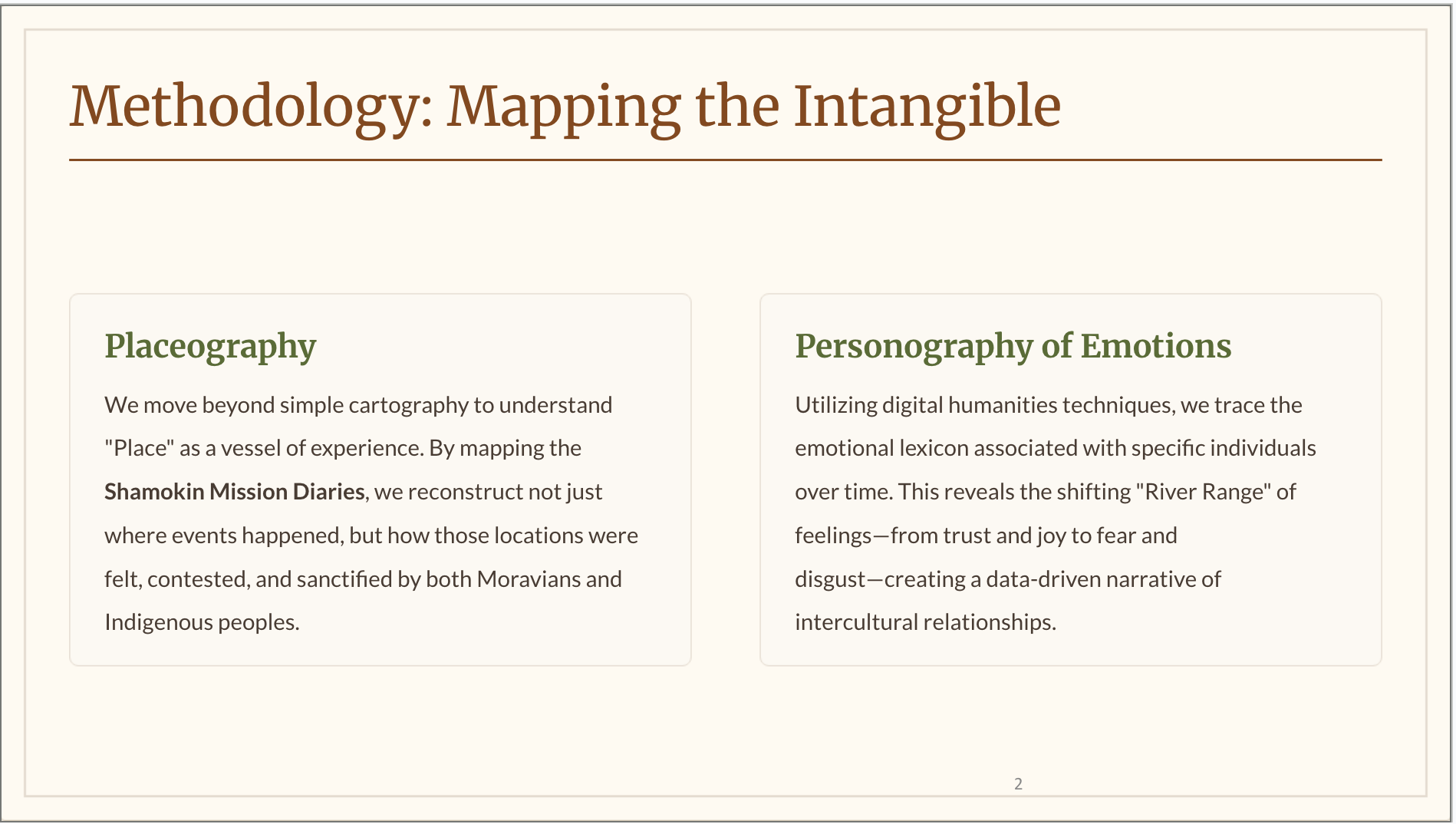
In order to address these questions, I have turned to the language of the Shamokin diary. As a philologist, I work with words. As a digital humanist, I use that language as data to recognize patterns and visualize them. As a translator, I know well that translation is ‘the most intimate act of reading’ (Gayatri Spivak).  So, with these tools, while transcribing and translating the Moravian mission diaries from Shamokin, Pennsylvania, I was struck by how the mission diarists described the landscape around the confluence (river, islands, bluffs, riffles, riparian buffers) as central to understanding their role. The physical geography of Shamokin constituted a confluence that required constant negotiation, with the forces of nature made manifest in floods and snowstorms, late frosts that destroyed newly planted crops, storms, and even an earthquake. This place shaped a unique mission encounter in which Moravians operated under the Indigenous authority of the Haudenosaunee. This adaptive mission strategy, centred on work rather than worship as primary witness, contrasts sharply with later Moravian missions on the North Branch of the Susquehanna (1765-1772), where mission places were built as intentional communities of worship and work and reveals how place determined religious praxis in colonial contact zones.

This paper explores the relationship between emotion, agency, and topography that emerged at Shamokin through the Moravian mission presence from 1742 to 1755, in the critical years preceding the French and Indian War. Drawing on the recently translated and published mission diaries (Faull, 2024), I examine how Shamokin differed from other Moravian settlements in colonial America. Unlike Bethlehem or Gnadenhütten, which were established as intentional communities, Shamokin existed as what Count Zinzendorf recognized as a spiritually strategic location where Moravians operated under explicitly negotiated Indigenous constraints (Merritt, 2003; Pointer, 2020).
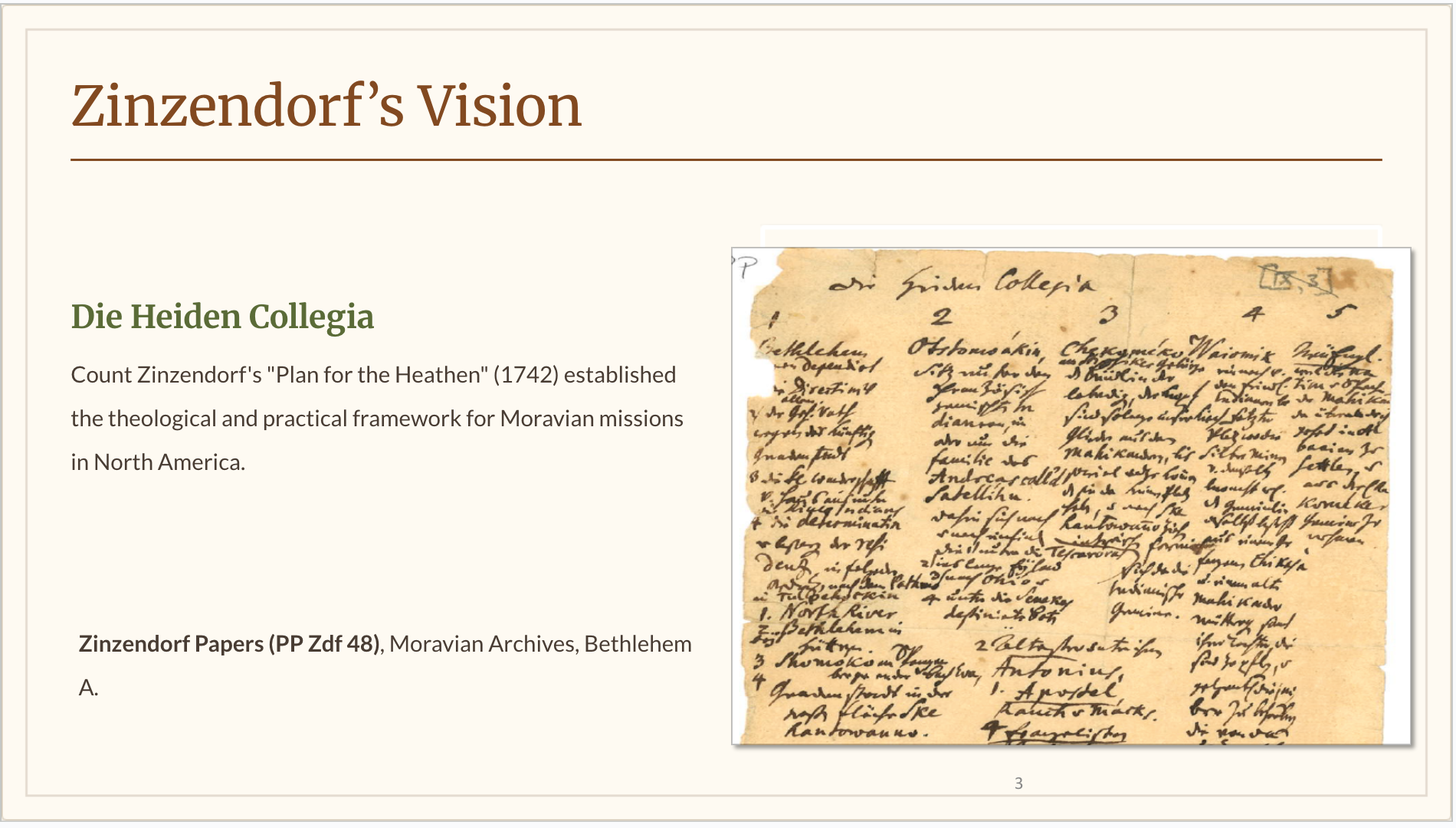
The Moravian presence at Shamokin represented a central part of Zinzendorf’s mission plan for North America, which emphasized strategically practised humility and cultural respect (Atwood, 2004). I will show how this humility and respect was manifested in the mission through the lens of indigenous agency. The physical place directly influenced religious practice, with European hymns sung alongside sweat lodge ceremonies, pastoral visits conducted across the frequently swirling, ice-filled river, and Shikellamy, the Oneida sachem with oversight over Shamokin, finding spiritual and physical refuge in the Moravian loghouse while maintaining Indigenous practices. Through the 1747 formal agreements establishing a blacksmith’s shop, the Moravians created a shared sacred space where work itself became a form of witness.

Building on the work of Jane Merritt, Richard Pointer and Rachel Wheeler that challenge the older historiographical view of Shamokin, where Shamokin was described as a “place of the prince of darkness”, the Moravian mission diarists describe a place of challenge, both physical and spiritual, but also of cultural and spiritual exchange. Similarly, Rachel Wheeler describes Mohican Christianity in New England, which she argues represented an intentional spiritual choice that transformed both Native and non-Native spirituality, claiming that the Moravians succeeded where Congregationalists failed partly because they were “culturally non-aggressive” colonial outsiders who lacked expansionist ambitions. This approach enabled genuine mutual learning and spiritual exchange between missionaries and Native peoples. In his recent study of Moravian theology on the margins, Ben Pietrenka claims that these liminal spaces radically upturned hierarchies of power. Indeed, such ruptures have been described by Katherine Gerbner in her new book “Archival Irruptions” as subversive discourses of power that are documented in the archives and require a radical counterreading of the traditional narratives of mission, race, and colonialization. It is against this backdrop that I investigate today the relations of agency and religion in the marginal place of Shamokin,  Pa. 

The town of Shamokin had long functioned as a crucial hub in a vast network of Indigenous mobility. The Moravian mission diaries of the 1740s and 50s reveal a constant movement of Indigenous peoples up and down the Susquehanna River: Tuscaroras, Cayugas, Oneidas, Mohawks, Nanticokes, and Lenape peoples are constantly arriving, departing, hunting, and passing through. Thus, Shamokin was not a static settlement but a dynamic crossroads where multiple Native nations intersected with European traders, missionaries, and colonial officials.

The Moravians’ attitude towards Shamokin evolved through contradictory emotions that traced the broader tragedy of Indigenous dispossession in the Susquehanna Valley. Initially, Zinzendorf well understood the importance of the forks of the Susquehanna as a strategic touchpoint with the powerful Haudensaunee Confederacy and its spiritual possibility—a place where their message of salvation could be spread, where communion could be celebrated, where the gospel might take root among multiple Native nations gathered together. Yet this hope coexisted with frustration over a place that never quite became what they envisioned, where missionary efforts yielded limited lasting results, and safety couldn’t be guaranteed. 

Shamokin served practical (if ethically challenging) purposes: a place to develop a relationship of trust with the Haudenosaunee, through building a blacksmith’s shop for gun repairs for Indigenous peoples. The diary is replete with references to a working landscape where Indigenous economies intersected with colonial trade networks, though increasingly on terms dictated by land sales and territorial encroachment. Whereas previous European visitors, such as John Bartram on his visit in 1743, described the place of Shamokin as ideal land for settlement, with its “peach trees, plums, excellent grapes,” and also described the Indigenous people of the area as unable to cultivate it for themselves, the Moravians saw the Indigenous population as politically sophisticated, technologically capable, and spiritually discerning, understanding and respecting their reasons for not cultivating the land according to colonial rules as being rooted in resistance to colonization.

Interactive Visualization at this link

The mission diaries reveal the dark reality of such colonial encroachment, evidenced primarily through the chaos of violence and disorder fuelled by alcohol. The diarists record regular drinking & carousing” (9/17/1745), “all night dancing & howling” (11/2/1745) where “Everybody [is] drunk” (6/5/1748, 6/9/1748) with “drunken brawls & fighting” (2/24/1749) causing “Sleepless night for missionaries” (1/11/1749) and culminating in the Penns Creek “Massacre of white neighbors” (10/16/1755) by the Western Delaware who were allied with the French. 

The Moravian missionaries at Shamokin thus lived a paradox of witness and persistence amid overwhelming chaos. Between 1747 and 1755, they engaged in relentless physical labor—constructing two mission houses, laying floors, building chimneys, repairing bridges, and erecting a smithy that became central to their relationship with the Indigenous community. Their documentation of measurements, dates, and improvements suggests both immense commitment to their work and an attempt to create order in an environment beyond their control.

The forge operated as more than a blacksmith shop—it was a tool of engagement and a testament to pragmatic adaptation. The missionaries fixed guns, made charcoal, accepted payment in hides and pelts, and deliberately kept cultivation “at the level of the Indigenous economy” rather than imposing European agricultural models. Yet their economy remained perpetually precarious: starvation diets, crops ruined by frost and hail, with chickens and horses stolen or lost.

Yet amid this distress, the Moravians maintained remarkably disciplined spiritual practice. They held communion services, foot-washing ceremonies, and, in the 1750s, lovefeasts requiring sugar and tea, Easter dawn services at the turnip field where Brother Hagen had been buried, and services that ran until 2 a.m. The stark contrast is captured in Christmas observed with lovefeast while chaos reigned outside. Their principled Sabbath observance—refusing to let Indians demand that they work at the forge on those days—led to “astonishing questions” even as it was criticized for interfering with economic needs. One poignant detail reveals both their vulnerability and their peaceful intervention: a brawl “silenced by missionary’s singing.”

By 1755, the mission’s fragile stability collapsed. Advised to flee (advice “disregarded”), threatened with land claims, facing “bloody action by hostile Indians,” they finally witnessed the “massacre of white neighbors” in October. The mission house and forge were offered for sale with no date given—a poignant detail suggesting the uncertainty of when they could actually leave.

The archival evidence clearly shows that the Moravians at Shamokin operated within Indigenous political and cultural frameworks, adapting themselves to Native authority, while simultaneously navigating colonial politics. When Shikellamy held a Nanticoke Council in 1747 to address the issue of two Nanticokes who had been shot with arrows, the Moravians participated by preparing food “which they placed before the council”—thus serving the Indigenous political process rather than directing it. Significantly, when the Nanticokes showed reluctance to listen to Shikellamy, the Moravians attributed this to “not to some essential notion of their race but rather to them being surrounded by traders,” placing blame on colonial disruption rather than on any inferred Indigenous characteristic.

Cultural exchange flowed in multiple directions. In 1757, Moravian visitors to a Shawnee village on the North Branch were invited to a sweat lodge and accepted, afterwards enjoying an evening concert of European chorales and music for strings played on violins provided by the Indians—a remarkable scene of reciprocal hospitality and shared musicality. Medical practices also bridged cultures: on July 10, 1747, several Indians came to Brother Hagen to be bled, reflecting a shared humoral worldview where both Moravian and Indigenous medicine understood the body as a system of flows requiring balance.

Yet the missionaries also practised strategic isolation, maintaining strict “aloofness from traders” who were “strictly kept out of the house.” This wasn’t cultural superiority but a survival strategy in an environment where traders brought the twin scourges of alcohol and violence. The Moravians navigated a careful path: adapting to Indigenous authority and participating in Native cultural life while protecting their mission space from the destabilizing forces of the colonial economy. Their approach recognized that the greatest threats to peaceful coexistence came not from Indigenous peoples but from European traders whose liquor traffic undermined the very communities the Moravians sought to serve.
Interactive visualization is at this link

The smithy at Shamokin was clearly the economic and relational heart of the mission. The Moravians structured its operation to align with Indigenous economic patterns rather than imposing European models. Indians were “kept on the preferred list,” receiving priority service, while payment came in hides and pelts through immediate exchange, avoiding the debt relationships that characterised exploitative trader practices. The forge offered practical services: repairing guns, manufacturing charcoal, and meeting community needs on a self-supporting basis. This economic philosophy extended to their agricultural practices: they explicitly kept “farming activities on the level of Indian economy” and maintained “agricultural enterprises at a minimum.” Rather than establishing a European-style plantation that would signal territorial claims and economic dominance, the Moravians adapted to Indigenous economic patterns, using the smithy as a tool of engagement that served the community without attempting to transform it. 

On August 2, 1747, letters from Bethlehem arrived (always a source of joy), but this time with the critical news that agreement had been reached with the Colonial government to build the smithy. Shikellamy calls a council of the Indigenous leaders, which permits Bishop Spangenberg to speak through his letters, composed in Onondaga and signed with his Haudenosaunee name, T’girhitonti. That same evening, the Moravians celebrated their first communion, thus demonstrating that work and sacred life were intertwined. Hagen writes in the diary, “How we felt at this communion with our Lord I cannot describe. It was also important to us because it is the first one here in the wilderness, perhaps as long as the forest has stood.” 

But the smithy was much more than a place of work- it was central to the Moravians’ mission at Shamokin, constructed and operated by them. In this interior space, they controlled who could enter and when, and who could have work done and when. According to the agreement with Shikellamy, it was Indigenous agency that decided whether the warriors needed to pay for the work. The space of the smithy, also, demanded a moral position in which the Moravians could not avoid complicity in the repair of arms. Every decision they made demanded a moral choice and left them no space for passivity in the face of conflict. 

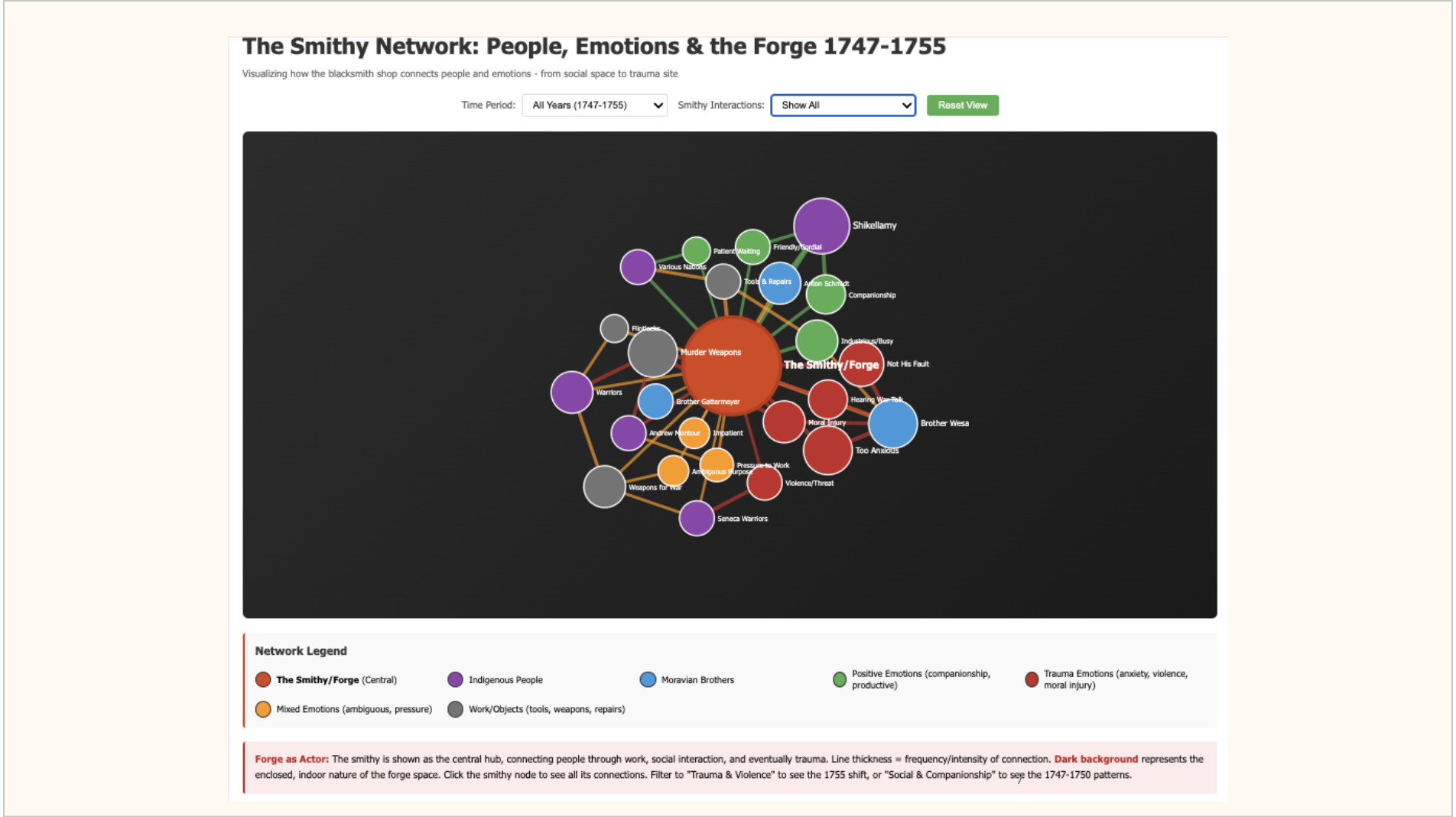
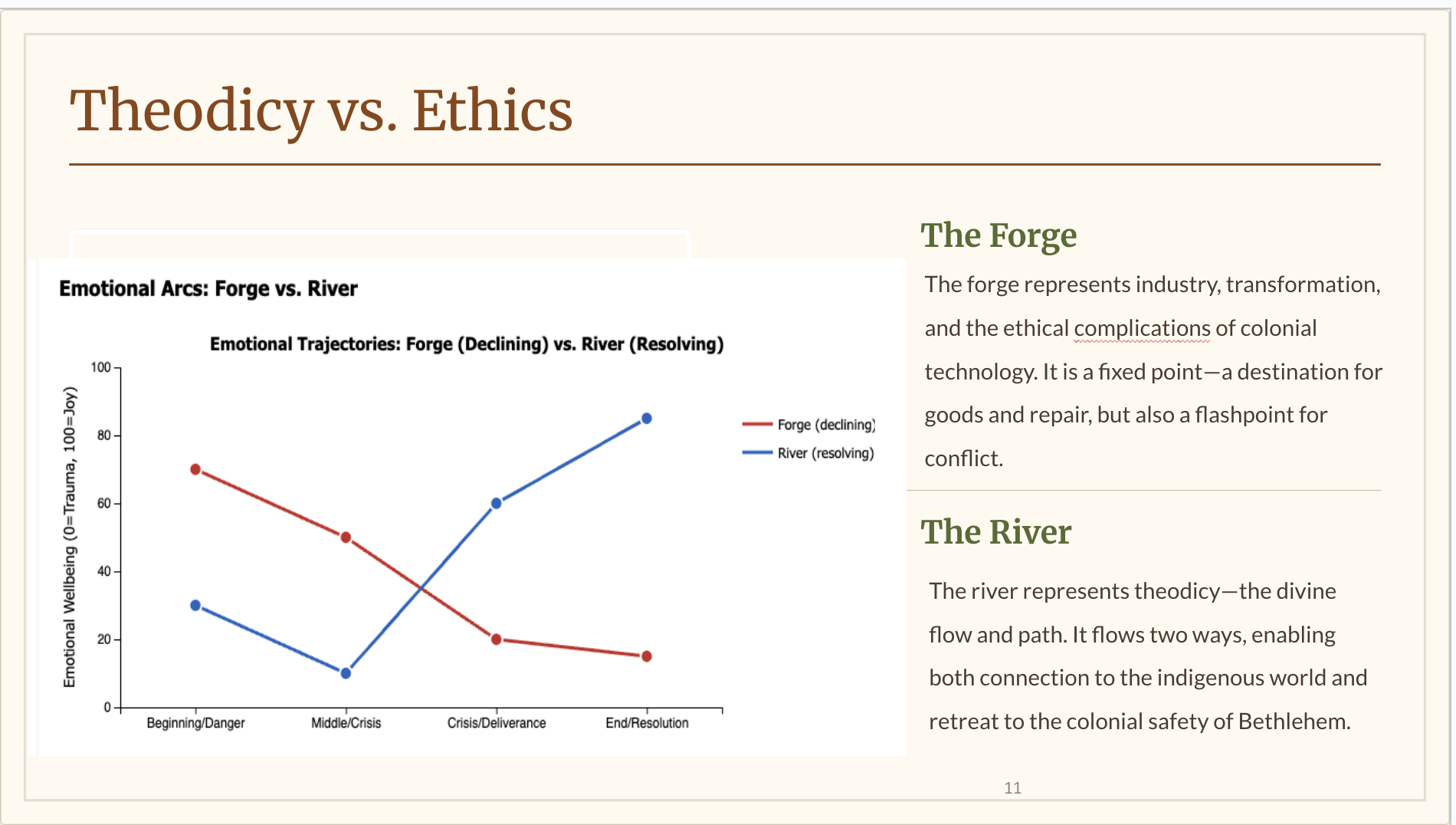
Looking at the smithy as a fulcrum of emotion and agency, we can view this diagram which us designed to show emotions connected to the smithy over time. For example, if one wants to talk of an emotional register, the smithy in 1755 is a place of impossible choices for Brother Wesa. A place that had once been a space of Shikellamy’s companionship (1747-8) had become a site of trauma (1755) where Wesa is forced to repair the bloodstained weapons of war.

Interactive visualization is at this link

If we perform the same analysis for the Susquehanna River, we can see that the river serves as an antidote to the ethical conflict in the smithy. It belongs to the realm of nature, an open force of nature beyond human control in a pre-existing landscape. It acts independently of human will, flooding, freezing, and flowing. Moravians respond to it but do not control it. It also offers a morally neutral territory, carrying warriors up and downstream. It offers danger through its rocks, riffles, and ice floes. Yet it is also deeply embedded in colonial geography, defining the boundaries of lawful settlement. The river has a social function, too, linking Shamokin with the Wyoming Valley (one of Zinzendorf’s original Heiden Collegia).
Interactive visualization at this link

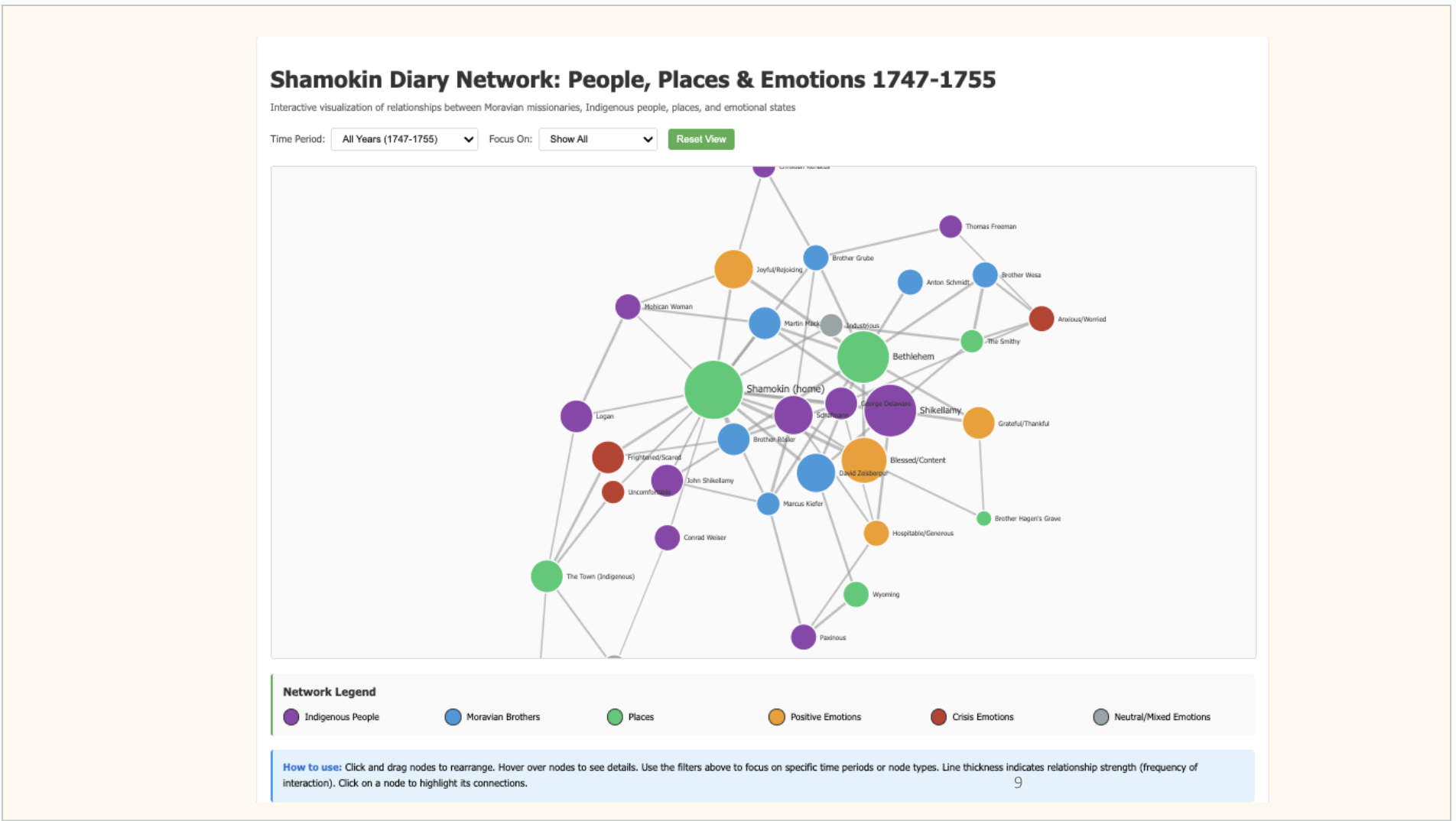
But not only are places linked to emotion; so are people. First, references to specific places are accompanied by specific sentiments in the diary narrative (of course, there are multiple diarists, and their reactions to people and places also determine the emotional index).

Interestingly, Bethlehem is always seen as a place of refuge, frequently referred to during this period by those on mission work as “das Kripplein,” the little manger. People are also associated with emotions: Shikellamy is always a friend and protector, and when he dies, his sons, Johan and Logan, inherit his role but are not as intimately involved in the work of the smithy.

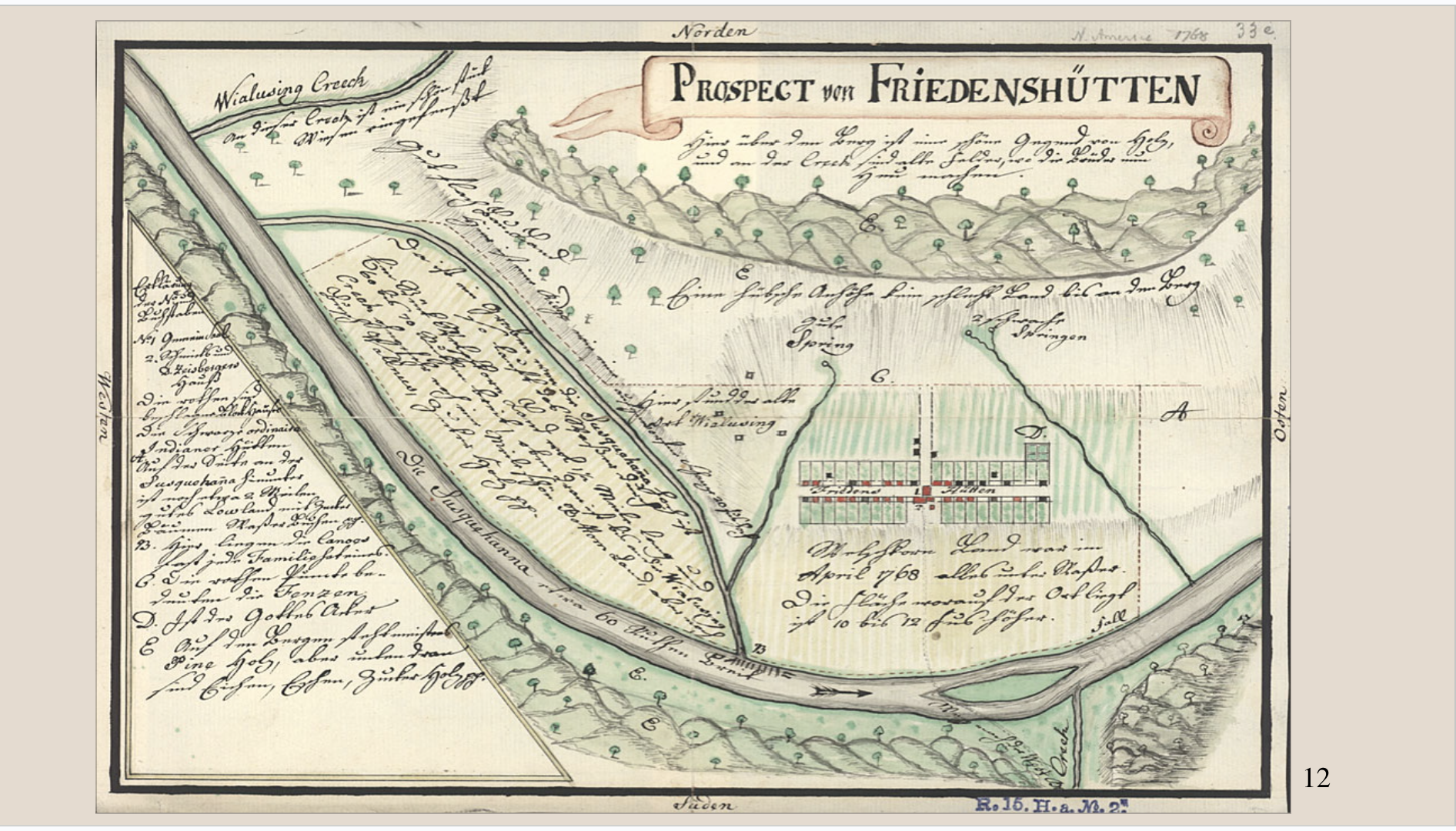
The sense of sacred place at Shamokin contrasts sharply with that of the Moravian North Branch mission sites—particularly Friedenshütten (“Huts of Peace”) (1768-1772) and Scheschquehannunk (1769-1772)—both established between Pontiac’s Rebellion and the American Revolution. These later “Places of Peace” were intentional Christian communities led by converts such as Johannes Papunhank (a Munsee religious leader baptised by David Zeisberger). Friedenshütten embodied the Moravian mission vision that had eluded Shamokin: a thriving mission town with substantial infrastructure, agricultural prosperity, and a vibrant liturgical life that earned admiration from colonial officials and Indigenous leaders alike. The community erected impressive buildings, including a meeting house with glass windows and a belfry, produced abundant harvests that fed both residents and countless visitors, and grew from fourteen to forty-seven communion participants. Their sophisticated governance structures, bilingual education, and extraordinary hospitality—extended even when it strained their own resources—demonstrated Indigenous Christian agency and strategic cultural competence. Yet this success contained its own vulnerability. Built on disputed land, caught between competing political pressures, and ultimately forced to abandon everything on May 3, 1772, Friedenshütten revealed the brutal reality that no amount of prosperity, spiritual commitment, or colonial admiration could protect Indigenous peoples from the violence of expansion and the fundamental insecurity of their land rights. Where Shamokin had struggled against chaos, Friedenshütten achieved everything the Moravians envisioned—and still could not survive.

To return to the questions with which I began this presentation: did landscape play a role in the choice of mission in a way that was not only defined by utility and strategic advantage? Did landscapes themselves hold sacred value? And if so, how did this concept differentiate itself from indigenous concepts of sacred landscapes? I would argue that landscape of Shamokin was selected strategically but became sacred though the 8 years of the mission being active there. Shamokin was selected strategically: Shikellamy’s invitation, Six Nations council site, smithy opportunity. But eight years of dwelling transformed it.  The missionaries noticed the river’s beauty (“like warp and weft”), tended Brother Hagen’s grave with pre-dawn visits, called their new house “this dear little place” and composed a hymn for it. They left “not without little tear.” Thus landscape accumulated sacredness through relationship, not geography.

BETHLEHEM was a permanent sacred, always positive across all periods. Letters from there “like honey and balsam.” The place they couldn’t stop longing for.

THE RIVER: Theodicy sacred. Sacred when God acted through it – the flood became Noah’s ark, dangerous falls became deliverance sites. Natural danger without moral culpability.

SHAMOKIN: Relational sacred. Sacred through Shikellamy’s daily protection, through communion’s “unspeakable proximity.” But this sacredness evaporated when relationships fractured in 1755.

The emotional geography reveals that the sacred for the Moravians wasn’t fixed in land but in relationships and divine action. How did this understanding differ from Indigenous sacred landscapes? The Shamokin diary shows that both groups navigated the tension between place and the need to be mobile. Therefore, the relationship to place was not simply “fixed” or “portable”. For the Moravians, Christ is portable (they can worship anywhere). However, through the text we can see that their emotions showed a strong longing for Bethlehem, and when crisis arose, it forced a flight to their permanent sacred centre.

For the INDIGENOUS PEOPLES, place was vital to rituals of identity. For example, the Nanticoke reburied their departed’s bones, the islands in the river were places for council fires and decision making, the land and forest and water were places for the hunt and trade. At the same time the indigenous people demonstrate strategic mobility (seasonal migration, dispersal under pressure) and also, most importantly, exercised agency over who could stay, who had to leave Shamokin. The critical difference was that Moravians could leave because Bethlehem remained secure. Indigenous people maintained protocols through displacement because colonial violence destroyed their sacred places.

The Moravians sought a “portable sacred” – Christ present anywhere. But the emotional geography of the Shamokin diary reveals they couldn’t escape place through theology, in that they couldn’t worship safely without Indigenous protection (Shikellamy made devotion possible); they couldn’t resolve moral complicity in one place (the forge), so they fled to another (the river) where suffering could be explained theologically. And finally, they couldn’t stop longing for one specific place (Bethlehem).

Meanwhile, Indigenous people maintained sacred obligations to specific places (returning bones, ritual sites) while strategically adapting to colonial violence – demonstrating not attachment vs. mobility, but agency under impossible circumstances. Colonial violence, not theology or culture, determined who kept their sacred places. The Moravians fled to Bethlehem. Indigenous people were displaced from Shamokin. Both groups’ relationship to landscape was relational, adaptive, and vulnerable – but only one group had a secure sacred center to return to.

Therefore, landscape mattered beyond utility, but it became sacred through dwelling, not through inherent geography. Landscapes held sacred value for the Moravians – but through relationships, divine action, and community, not fixed spiritual power. This differed from Indigenous concepts – but both groups navigated place/mobility more than simple binaries suggest. The emotional geography reveals that vulnerability, not belief, shaped the sacred landscape. And, at least for a while, Indigenous agency determined who could stay.

Race, Gender and Feelings: Moravian Religious Sentiments in 18th century North American Memoirs

Paper given in November 2021 to mark Professor Wolfgang Breul’s Birthday. A small portion of the results discussed here are published in the Fall 2022 issue of the Journal of Moravian History.

Thank you for invitation to present a paper on the subject of “Fromme Gefühle” to celebrate Professor Wolfgang Breul’s significant birthday (albeit a year late!) As we share a birth year, I am well aware of the passing of this milestone myself, but am fortunate enough to be about six months older and therefore marked its passing in the company of friends with good food and wine before Covid forced us all into lockdown!

We are here to show our indebtedness to Professor Wolfgang Breul for his lifelong research into aspects of Pietism that were not the norm when he began his academic career. Like him, I am intrigued by the questions of how Pietism, as a religion of the heart both challenged Enlightenment concepts of what it means to be human, whether in terms of reason, writing, and scientific enquiry, and also extended the possibilities of human fulfilment to those denied by the philosophers of reason. Those considered not to be fully human because of their sex and race by thinkers such as Kant and Hume, and who were excluded from arenas of political, educational, cultural and economic agency through the hue of skin, hair type, breadth of forehead, or the possession of a uterus, enjoyed perhaps the liberatory potential of Pietism’s promise of universal salvation through a personal relationship with Christ.

I have devoted much of my professional life to the study of autobiography, gender and race and in particular the genre of the Moravian memoir (Lebenslauf) with its promise to deliver an authentic record of an individual’s life. The custom, introduced by Zinzendorf in the 1750s as a means to bid farewell to the Gemeine, was widely practised throughout the Moravian world and also in the North  American congregations of the 18th century. 

What I would like to briefly discuss today is whether an examination of specific corpora of memoirs undermines or confirms the notion of “emotional communities” in the ethnic and cultural groups that made up Colonial and early American congregations. Drawing on a North American corpus, written in German and English by Moravians of European, African, and Native American descent can we detect common emotional responses to recorded life experiences?  In what ways do these North American documents reveal fundamental differences in the execution of the promise of the Moravian memoir when we include historically disenfranchised and minoritised populations? In this preliminary examination, I will be using both analogue and computational methods of reading and analysis of archival documents from the digitized and manuscript collections of the Moravian Archives in both Europe and North America (moravian.bucknell.edu).

Although an enormous corpus (over 65,000) of memoirs exists and is housed primarily in archives in Herrnhut, Germany and Bethlehem, Pennsylvania in the US, but also in smaller less researched collections of documents in many of the Moravian settlements across the world, less than 10% of the material composed between 1750-1850 has been published.  

Over the last 25 years, scholarly interest in the genre of the Moravian “Lebenslauf” has been fueled by first the recognition of autobiography as a genre worthy of scrutiny and second by easier physical access to the main repository of the manuscript sources in the Unity Archives in Herrnhut, Germany. Concurrent with this have been changes in conceptual models in social and religious history, and gender/race theory that see such “ego-documents” as valuable primary sources to gain a perspective from the social classes that do not usually have a voice in the writing of history, such as women and men of the artisan classes and marginalized peoples who were enslaved or driven from their lands by settler colonists. One constant focus of the critical gaze has been the question of the degree of expressive and emotional freedom allowed each individual to record authentic and unique reflections on lived experience within the memoir.  Whereas some critics have argued that the very institutional edict to write a self-narration necessarily limits that act in terms of form, formulation, and individuality, others have argued that the Pietistic environment in which these self-relations were created, encouraged, at least in the 18th century, a balance between the demands of the community and the self.  As Peter Vogt has so aptly stated, the Moravian memoir constitutes “a dynamic of reciprocity between individual witness and community identity.” Paul Eakin also discusses such reciprocity in the narration of the self and argues that without a story there is no self, and, in the age of the digital, this self is “not only reported but performed, certainly by any of us as we tell or write stories of our lives, and perhaps to a surprising degree by the rest of us as we listen to them or read them.” (Eakin 2014, 24)

So how does this dialectic between the demands of the individual and the community play itself out in the North American memoir in light of promises of liberty in both the US Declaration of Independence and formalized in the motto adopted by the US Moravian Church, ‘In essentials, unity; in non-essentials, liberty; and in all things, love’? The origin of the motto is thought to have come from the 16th-century thinker, Peter Meiderlin, who apparently adopted it from an earlier Catholic bishop, Marc Antonio de Dominis (1560-1624) himself embroiled in the vibrant disputes of the Reformation and Counter-Reformation. It is thus a motto that is not exclusive to the Moravian Church but is rather entwined in the confessional and denominational conflicts of the 16th and 17th centuries, and, according to Craig Atwood, it is a motto also used by other religious groups, such as the Quakers and Evangelical Presbyterians. It is clearly then not a motto that the 18th-century Moravians would have known, either in North America or in Europe. Considered an attempt to transcend sectarian differences, this dictum was first cited in a Moravian context by Augustus Schulze, a professor at Moravian Theological Seminary in 1902 and was then quickly adopted by the American Moravians, with its obvious echoes of the language and intent of foundational documents of the United States. Despite this external origin, the motto serves as a useful summary of the ethics of the Moravian Church in America: e pluribus unum.

Mottos serve as an externally and internally directed signifier. To outsiders of a group, they signal important beliefs held by the insiders, To the insiders, they act as a reminder of the way in which they live, acting as a kind of shorthand to identity, a glue. Scholars of Moravian history, when analyzing the identity and modes of cohesion of the Moravian Church, draw heavily on Benedict Anderson’s crucial work, “Imagined Communities” (1983). For example, in her foundational study of the “Herrnhuter Brüdergemeine” as a global community, Gisela Mettele (2009) employs Anderson’s concept of the necessity of “simultaneity” and “communication” (highly appropriate for today’s Zoom environment) coupled with the importance of language (German) to construct an intellectually satisfying picture of the Moravian Church as an entity that could thrive in the realization of its motto “In essentials unity, in non-essentials, liberty and in all things love”. Similarly, Peter Vogt, in his essay, “Everywhere at home” (2006) outlines the pillars on which the transatlantic Moravian Church founded its work.  For Vogt, these consist in 1) strong leadership, 2) an effective network of communication, and 3) a uniform system of belief and worship. Vogt’s essay outlines clearly those aspects that he considers most important for such unity in belief and worship.

If we think of a unifying force within the Moravian Church, let us take as an example, the terminology of Moravian identity. How many of us Moravian scholars have had to include a glossary of terms in any monograph on or edition of Moravian materials? What to Moravians and non-Moravians who have immersed themselves in this history may not need explanation is quite baffling to outsiders. What is a Lovefeast? A Choir? A Singstunde? A Pedilavium? A Sickwaiter? This specialized terminology which exists in German, English, and many of the other languages of the people of the Church, provides, as Vogt argues, “the connectedness between the members of the community in terms of fraternal kinship ties” (Vogt 2006, 18): a kinship based not on blood ties but on a shared vocabulary of faith. Vogt argues that the very concept of the “Gemeine” “implies the awareness and the concrete experience of being connected to fellow believers” (19).

The organization of the Moravian Church was first held together (argues Vogt) by the charismatic personality of its founder, Count Zinzendorf and after his death the Unity Elders Conference saw the organization of the Gemeine as providing a strong and universally recognizable structure within which members could continue to feel connected globally. This “homogeneity”, Vogt continues, was also present in the unity of worship and faith. The Singstunde in Salem is the same as the Singstunde in Herrnhut, or Neu Herrnhut in Greenland or Australia, or the Singing Hour in Fulneck, Yorkshire. Coupled with this uniformity of ritual structure is the fact of its communication to all other places in the Moravian world through the Gemeinnachrichten or its successor publications. Extracts from mission reports, memoirs deemed of universal interest, diaries, letters were sent out to the Moravian congregations around the globe. These same reports were read out loud to the congregations, if not completely simultaneously to the hour, but on the same Sunday at the monthly Gemeintag (Vogt 24: Mettele, 145-7). In this way, Onondago and Lenape peoples in Central Pennsylvania could hear about the mission to the Inuit in Greenland; a young Friedrich Schleiermacher in Barby could learn about Heckewelder’s travels through Ohio and up to Detroit; and Anna Anders in Bethlehem could hear about the life of the child, Peter West, born in London in 1751 and who was buried in Fulneck in 1760, in the Gottesacker where Anna herself would be buried in 1803. This unifying ritualistic action of writing, reading, and listening to the lives and actions of others provides, according to Vogt and Mettele, the stability and unifying strength of the expanding Moravian Church across the globe.

But what about that other tenet of the North American Moravian motto, “in non-essentials, liberty”? What are such non-essentials, and how did liberty manifest itself in the lives of the Moravians? To return to the 18th century: in the light of the origins of this motto, it is clear that the notions of “essentials” as outlined by Peter Vogt and Gisela Mettele can be agreed upon. But, in an era prior to the political revolutions of the late 18th century, we must remember that “liberty” or “libertas”/Freiheit occurred in more of a confessional realm than political. So how might this motto apply to the memoirs from this early period? Critics, such as Gisela Mettele, Stepahnie Böß, Christine Lost (and myself) have argued for the importance of the Moravian memoir as a social and theological practice within the church. Mettle’s examination of the memoirs that were circulated in the Gemeinnachrichten and later published in the Nachrichten aus der Brüdergemeine argues for the importance of the uniformity of the published lives to show “simultus iustus et peccator”, the publicly communicated salvific history of the individual as sinner and redeemed. Thus, the individual differences in terms of details of where s/he was born, into which social class s/he was born, which language s/he spoke could all be considered insignificant in comparison with the essential consciousness of one’s need for salvation. This last point is especially bewildering to those of us in the 21st century when we read autobiographical documents by enslaved peoples or those whose lands were occupied by settler colonists. The commonality with white Moravians consists in the “slavery to sin” and not in the question of being enslaved or dispossessed and colonized. Within the language and symbology of the Moravian church, there might be a place where some form of liberty has been exercised. I would agree with Peter Vogt about the role of ritual in cementing the far-flung communities together. However, as we have seen from recent work by Rachel Wheeler and Sarah Eylerly, Moravian hymns still are expressions of faith whether they are sung in Mohican, Delaware, German or English.  But when it comes to the composition of a memoir, there is inherent within that very act the tension between the individual life and the universal pattern of salvation.

The worldwide reach of the Moravian church means that Moravian archives preserve some of the earliest ‘ego documents’ produced by eighteenth-century Africans and Native Americans. And archiving these documents has fulfilled a twofold purpose; that is storing and ordering them in the institutional archival memory of the Church and also, for those who access this archival memory, as a locus of presence and interactivity in the lived memory of the Church. (Haskin 2007, 401) As noted above, the relation of the lives of exemplary believers, as Peter Vogt argues, helped to create “a tangible impression of the invisible church community.” (Vogt 2017, 39) In an examination of several centuries’ worth of Lebensläufe from the Herrnhut archives, Christine Lost describes the communicative structure of Moravian experience. (Lost 2007; Mettele 2009) as both inwardly and outwardly directed; that is, it serves as a means of self-examination for the writing “I”, as well as participating in the construction of a communal identity. This dialectic of individual/community (that so influenced Friedrich Schleiermacher’s concept of religious consciousness and ethical action) reflects very much Zinzendorf’s own understanding of the function of the Lebenslauf. The relation of one’s life within this community serves as an act of witness and testimony to the invisible host of those who had gone before and who were still to come.  Additionally, the intersection of religion, cultural and personal memory, (Jan Assmann 2008) introduces a narrative tension into the writing one’s memoir, as the author balances demands of a personal desire to belong to a social group with the lived realities of one life. 

And maybe we also need to ask, to what extent can there be liberty, what might it look like, and what role does this balancing act play in creating the “universal history’ of the church, as Zinzendorf envisioned it. What happens when the authors of those self-relations belong to otherwise disenfranchised groups within the 18th century; groups such as the enslaved peoples of Africa, the freed and formerly enslaved, the Christianized indigenous peoples from the Moravian mission movement, and women? In what way can the Moravian memoir act as an “authentic relation of the self” and not instead represent the acquisition of a new argot that signals membership in a new group?

The development of tools in the field of digital humanities affords researchers a way of not only approaching these questions but also of thinking in new ways about how to conceptualize notions of self, narrative, and language. Corpora of memoirs have already been constructed by researchers interested in demographics, religious community, missions, and memoirs in Moravian history (see, for example, Smaby 1988, Mettele 2009, Böß 2016, Lost 2007, van Gent 2012, and Faull 1997 and 2017). The development of digital tools in text analysis, such as Voyant and Antconc, permits the investigation of large corpora in search of topic models, keywords, lexical “keyness” in comparison to non-Moravian corpora.  Looking for meaningful patterns in the exercise of distant reading transforms digital tools into integral parts of the process of understanding the study of Christianity.  Furthermore, extracting tagged entities from marked-up texts leads to the possibility of both network visualization and geospatial analysis, allowing such work to expand and ask new questions and find new answers. In many ways, re-enacting the archival drive of the Moravians in the 18th century, the methods of DH permit analyses of both the metadata and the text of large amounts of information that allows the other function of memoir to be fulfilled, the function of lived memory in which the archived materials of the past may become present and interact with others. (Haskin 401) 

The Moravian Lives project is aimed at realizing the potential of DH approaches to opening up the memoir corpus, namely through the construction of a searchable database of the memoir metadata of all the holdings in the main archives of the Moravian Church in Bethlehem, PA and Herrnhut, Germany, and also linking the metadata visualizations with the facsimile and transcribed memoirs and their extracted named entities. 

The Moravian Lives platform provides a means of accessing and analysing corpora with specific parameters of time period, geographical location, gender. As digitized memoirs in the Bethlehem archives have been linked to the search interface, we can access the memoirs of Native American and African American members of the Congregation, members such as Peter and Mary Titus. 

For example, if we search for Mary Titus in the map interface we find the record exists and is linked to the digitized original. The transcription has also been completed, and thus we have access to a digital text

Slide 15

Similarly, if we search for her husband, Peter Titus, we find his memoir on the transcription desk, and it has already been transcribed and also Andrew’s memoir which I have published and discussed previously. 

Much work is to be done on the topic of what I have termed “Black Bethlehem” but we have been able to digitize the memoirs I have been able to locate so far in a collection on the Moravian Lives transcription desk. Being able to make collections of memoirs allows us to create “corpora” or bodies of text on which we can perform computational or algorithmic readings in an attempt to describe and analyse possible patterns of normative expressions. 

 As Jacqueline van Gent has argued in the context of Moravian ego-documents, the expression of emotion in textual sources (letters, memoirs etc) does not necessarily allow us to know what emotion a subject was feeling at the time of composition.  Rather, salient emotions reported in these sources adhere to the language rules and expectations of a linguistic (and emotional) community.  In the context of the memoirs of enslaved peoples (Andrew and Magdalene), converted non-European peoples can adopt the emotional vocabulary of the Moravians in order to display their membership in the group.  The question as to the authenticity of those emotions is a much harder one to answer. However,  as mentioned above, as one part of the unity of the Moravian motto, the “norms” of Moravian language adhere to expectations for norms that are set through specific practices (praxes within the Moravian congregations).

Results for key terms from Bethlehem’s English language memoirs
Results from African-descended men’s memoirs in Bethlehem

Furthermore, if there are limits to the authenticity of expression, especially within marginalized groups, then can linguistic expression reveal something about our subconscious states? Given the limitations expressed above as to the use of conscious selection of vocabulary, psychologist James Pennebaker’s methodology provides a multidimensional lens to analyse language that relies not on the “content words” of what we say but on the “function words” or stop words, often stripped out of a text when using distant reading techniques, such as Voyant or Antconc.  These function words–the articles, prepositions, pronouns, negations, auxiliary verbs, conjunctions, quantifiers, common adverbs–are those parts of speech that we use unconsciously; they are used at very high rates, they are short and hard to detect, they are processed in a different part of the brain than content words, and they are very social. So can this method overcome the problems I outlined above with other computational (and non-computational) methods in the analysis of Moravian memoirs?  Can we access subconscious psychological states through the application of Pennebaker’s methods? Running the corpus through the LIWC software we find: (results here)

Looking at this corpus, Women in Bethlehem Archive (German): there is a significant difference between memoirs by White American women and Native American in terms of positive emotions (including terms such as love, sweet, nice). However, the NegEmo measure (anxiety, sadness, hostility) shows not much variance. Maybe the absence of positive emotion does not necessarily mean that there is a presence of negative emotion. Of the women’s memoirs from Bethlehem that are in English, we find much more variation in the Authenticity measure — Burger, Baker, Powell, Quitt all show distinctly higher values.  Of the men from the Bethlehem Archive who are writing in German, the lowest PosEmo scores in the corpus include Andrew’s memoir.  However, one of the highest PosEmo scores belongs to Peter Titus.  Andrew’s memoir scores among the highest for NegEmo. Of the men in Bethlehem who write in English there is hardly any variation in PosEmo or NegEmo scores. 

 Moving now to a small corpus of 12 memoirs by Native Americans, how do these subconscious “scores” look? As we know, such texts are very hard to find in the archives. Often the biographical information is hidden behind Europeanized names or racialized monikers, and of this corpus 20 are written in the third person and two in the first person. However, even within the third-person memoirs, we find direct quotations from the speaking or interviewed subject. Running the texts through LIWC we find among the Native American authors that the highest score for “anger” and “negative emotion” is found in “Michael’s memoir (it can be found on the BDHP website). 

Michael (we do not have a record of his Native name) came from the Minnisink people and was baptized in Shekomeko by Brother Büttner. Described as a “great warrior” in his memoir, his bravery was depicted on his face in a series of tattoos: a snake, scalps on a pole, two crossed spears and a boar. The Choir Helper of the Single Brethren who records the memoir says “all of it was done very neatly.” Michael, according to the text, refuses to consider the proposed relocation of Christianized Native Americans to the Wyoming Valley. During the French and Indian war, he bolsters up the spirits of the Single Brethren (who were posted on the fences around the Bethlehem settlement) and urges them not to be afraid but rather says, “If you are in good stead with the Savior, you would not be so nervous.  Your bad hearts are responsible for your anxiety.” Michael is considered the “crown of all our baptized in this part of the world, because his holiness progressed after his baptism without many changes and transformations.” So we need to ask ourselves where does the negative emotion and anger come from that reveals itself in the use of function words in Michael’s memoir? His resistance to being moved out of Bethlehem? His bravery? His choice to become Christianized? 

Or we might look at why the memoir of “Isaac,” a young Mahican/Wampanoag man who died at the age of 18 having been baptized at the age of 11 scores so low for “authenticity?”. His mother and father had both been baptized by the Moravians. By 14 he had lost both his mother and father to smallpox and fever and was taken in by friends who moved with him first to the Wyoming Valley and then to the Moravian mission of Gnadenhütten. He escaped to Bethlehem after the attack on the mission in November 1755 and was taken into the Single Brethren’s house where he died the following year of consumption. On his deathbed, the choir helper notes, “At his request a number of little hymn verses in Indian were sung to him by the Indians present.  Shortly before his departure Br. Schmick asked him if he felt Jesus’ Blood in his heart and would gladly go home. To which he responded; “Quame,” that is, “Yes.”  After that he stretched himself out, laid his hands on his breast and went to sleep for a while.”  What I find so interesting in this description is the language in which the verses are sung and that his last words are recorded in Wampanoag.

Conclusion

If we return to the nature of the practice of unity and liberty within the Moravian Church of the 18th century, can we perhaps test those claims by examining the recorded lives of those who belong to non-European groups, especially women? I have tried to show in this brief talk first, the main ways in which scholars have tried to understand the creation of unity within the Moravian Church of the 18th century, through neologisms, specific linguistic tropes, ritual, and simultaneous communication. Then, I examined one of the main means to create unity, that is the writing of a memoir, that definitely follows a specific narrative and emotional pattern which is composed to be read to others. Beyond reading individual memoirs out of primarily genealogical interest or for the subject’s perceived exemplary significance to the movement, studying the large corpus of Moravian memoirs is only possible if they are published. The Moravian Lives digital project aims to make available through the publishing of the original archival document and its transcription thousands of memoirs. By creating a digital text we make these sources available to scholars to test the claims of universality, of liberty, of unity and love. We make available the lives of those whose very chances at liberty or life at the birth of the United States was not guaranteed and who are indeed still fighting to “become American”.

Tools for DH–Humanities in Action

I am teaching a partial credit course for the Languages and Cultures and Humanities Residential Colleges this year, called Humanities in Action.  This is a project based course that meets once a week over supper to develop ideas for Humanities based projects and develop and design them in a group.

As I have been working with students and faculty on various projects in DH I have wanted to have one page where I put together sites/tools/tutorials that are helpful to us. I am compiling these here and this is still a work in progress, but it might be useful to colleagues out there also.  In DH we tend to learn collaboratively; so many of the tutorials are adapted from colleagues who have pioneered this approach to teaching, such as Miriam Posner at UCLA and Alan Liu at UCSB,

Tools for DH–Humanities in Action

There are some basic tools that can help you with your DH projects, whether you know programming or not.  Here are some of the ones my students and I have found most useful.  Tutorials are also linked.

Text analysis

jiayu's network
Network visualization of terms in Wikipedia’s RPG game descriptions (by Jiayu Huang for HUMN 270 Fall 2015)

Voyant is the best multi-tool text analysis platform for a start.  The version that is online is the earlier release and can be found as part of the suite of tools that can be found here.  There is a new version of Voyant that brings these different platforms into one interface and which doesn’t require switching between tools.  If you want to use that, ask me.  I have a version on my thumb drive.

Voyant is very good as a concordance and frequency analysis visualization tool.  It can work with large amounts of text in multiple files.  You can compare aspects of different texts easily.  For example, which words come up most frequently in which texts; which terms are collocated; what are the vocabulary densities of different texts?

Here is a tutorial for Voyant 2.0

There are also sites/tools for analyzing large amounts of text data from a macro or high level perspective:  for example, Google Ngram viewer which visualizes word frequencies in the corpus of Google digitized books (in multiple languages)  and Bookworm which visualizes trends in repositories of digitized texts.

Topic Modeling

Screenshot 2015-09-27 19.26.38Topic modelling is a method by which your text is chunked into pieces and a computer works out what the most important topics are in the chunks.  The algorithm is not interested in meaning, just in related concepts.  The best tool for this is MALLET; a Java-based package for statistical natural language processing, document classification, clustering, topic modeling, information extraction, and other machine learning applications to text. MALLET includes sophisticated tools for document classification: efficient routines for converting text to “features”, a wide variety of algorithms (including Naïve Bayes, Maximum Entropy, and Decision Trees), and code for evaluating classifier performance using several commonly used metrics.

But if you are not comfortable with command line programming there is also an online version that can work for smaller amounts of text.  That can be found here.

There is also a nice demo tool that can be used to identify topics, themes, sentiment, concepts at AlchemyAPI

Screenshot 2015-09-27 19.29.27Miriam Posner has written a great blog about how to interpret the results from Topic Modelling outputs.

Mapping

There are lots of online platforms out there for mapping data.  It all depends how fancy you want to get and whether you want to do more than map points.

CartoDB is definitely fast and flexible.  If you have a csv with geo-coordinates you can upload in seconds and have a map.  It also has a geo-coder that can quickly turn your list of places into latlongs.Screenshot 2015-09-27 19.49.35

Another way to go is through Google Fusion tables.  Again this is a super fast and easy way to map data.  You can also produce a nice “card view” of entries that will make your Excel spreadsheets into much more reader friendly format.  There are also other multiple ways to visualize your data in graphs, networks, and pie charts.

ArcMap online is another way to go if you want to produce far more sophisticated mapping visualizations, such as Story Maps and Presentations.  Bucknell has an institutional account.  If you want to use it, let me know.

Palladio is an interesting multi-dimensional tool from Stanford Literary Labs.  It can produce maps, networks, timelines and graphs of your data.  Here is a tutorial for my HUMN 270 class, written by Miriam Posner.

Building 3D Models

This is a part of DH I have not yet ventured into, but others on campus definitely have!  The easiest entry into modelling is SketchUp.  We also have Rhino loaded on the machines in Coleman 220 and it is regularly used in Joe Meiser’s Digital Sculpture class.

Timelines

Screenshot 2015-09-27 20.30.02There are various platforms out there for constructing digital timelines that also allow for the inclusion of multimedia elements and one, Timemapper, also allows for a mapping window.  Most frequently used are Timeglider and Timeline.js

Creating a Digital Exhibition

If you re interested in curating a digital exhibition of artifacts, the best platform to use is Omeka.net. This is a free online version of the more robust and versatile Omeka.org platform which has to be installed on Bucknell’s servers (which can take a while).  Omeka.net allows you to upload digitized images, documents, maps etc to a “collection” that can then be arranged and curated as an online exhibit.  This is particularly useful if you have found a collection of photographs (maybe your own) that you would like to present in a public facing platform with a narrative logic.

Screenshot 2015-09-29 09.00.21
View of Matthis Hehl’s Itinerant Map of Pennsylvania, annotated using Neatline. http://ssv.omeka.bucknell.edu/omeka/neatline/fullscreen/itinerant-preachers-map-of-pennsylvania

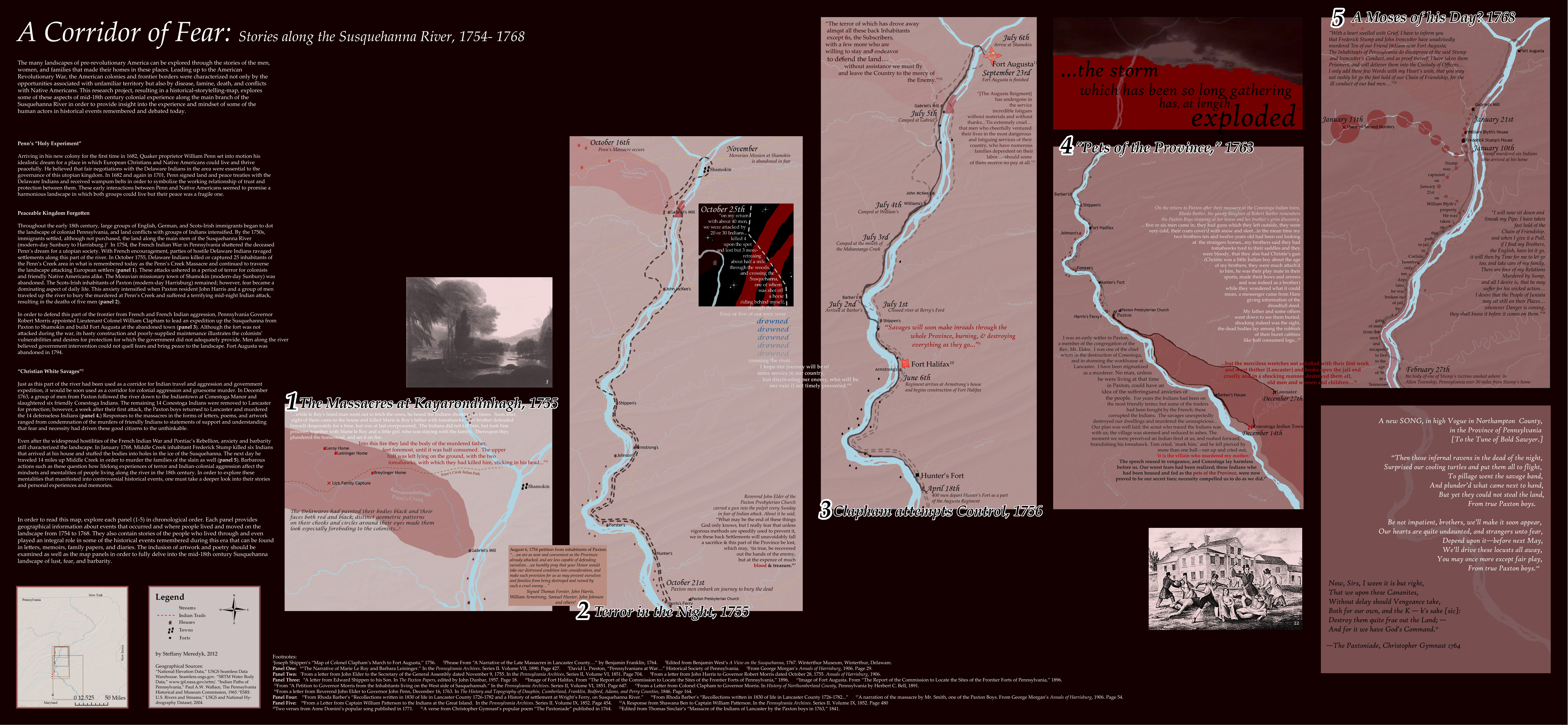
Again, if you want to do this I am happy to show you how.  Here is a link to my own (developing) Omeka site at Bucknell on the Stories of the Susquehanna.  The server-based version has a very nice visualization tool called Neatline, which allows you to link the digital artifacts in your collection to a base image (maybe a map or a painting) and then annotate. This is an example I am developing for the 1750s Itinerant Preachers’ Map of Pennsylvania which I have used a great deal in my research and also in my teaching.  There is also a Timeline widget you can activate.  I have discovered a great tutorial on how to use Omeka and Neatline here, put together from a workshop given at the Michelle Smith Collaboratory at the University of Maryland.

Networks

If you want to create a network visualization in more detail and depth, use Gephi. Gephi is an open source, free, interactive visualization and exploration platform for all kinds of networks and complex systems, dynamic and hierarchical graphs.  It runs on Windows, Linux and Mac OS X.  One of most important issues to consider before investing a lot of time in learning Gephi is whether or not your research question might be answered through using this visualization platform.  Ask yourself these questions, and then if the answer is yes, prepare your data!  Gephi has an excellent set of tutorials on GitHub.  Data can be prepared directly in Gephi or can be imported in csv format.

Pedagogical Hermeneutics and Teaching DH in a Liberal Arts Context

Diane Jakacki and I gave the following presentation yesterday at DH2015 in Sydney, Australia. We include the slides and the abbreviated form of the talk.  The complete version will be published as an article in the near future.

Thanks to everyone for coming and for your interest!

We take our title from Alan Liu’s challenge to DH educators to develop a distinctive  pedagogical hermeneutic of “practice, discovery, and community” What does this look like?  How do we put this into practice?

This paper focuses on our teaching experience at Bucknell University in the academic year 2014-15 to show how the planning, design, and execution of a new project-based course, Humanities 100, introduced undergraduate students to the world of digital humanities through the use of selected digital tools and methods of analysis. This course, taught within the Comparative Humanities program, was designed specifically for first- and second-year students with no background in digital humanities, in order to encourage the development of digital habits of mind at the earliest phases of their liberal arts curricular experience. Developed to encourage examination and experimentation with a range of digital humanities approaches, the course asks students to work with primary archival materials as core texts to encourage digital modes of inquiry and analysis. The decision to root the course in a multi-faceted analysis of archival materials provided the rare chance for students to also engage in the research process typical for a humanities scholar: namely, the discovery of artifacts, the formulation of research questions, followed by the analysis and synthesis of findings culminating in the publication of initial findings in a digital medium. In the process, we introduced students to the basic structure of how to develop a DH research project.

The Comparative Humanities program is an ideal curricular environment to teach such classes with its explicit learning goals of comparativity (historical period, cultures, genres, modality) to which we added course specific learning goals that pertain to DH. (Slide with goals) The course therefore provided us with the opportunity to not only expose students to methodologies related to distant and close reading, network and spatial visualization, but also requiring that they learn to think critically about what each of these methods, and the tools that they used within the course, reveals in the texts with which they worked.

To date the course has been taught three times: as twin sections in Fall 2014 in which we both used the same scaffolding method with discrete subject matter and core texts. We participated fully in one another’s sections – this gave us the opportunity to teach our specializations within each other’s classes. Katie Faull taught the course again in Spring 2015, and Diane Jakacki participated. Both of us will teach a section next year.

This approach to teaching is important as we consider how to incorporate DH into the classroom. It required significant commitment on both our parts to the actual execution of the course, as well as recognition that we needed to be transparent to ourselves as well as to our students about how this represented a new model for course design at Bucknell. It is important to note that while other DH-inflected courses are being taught, this is the first Digital Humanities course at Bucknell.

At  Bucknell, the focus in digital humanities scholarship and learning to date has been primarily on spatial thinking, until recently rooted in working with ArcMap-type GIS and thinking about humanities in “place”.  It was important to both of us to emphasize and extend that objective in the development of the course and its learning outcomes, and so we focused on finding materials that would be of interest to students so that they could relate to the historical context more directly.

The first time the course was  taught we decided to run it in two sections, anticipating an opportunity to reflect different perspectives of our expertise with DH methods and tools. Diane’s focus has until now been on text encoding and analysis, while Katie’s has been on mapping and data visualization. We also worked with discrete data sets of archival materials. Katie’s course focused on the Colonial mission diaries of the Moravians from Shamokin, Pennsylvania (today Sunbury) and situated 9 miles downstream from the university. Written in English, the diary sections selected dealt with interactions between some of the first Europeans to the area and the Native peoples they met and worked among. Katie has spent the past five years working with this subject matter, and is considered an expert in the field of Moravian studies.

Diane’s course considered a subset of the diaries of James Merrill Linn, one of the first graduates of the university and a soldier in the American Civil War.  The choice of the Linn material had to do solely with its accessibility – Linn’s family left his life papers to the Bucknell Archives. Diane’s research is not in 19th century American history, and so she had to be honest that engaging with Linn’s diaries would be a discovery for her, too. In Katie’s iteration of the course this Spring, she selected materials that took the students slightly further afield, but still kept them within the Susquehanna watershed and the Chesapeake Bay using a different set of Moravian archival materials.  (Slide with archival materials)

Both of our choices reflect and extend Bucknell’s interest in digital/spatial thinking in terms of its place in the larger historical and cultural narrative. In all cases, students responded well to the investigation of places familiar to them, with several students having family connections to specific locales mentioned in the archival materials. The pedagogical hermeneutics of Humanities 100 were intentionally designed to encourage student examination and experimentation  and discovery with a range of digital humanities approaches.  To this end, the sequencing of the modules was carefully designed so that the “product” of each module then became the “data” of the next module.

In addition to praxis-oriented assignments, we wanted students to understand the broader context of their work within a DH framework. To that end we assigned theoretical readings and analysis of a range of major DH projects, which students then wove into their online reflections. Extensive use was made of online platforms that emphasize important forms of digital engagement, including collaborative online writing environments. Each module ended with a short assignment and also a reflective public-facing blog post that became a shared form of intellectual engagement.

In order to begin any kind of DH archival project the students had to produce a digital text.  In the first iteration of the course we did not have a transcription desk available and so students transcribed the assigned pages of the original into a shared Google doc.  This digital text was then color-coded in terms of “proto” tags to ease the way into close reading with TEI tags in Oxygen.  By the time the second semester started we had obtained an institutional subscription to the online platform Juxta Editions which we were then able to use as the transcription platform and also the introduction to thinking about tagging. From the transcription came the lightly marked up digital text that was then imported into Oxygen for more complex tagging.  Students then began tagging in earnest and were introduced to the discoveries of close reading involved in marking up a text.  Names, places, and dates were easy (in Juxta edition they had already been imported).  However the hermeneutical fun started with working out whether a boat was a place or an object, for example.  Or whether God was a person.  And just what is balsam, an object?  an emotion?

During these classes, the historical remoteness of the texts (in Faull’s class from the first half of the 18th century, focusing on Native Americans in the fall and in the Spring on preaching to the enslaved peoples on the Tobacco Coast) was lessened by the act of tagging and the lively discussions that surrounded it. Once a reliable text had been established we then introduced students to the concept of “distant reading” through the Voyant platform.  At the same time as students were encouraged to “play” we also pointed out the circular motion of discovery and confirmation that is inherent in any research experience. The students had just read these archival texts very carefully in order to transcribe them, so we asked them the usual kinds of questions one asks when approaching any kind of new text.  What is it about?  What are the major themes?  Who are the most important characters?  Then, having read Edward Whitley’s text on distant reading we asked the students to think about what reading a text distantly does to that hermeneutic. (Slide of distant reading prompt and visualizations)

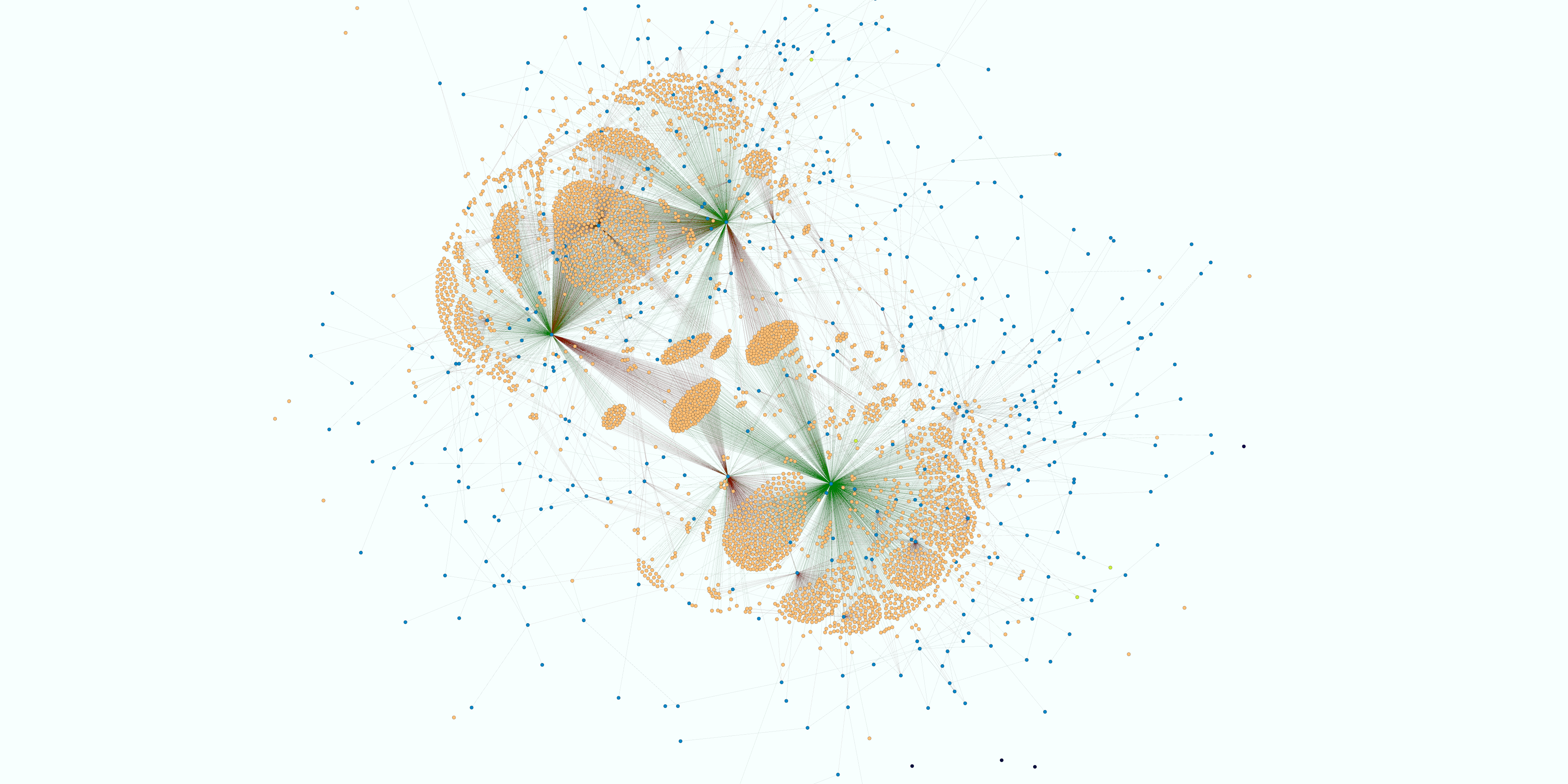
This data, the TEI tags, crucial to the success of the students’ mark up assignment and the production of a final digital document, needed some restructuring as we moved onto the next module.  To manage this, we developed a prosopography for each core text – a database of people, places, and connections that grew organically out of the focus of each specific section and provided the data for entry into Gephi and was then built out in adding geospatial data for GIS. So for example, one group of students wanted to use Gephi to interrogate the assumption that relationships between the missionaries and the Native Americans in the area around the mission remained constant.  However, by using the TEI persName tags and exporting them into a Gephi node/edge tables the students were able to show how relations between the Native leaders and the Moravian missionaries changed over a five year period of the mission (Include slide of Jerry and Henna’s work). Students also used the sigma.js plug in so that the network visualizations were interactive.  However successful this team was in their work, it was clear from all iterations of the class that the hermeneutics of social networks was the hardest for the students to analyse and manipulate (which is quite ironic, given how most of them are well plugged in to Twitter, Instagram, etc).

Lastly, students worked in ArcGIS Online to consider the evidence they had discovered within these texts in terms of spatial analysis. The story maps they produced became a new form of critical essay, with thesis, arguments supported by direct evidence, and conclusion all presented within a story map framework. so, for example, one student used Linn’s references to ships running aground during a storm at Hatteras Inlet, found a contemporary document reporting on the damage done to Union ships during this point in the campaign, and overlaid his evidence on a nautical map drawn in 1861 to determine where Linn’s ship had foundered.

Both the composition of the class (in terms of student personalities) and also the nature of the material determined to some extent the kind of final project students chose.  For example, in my section there were some natural groupings of students and there were a variety of final projects (one involving Gephi; two TEI markup; one hybrid ArcMap and TEI; and one story map). In Diane’s class all but two students chose to work independently  In the second iteration of Katie’s course, students decided that they would produce one final group project all together –a  course website that highlighted the best of their DH work. (Slide of Payne Froehlich website)

Assessment slide–self-explanatory

Another challenge to the class design was the high number of L2 students who enrolled in it.  In Katie’s Fall 2014 section there were 2 students of 9 from mainland China; in her spring section that ratio increased to three of five.  In the fall there was one from Australia and one from Vietnam (neither L2s but international students); one student in the spring course was from South Africa – her first language was Afrikaans.  Although the students admitted to being challenged by the readings and also the public facing writing in the blog site, a means for adjusting for student errors and allowing for corrections was developed that would allow the students to post their blog reflections in a way that did not impede their openness to reflection, knowing that they would have an opportunity to correct their English.

However, for all the challenges involved in teaching the class, there were moments of glory. Disengaged students became engaged; solitary learners recognized the essential need to collaborate in order to succeed; participants recognized the transformative nature of the course to their own concepts of the humanities. Students were eager to participate in crowdsourced data collection; they were intrigued to visualize ego-networks as they learned the concepts of network theory; they were excited to see their marked up transcriptions published in an online digital edition. Through these discoveries, they realized that they were creating a community of young DHers and expressed eagerness to take part in more of these learning experiences. Thank you!

“Writing a Moravian Memoir: the Intersection of History and Autobiography”

Screenshot 2015-05-14 19.19.51 Monday, May 11, 2015, University of Goteborg, Sweden

I delivered this seminar paper via Skype to a group of European scholars interested in ways of reading and analyzing Moravian memoirs.  The two day seminar was entitled “Life-writing and Lebenslauf:  Pillars of an invisible church” and was organized by Dr. Christer Ahlberger, in the faculty of History. In this paper I discuss ways of thinking about autobiography and the Moravian memoir, both as a radical act within the history of the genre and also, when analyzing the memoirs with the methods of DH, as a radical hermeneutic to reveal new voices in the historical record.

Screenshot 2015-05-14 19.24.46The genre of autobiography is a tricky one. Although only recently even acknowledged within the scholarly community as an object worthy of critical scrunity, autobiography has for millenia served the purpose of providing a model of the exemplary life. Whether in the form of saints’ lives, the chronicles of kings and queens, the political autobiography, or Johannes Arndt’s “best seller” the Historie der Wiedergeborenen, all have served the purpose of shaping others’ lives. Through autobiography the author is able to examine memory, shape experience, interrogate the reasons for action and examine conscience. For the reader, the genre provides an opportunity to view this process within another human subject, to witness the relation of authentic (or inauthentic) experience and emotion. Continue reading ““Writing a Moravian Memoir: the Intersection of History and Autobiography””

Teaching with Emerging Technology: the Centrality of the Collaborative Mode

Screenshot 2015-01-30 13.22.22Over the last 6 months I have been working with the latest instructional technologies and digital tools in my class, Humanities 100.  This course, brand new for the 2014-15 academic year is designed to teach students how to create a digital project with archival materials.  The goal of the course is to teach students the importance of the creation of a digital text; to think about the design of data that stems from that digital text; to make intelligent decisions about the presentation of that digital text on the web; to teach students how to mark up a text in TEI lite and beyond; to begin to think about how to add geo-spatial elements to the analysis; and also how that text can be mined to build up a database of people and places (at the least)  that can then be used to create a network analysis of the text. That is a lot to learn; and from my experience last semester I can say that some students wanted to stop at, say, transcription of the text, or mark-up.  Continue reading “Teaching with Emerging Technology: the Centrality of the Collaborative Mode”

The Importance of Understanding Visual Rhetoric: thoughts on Johanna Drucker’s Graphesis

I am re-posting on my personal site my blog entry for my class site for The Humanities Now!  These are questions that I have been thinking about a lot, and my reading of Johanna Drucker’s Graphesis has really helped to crystallize my ideas.  I am so happy that she will be coming to Bucknell in April of 2015 as part of our Humanities Institute on the Digital Humanities.

Over the last week or so, we have revisited visualization as a technique for interpretation. In our production of networks using Gephi, the process of creating data, preparing it for input into the software, manipulating it once in the software and then interpreting it once entered has been foremost. As we move on to mapping, we will find parallel processes at work: preparing data, entering it, manipulating it, interpreting it. And as we do so, it behooves us to think critically about what we are doing, and what we are not doing.

Johanna Drucker’s intelligent, broad view of visualization as a form of knowledge production offers us many pointers for taking each step on our path to visualization and interpretation with deliberation. The long chapter “Interpreting Visualization–Visualization Interpretation” from her book, Graphesis: Visual Forms of Knowledge Production (Harvard, 2014) presents us with an overview of forms of visualization primarily since the Renaissance, and it also issues a plea for the development of a greater understanding of the force of visual rhetoric; a plea that is directed especially at humanists, as they enter into a realm of spatialized representation that might appear to belong to the realm of the quantitative over the qualitative.

Visualizations can be either representations or knowledge generators in which the spatialization or arrangement of elements is meaningful. When reading a visualization, Drucker encourages us to use language carefully, employing terms such as “juxtapose”, “hierarchy”, “proximity”. Drucker claims that visualization exploded onto the intellectual scene at the edge of the late Renaissance and beginning of the early Enlightenment, when engraving technologies were able to produce epistemologically stunning diagrams that both described and also produced knowledge. Now with the advent of digital means to manipulate and produce data we can all produce timelines (!) without giving a thought to the revolution in the conceptualization of time and history that (our near neighbor) Joseph Priestley occasioned. So, as we play with Timemapper or Timeglider, Drucker cautions us to become aware of the visual force of such digital generations. “The challenge is to break the literalism of representational strategies and engage with innovations in interpretive and inferential modes that augment human cognition.” (p. 71)

How do we do this? Drucker argues for us to recognize three basic principles of visualization, both as producers and as interpreters: a) the rationalization of a surface; b) the distinction of figure and ground; c) the delimitation of the domain of visual elements so that they function as a relational system.

In her sections on the most prevalent forms of visualization, I find most pertinent to the coming module on mapping her insight that a graphical scheme through which we relate to the phenomenal world structures our experience of it (p. 74). In other words, the mapping of the earth, sky, sea or the measurement of time, that are in themselves complex reifications of schematic knowledge, actually become the way in which we experience that thing. The week is seven days long and the month is 28-31 days long (because of lunar cycles) and thus astronomical tables become the way we structure time. But time isn’t like that; it isn’t linear, especially in the humanities! It contains flashbacks, memories, foreshadowings, relativities (it speeds up when we are nervous, and slows down when we are scared). So we are imposing structures from social and natural sciences onto human experience. Drucker argues that the shape of temporality is a reflection of beliefs and not standard metrics, and therefore asks how do we find a graphical means to inscribe the subjective experience of temporality or the spatial?

For example, digital mapping may give us the ability to georectify a manuscript map onto a coordinate system, but what does this give us? It might show us how accurate a mapmaker was, or was not; it might help us to locate an archaeological site with more probability, but it is ignoring the fact that the manuscript map, drawn perhaps on buckskin, or stone, or vellum is a representation (and a thin one at that) of a traveler’s or observer’s experience that we are then translating into a system of coordinates. What is absent is the story; way-finding depends upon narratives, travel accounts, diaries. We must be aware that maps produce the illusion of isomorphism, but this illusion is based on an elaborate system of abstract schema and concrete reality.

I am most captivated by the section of her chapter that focuses on visualizing uncertainty and interpretive cartography, as this is an area I have thought a lot about in the last five years during which I have been working with GIS. As a software, GIS gives us enormous power to produce knowledge as a generator; through the combinatory power of layers, and base maps, and points, and embedded data tables, GIS has often seduced me with its “deceptive naturalism of maps and bar charts” generated from spreadsheets that I and my students have spent months creating. It strengthens the fiction of observer-independence; the objectivity of the “bird’s eye view”, and, as Drucker so aptly states, “we rush to suspend critical judgment in visualization.” For me, however, and for the students I have worked with, the question of how to represent ambiguity has consumed us; as has also how to make ambiguity the ground of representation. I think here of the brilliant visualizations of Steffany Meredyk, ’14 as she created her interpretive map of the main stem of the Susquehanna River.

Steffany Meredyk's map of the Susquehanna River
Steffany Meredyk’s map of the Susquehanna River

Using the work of Margaret Pearce, Steffany and I talked for long hours about the importance of reinserting the positionality of the observer into the visualizations of the river. Taking her “data” from accounts of massacres in the 1760-80s that occurred on the Susquehanna River, and using graphical means of Adobe Illustrator to represent ambiguity, uncertainty and emotion, I consider Steffany’s work to act as a model for the way in which we can use digital media and methods as humanists. We can, as Drucker observes, “model phenomenological experience; model discourse fields; model narratives and model interpretation.”

What’s Your Susquehanna Story?

The Principal Investigators of the Stories of the Susquehanna initiative are pleased to announce the launch of the “crowd sourcing” platform for the river.  As a public humanities project, the Stories of the Susquehanna initiative invites members of the public to submit their Stories of the Susquehanna for possible inclusion. If you have a story about the cultural, historical, or environmental significance of the place where you live in along the Susquehanna River, we’d love to hear from you! What’s your story?

Discussing the Untranslatable and World Literature

In case anyone wonders what academics do during the summer, read on!  This week, the Program in Comparative Humanities is hosting a faculty reading seminar on the topics of Untranslatability and World Literature.  We are nearing the halfway mark.  If you want to take a look at the course outline, readings, discussions, and my thoughts, look here.  This is definitely a work in progress, but the discussions we are having are lively!

Thanks to the Provost’s office at Bucknell University for providing the funding for this event.  We have been holding summer reading seminars in Comparative Humanities since the inception of the program in 2001.  Topics have included Film and Adaptation, Translation, Integrating Islam into Core Courses, the Philosophy of Place, Close Reading, Digital Humanities, and this year, Untranslatability.

Digital Learning in an Undergraduate Context:

… promoting long term student-faculty (and community) collaboration in the Susquehanna Valley

This is the transcript of the paper that Diane Jakacki and I presented on July 9, 2014 at DH2014 in Lausanne, Switzerland. We are currently expanding this paper into an article for publication. The PowerPoint slides that accompanied our presentation are included at the end of this post.

INTRODUCTION
At several sessions and discussions at the 2014 Digital Humanities Summer Institute we noticed a marked increase in discussions focusing on teaching Digital Humanities; namely, how do we effectively port the tools and methodologies with which we work as researchers into the undergraduate classroom. Simultaneously, the question gradually shifted from “DO we teach Digital Humanities to undergraduates?” to “HOW do we teach Digital Humanities to undergraduates?”

Continue reading “Digital Learning in an Undergraduate Context:”