
The Principal Investigators of the Stories of the Susquehanna initiative are pleased to announce the launch of the “crowd sourcing” platform for the river. As a public humanities project, the Stories of the Susquehanna initiative invites members of the public to submit their Stories of the Susquehanna for possible inclusion. If you have a story about the cultural, historical, or environmental significance of the place where you live in along the Susquehanna River, we’d love to hear from you! What’s your story?
Discussing the Untranslatable and World Literature
In case anyone wonders what academics do during the summer, read on! This week, the Program in Comparative Humanities is hosting a faculty reading seminar on the topics of Untranslatability and World Literature. We are nearing the halfway mark. If you want to take a look at the course outline, readings, discussions, and my thoughts, look here. This is definitely a work in progress, but the discussions we are having are lively!
Thanks to the Provost’s office at Bucknell University for providing the funding for this event. We have been holding summer reading seminars in Comparative Humanities since the inception of the program in 2001. Topics have included Film and Adaptation, Translation, Integrating Islam into Core Courses, the Philosophy of Place, Close Reading, Digital Humanities, and this year, Untranslatability.
Digital Learning in an Undergraduate Context:
… promoting long term student-faculty (and community) collaboration in the Susquehanna Valley
This is the transcript of the paper that Diane Jakacki and I presented on July 9, 2014 at DH2014 in Lausanne, Switzerland. We are currently expanding this paper into an article for publication. The PowerPoint slides that accompanied our presentation are included at the end of this post.
INTRODUCTION
At several sessions and discussions at the 2014 Digital Humanities Summer Institute we noticed a marked increase in discussions focusing on teaching Digital Humanities; namely, how do we effectively port the tools and methodologies with which we work as researchers into the undergraduate classroom. Simultaneously, the question gradually shifted from “DO we teach Digital Humanities to undergraduates?” to “HOW do we teach Digital Humanities to undergraduates?”
Continue reading “Digital Learning in an Undergraduate Context:”
Discussing the Digital at DHSI 2014
At the first “Birds of a Feather” session at DHSI on Tuesday afternoon, chaired by our very own Diane Jakacki, the question posed was “Who are we and where are we going?” A pertinent question indeed, as the auditorium designed for the opening session could not hold the over 600 people who had come this year to University of Victoria for a week-long intensive foray into classes, flash talks, discussions, and meetings on the Digital Humanities.
I am at DHSI to attend a seminar designated for Deans and Chairs (in a room in which there might be the only people with grey hair) to try to learn about the problems of creating, sustaining, evaluating and growing DH at an institute of higher learning. My classmates are from large public and private R1s, and smaller Liberal Arts colleges, from the US, Canada, Australia, and South Africa, and we are all tasked with the question of reading about and discussing the problems of defining DH, evaluating it, developing it, and facing the challenges and rewards of collaborative DH work with faculty and students (and of course graduate students) in our various educational environments. Then, we are sent off to audit as many classes as possible, ranging from the Fundamentals of TEI (text markup language) to Drupal for DH, to GIS (know where I’ll be heading…), basic programming, database development, and physical computing (getting the internet to talk to physical objects) inter alia. On Friday, the group reconvenes to discuss how such digital knowledge might be embedded within the teaching and scholarship of our various institutions.
On using ArcMap Collector as a mobile app for SSV
Since its inception, Stories of the Susquehanna has been a collaborative, interdisciplinary  digital project that has at its core a geospatial interface. What started out as historical/cultural mapping of the Native American landscapes of the Susquehanna in ArcMap Desktop with maps published in static image format (as discussed in the interviews of me and Emily Bitely) has evolved through the iterations of ESRI’s software development.
About a week ago, one of our Digital Scholarship Coordinators and SSV project manager, Diane Jakacki pointed to to the fact that ESRI was now publishing apps.  At first skeptical, I proceeded to delve further into the Collector app and battled my way through tutorials designed for insurance adjusters gathering data in the field (no, I don’t need fields labeled “Habitable” or “Partially Destroyed”) to create a feature layer that could be added to any map in ArcMap online. This feature layer was supposed to be able to both locate you in the field and allow you to input field data in real time at the same time as giving you access to the rich data associated with points and lines in pop-ups. The new feature layer could also permit the attachment of photos and video.
My co-PI, Alf Siewers and I had been discussing over the last few months how we could best create this kind of mobile interface and had been in long discussions with both Diane and Andy Famiglietti as to how this might happen. This app seemed to me to offer us a ready made way to send our students out into the field to collect data, upload it, and also see it within the context of the historical information that had already been collected.
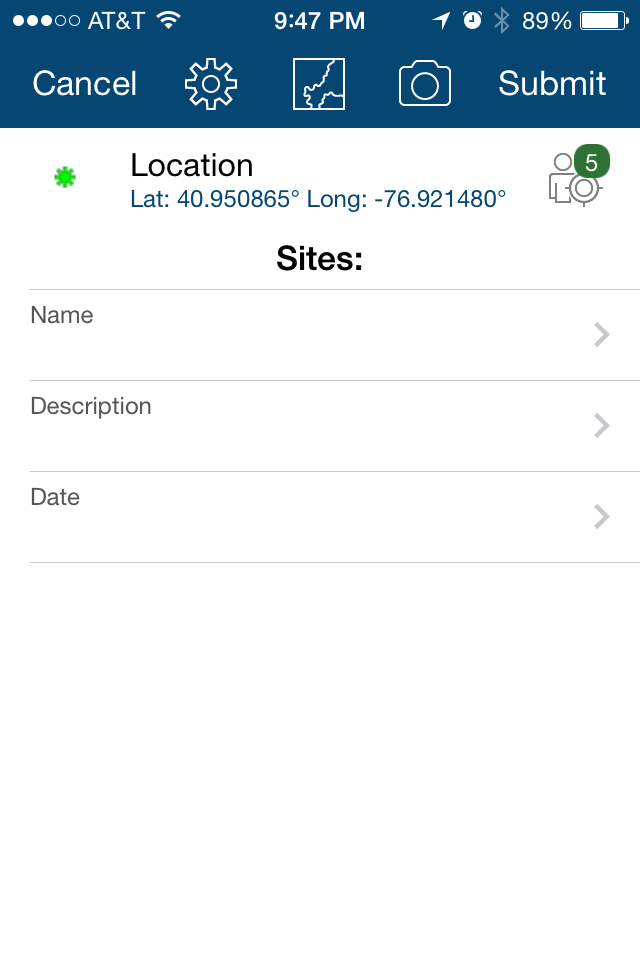
After some tussling with an outdated version of ArcMap (10.0 vs. 10.2) and successfully navigating our excellent ArcMap Online resources, I was able to author and upload a prototype of a multi-layered interactive map of the Susquehanna watershed that had the mobile features I wanted (well, almost). However, one field caused the app to crash repeatedly and I knew I had to re-author it in Desktop.
Enter my Presidential Fellow, Steffany Meredyk. Today, as almost a final collaborative act after four years of working together, Steffany and I worked out the problem; now we can test out an interactive crowdsourcing feature layer for online maps of the Susquehanna this weekend on the North Branch Kayaking Sojourn. Whoops of joy were detectable…. but not uploaded…
 The Collector app has a rich potential for data gathering in the field. Whether to record information on bird populations, the state of repair of the rail-trail, tracking plant coverage, or encouraging crowdsourcing of local history, this is an exciting and versatile digital step forward in our work of bringing the Stories of the Susquehanna alive.
(un)Mapping Networks
How do you represent visually relationships between people and places that are, I have discovered, unmappable. Only in this last week, under the gun of a deadline thrice removed, did I finally realize that this is what I have been trying to do. Still working on a chapter for a book on Pennsylvania’s Babel of the 18th century, I needed to find a way to describe the dynamic and complex way in which not only Native peoples but Moravians, men and women, communicated and travelled in mid-18th century Pennsylvania. This is an important realization as, within the traditional historiography of this period, both Native and Euro women were just elided. More recently, the focus has turned to Native women in in terms of their agency and mobility. However, what I have been wanting to discuss is how a group of women who were active as missionaries in the Moravian mission field of the 18th century brought with them their expertise from either Europe or the early settlements in New York State and Pennsylvania to effect a translation of culture and knowledge here on the Susquehanna River.
The source materials I have been working with for this chapter are predominantly unpublished, or, if published, reside in 18th century Fraktur imprints. Seemingly straightforward questions, such as birth dates and places, require lengthy investigations of manuscript sources or typed up lists of information taken from the Geburts- und Tauf Register of the Bethlehem communty (also unpublished) or other missions. Spreadsheets of names, dates, places that I have put together over the years have helped in these investigations. And in this quest I was to find out that this accounting of data over the last 25 years would help more than I could have imagined.
I have wanted to map the way in which these women lived and worked (in German I would use the verb “agieren”) in the mid-Atlantic. I wanted to show how their lived lives became an integral part of the warp and weft of the environment of the Pennsylvania backcountry. But to do that I had to also delve into why they were here, what brought them to this place at this time? How did they translate the skills, experiences, concepts of self that had been learned in the Pfalz, Germany, or a village near Oxford, England, or a farm close by the Mohican villages in upstate New York to the banks of the Susquehanna or the Lehigh rivers?
I started to make maps. Firing up my GIS layers, I mapped the missions, I mapped the women, I inserted date ranges. But it still was static. It didn’t show the movements of the women between the missions over time in an effective way (maybe because I am not as skillful at this as my students…) Then, staring at the DH Humanities list from my alma mater King’s College, London, I saw the announcement of palladio in beta out of Stanford. Assuming that this was a happy by-product of the well-known and ground-breaking project “Mapping the Republic of Letters” I decided to “dive in.”
When I first started working on the Moravian women’s memoirs 25 years ago I was surprisingly data driven. I wanted to know who these fascinating and diverse people were. One of the places in Bethlehem that inspired me to work on the Pietist group was the “Gottesacker” with its flat gravestones that are ordered in terms of marital status, age and gender and not by social ranking or racial group. I found the register of the Gottesacker and built a database of all the women who were buried there, found information about their birthplace, dates, brief biographies. When I looked at how data was supposed to be entered into Palladio, I thought this would be a good first project. With the help of my research assistant, Hein Thun, we entered all the exact locations of birth and death in longitude and latitude and then I entered this into the online program. What came out was good. A mapping of places from which the Bethlehem women came in the 18th century, both in terms of a geo-location and also a very basic visualization.


Having had some success with this visualization I wanted to try it with the missions and missionary women. But I couldn’t get it to show what I wanted. I was still too hung up on mappy maps.
It wasn’t until I talked to Andy Famiglietti, one of the Digital Scholarship co-ordinators at Bucknell, that I realized that I had to think of maps that weren’t maps. I had to remove the “geo” from my spatial thinking to visualize these relationships. This was not easy for me; really, really not easy. I had tried working with Gephi before, but it was only once Andy explained to me the fundamental rule of thinking about networks as relationships between two entities (not three, not four) that I understood why my attempts to date had failed. So, modifying the data, stripping it down to the “edges” of people and places, we were able to visualize what I had been looking for and trying to express in my chapter.
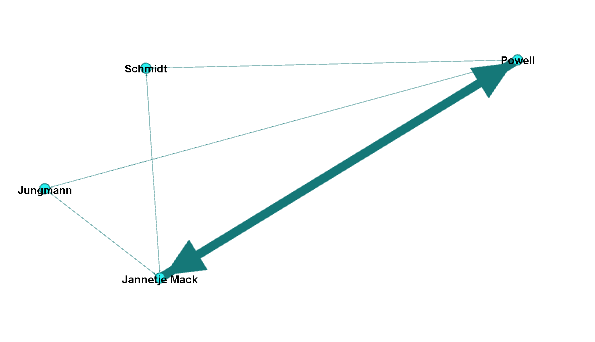
It was truly a “eureka” moment. Yes, it is not the most elegant, or beautifully rendered visualization. But it showed what I wanted it to show, the strength of relationships between these women and their places of agency.
Curious to see how Palladio might represent this same data I fiddled around that night and came up with another, different, visualization of these people and places.

Again, it is not beautiful and I have not fully explored the capacities of Palladio, but it is a beginning. A beginning of mapping without maps, of being able to render visible what has been invisible to date, namely, the strong network of women’s lives in the history of this place.
.
(M)other tongues
Two emails in the last week reminded me of my multilingual roots; one from the editor of a volume of essays on colonial Pennsylvania, asking that my quotations from primary sources in my contribution be in the original language (in this case German), and the other from a doctoral candidate in Germany, requesting my help with manuscript materials from the 18th century, also in German. The editor’s request was unusual for me. After years of publishing in scholarly venues where the original non-English language was either elided or banished to the footnotes, after decades of translating materials for those who at conferences smile and say, “Oh, I don’t want to do all that work with the German, I leave it to people like you,” the request to foreground the original was refreshing and surprising.
The problem with both requests was that neither source had been published in German Both reside on my hard drive, carefully transcribed from the German, along with editorial marks to indicate the scribe or author’s deletions and insertions, an editor’s marginalia, re-workings and rewordings. The hundreds of pages of German (all supported by healthy grants from the National Endowment for the Humanities) have constituted an interim stage between original manuscript and printed translation. Occasionally, I have been urged by German researchers to not forget them, but with the pressure to publish in North American scholarly presses (who for the most part abhor the non-English) these requests were answered piecemeal. Until now.
The request for the original German of Margarethe Jungmann’s memoir that I had published in translation nearly 15 years ago in the volume Moravian Women’s Memoirs (Syracuse UP, 1997) spurred me to go back to my transcriptions and decide to make them available on this site. After a few hasty consultations with our Digital Scholarship Coordinator, Dr. Diane Jakacki, and an equally hasty email to the Archivist of the Northern Province, Dr. Paul Peucker to ask permission to publish original materials housed at the Moravian Archives in Bethlehem, I entered into a frenzy of WordPress posting; adding a submenu for Moravian Materials, a page for the memoirs, entitled Umgang mit dem Heiland with a linked table of contents, and then making a page for each memoir. Over the space of 24 hours, I read through each memoir, line by line, checking the formatting and occasionally modifying the old html from the MS Word files. And posted them.
As I read, the beauty of the authors’ German once again came alive. For most of these women, their mother tongue was German, but a non-standardized German. Many wrote as they spoke, with dialect spellings, so that when read aloud you can almost hear their accented voice, recognize their origin from the Pfalz (Palatinate) or Sachsen (Saxony). And some are more filtered through a “Moravian vernacular,” carefully deploying the tropes and styles of the pietistic community in response to the request to write an account of their lives. How does a woman from LIttle Papaa on the Guinea coast write her life in German? How does a woman born in York, Pennsylvania or Paris, France, or London, England write about her life in what is not her mother tongue? Does the language become flattened into what Gayatri Spivak has termed “translatese” (see her classic essay, “The Politics of Translation”)? Does the imposition of an other tongue violate the subjectivity and identity of the author?
My mother was German. A refugee from the Russian front in 1945, she ended up in Bristol, England as the bride of a British soldier. Britain in the 1950s and 60s was not a very friendly place to Germans or the German language, and so the sound of her mother(‘s) tongue was mostly silenced, spoken only at home, and emerging in brief moments of linguistic naivety when I, unaware that I was not speaking the common vernacular in Herefordshire, England, would utter a word that marked me as “other.” And this linguistic otherness intrigued me. Having multiple words and worlds in which to express myself became a fantastic prism through which to distort and enrich the world around me. Having only one language world was something I could not imagine, and so I acquired more of them. The polyphony of the polyglot is sometimes deafening, a Babel of voices, but it is multidimensional, complex, and exhilarating.
Precisely this polyglot place was here in Pennsylvania in the colonial period. There was English, German, French, Dutch, Swedish, all imported from Europe. But there was also the polyphony of the Native American languages; Iroquoian and Algonquin language groups, fundamentally different and defining the nations of the “New” world. These linguistic worlds intermixed in Pennsylvania along the branches of the Susquehanna, up and down the Delaware and the Schuylkill. As Patrick Erben has examined in his wonderful work, “A Harmony of the Spirits: Translation and the Language of Community in Early Pennsylvania” (UNC Press, 2012) this multiplicity of languages was not a threat to the harmony of Penn’s “Holy Experiment” but rather its constitutive moment. And new work emerging from conferences like “Envisioning the Old World: Heinrich Melchior Mühlenberg and Imperial Projects in Pennsylvania” organized by Dr. Bethany Wiggin of the German Department of the University of Pennsylvania, in 2012 show how the field of German studies in North America is changing. More and more, it encompasses the comparative and the interdisciplinary in its examination of the history and languages of the German Atlantic world. What was once termed “German-American Studies” and looked on with the slight suspicion that it resided only in the “Wurst and Bier” of a Philadelphia or Texas “Deutsches Brauhaus” has developed into an intellectually sophisticated and legitimated mode of inquiry. No longer eliding the (m)other tongue, but rather celebrating Babel, I want to thank the visionary scholars and presses that are making this happen! Prosit!
Advocating 4humanities @Union College, Schenectady, NY, February 10, 2014
What can we humanists do to be our discipline’s best advocates? How can we break down the intellectual and class walls that we in the academy have built around ourselves in a time of public critical discourse on the relevance, use, and even worth of our discipline? And how can we employ the tools and community of DH to help us in that outreach and argument? A group of us from Bucknell drove up through the snow and mountains, along interstates all in the 80s, to Union College to attend a fascinating, thoughtful and thought provoking workshop led by Alan Liu, Chair of English at UCSB on the recently released congressional report “The Heart of the Matter.”
Liu had provided us with the text of the report prior to our meeting, complete with his annotations and analyses. Part of our homework was not only to read and analyze the report, but also to see how Liu had employed the tools of “distant reading” or digital discourse analysis to reveal its topics, assumptions and argument clusters. Plugging the text into Voyant, using Taporware to remove the stop words (the, an, that etc) it is possible to quickly construct multiple visualizations of word and concept frequency, word and concept linkage and proximity, and also rhetorical framing. Mobilizing vocabularies of nation and security, public funding and social relevance, civic consciousness and individual enrichment, personal and public memory, the report strikes an odd balance between support for the project of the discipline, and an argument for its deployment in a discourse of national security.
We walked into the gorgeous Nott Memorial building armed with what we thought was a pretty thorough understanding of how this “blue ribbon” group had formulated their approach to getting to the Heart of the Matter. But a few minutes in the presence of the careful, intelligent, and suggestive Liu brought to the fore the way in which he, when faced with the realities of cuts in the UC system, responded to the challenges facing the humanities worldwide. Mobilizing the forces of advocacy, DH, and public humanities, Liu started the website 4humanities and publicized its mission of advocacy in the digital age. Along with the organizer of today’s conference, Professor Christine Henseler, Chair of Foreign Languages at Union, and her page Humanities Plain and Simple, Liu outlined the many and varied forms in which we can all push the humanities to the forefront of the public’s eye.
So, how do the rest of us in the discipline do this? Liu showed us a variety of ways in which we can show off how the humanities makes things. Humanities Infographics to print out and display: create a Humanities Backpack with short videos about the humanities; drive the Humanities bus around the country–yes, a road trip to make videos of why the humanities matter. All these ideas are supported through this network of global and local chapters of 4humanities, stretching from UCSB to UCL which help to develop strategic principles for humanities advocacy.
A central part of the 4humanities project is public outreach. Much in the same way as we in the Stories of the Susquehanna have always made public outreach and public involvement part of our project, so Liu argued for the need to make the connections between what we do in our classrooms and disseminating our work, even through the means of machine readers, through social networks to the public. The authors of the Heart of the Matter had certainly recognized the importance of such public outreach with the suggestion, for example, of the creation of a Culture Corps consisting of volunteers from the community who could bring their expertise on local issues to the classroom. Given the way in which we now have a very different notion of expertise, where the purveyors of knowledge not only reside in the universities or print media, but rather in sites such as Wikipedia where knowledge is crowdsourced, this changing vision of the concept of expertise needs to be recognized and incorporated into the humanities. Moments of discovery, whether a child finding a grandmother’s camisole in an attic trunk, or a Vietnam vet’s recovery of a long hidden memory unearthed while rereading letters home, these are part of the human experience that need to be shared. And, as Liu pointed out, many times the public is surprised to learn that this constitutes the humanities.
Today was a call to action and a gentle reminder that most of us in the discipline are not trained in the fine art of public outreach. To us, working in the Stories of the Susquehanna, it was an affirmation of an integral part of our work in making the humanities the heart of the matter along the banks of the river.
Stories of the Susquehanna website up!
A great deal of the historical and digital work that I have been doing over the last 5 years has been in collaboration with some great colleagues (Alf Siewers at the top of the list!) and students (Emily Bitely and Steffany Meredyk, especially). To get a good overview of this work, please visit the Stories of the Susquehanna website which is now up and running! Hooray!
Using Spiderscribe for Humanities 150
This evening, in the HUMN 150 class, Art Nature Knowledge, we will use our first mind map, created using Spiderscribe. I hope it works. I will try to add notes as the “scribe” during the class, so that tomorrow we will be able to use this mind map for discussions of the texts.
Here’s the map for the course Introduction!
http://www.spiderscribe.net/app/?970b8945a280d230b7bdee6e6d8cd359
I will report back on how this goes! Wish me, John Hunter, and Nick Kupensky luck!!
 Moravian Studies and Digital Thinking and Praxis